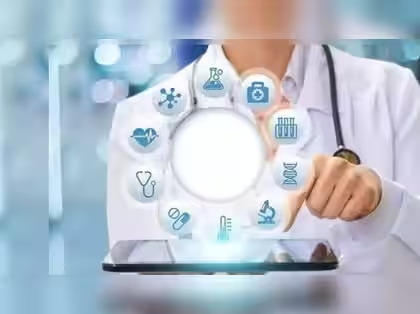
Delhi, being a hub for healthcare services, startups, and government initiatives, provides an ideal ecosystem for students to learn and apply AI and DS techniques in healthcare projects. In this blog, we explore how AI and DS are integrated into healthcare-focused training in Delhi, the tools used, and the skills students gain.
Why AI and Data Science Are Transforming Healthcare
AI and DS are revolutionizing healthcare by enabling:
- Predictive Analysis: Anticipating patient outcomes, disease outbreaks, and hospital resource requirements
- Diagnosis Support: Assisting doctors with image-based diagnostics and clinical decision-making
- Operational Efficiency: Optimizing scheduling, inventory management, and workflow automation
- Personalized Medicine: Tailoring treatment plans based on patient history and genomic data
- Medical Research: Accelerating drug discovery and identifying patterns in complex datasets
For Delhi students, mastering AI and DS in healthcare projects ensures they gain practical, industry-relevant skills that are in high demand both locally and globally.
Core AI and DS Skills Taught in Delhi Healthcare Projects
Healthcare-focused projects in Delhi-based courses equip students with both technical and domain-specific skills:
1. Data Collection and Preprocessing
Healthcare data often comes in diverse formats: electronic health records, imaging data, lab reports, and patient surveys. Students learn to:
- Clean and normalize structured and unstructured data
- Handle missing or inconsistent values
- Transform raw data into usable formats for analysis and modeling
2. Exploratory Data Analysis (EDA)
EDA is crucial for understanding healthcare datasets. Students practice:
- Statistical analysis of patient data
- Identifying trends in hospital admissions, disease prevalence, or treatment outcomes
- Using visualization tools like Tableau, Matplotlib, or Seaborn to represent data clearly
3. Predictive Modeling
Predictive models help forecast patient risks, readmission rates, and treatment effectiveness. Students learn to:
- Build regression and classification models for patient outcome prediction
- Apply machine learning algorithms such as decision trees, random forests, and logistic regression
- Evaluate model performance with accuracy, precision, recall, and F1 scores
4. AI-Powered Image Analysis
Medical imaging is a vital area for AI application. Students explore:
- Detecting anomalies in X-rays, CT scans, and MRI images
- Using convolutional neural networks (CNNs) for automated diagnosis
- Integrating AI outputs into clinical decision-making processes
5. Natural Language Processing (NLP)
Healthcare data includes unstructured text such as doctor notes and research articles. Students gain experience in:
- Text extraction and cleaning
- Sentiment and pattern analysis
- Using NLP libraries like NLTK and SpaCy to derive insights from textual data
Tools and Libraries Used in Delhi Healthcare Projects
Delhi-based data science courses introduce students to industry-standard tools:
- Python Libraries: NumPy, Pandas, Scikit-learn, TensorFlow, PyTorch
- Data Visualization: Matplotlib, Seaborn, Tableau, Power BI
- Cloud Platforms: AWS SageMaker, Google Cloud AI for scalable healthcare solutions
- NLP Tools: SpaCy, NLTK for analyzing clinical notes and medical literature
- Computer Vision Tools: OpenCV, Keras for image-based diagnosis
-
Hands-on training with these tools prepares students for real-world healthcare analytics projects.
Types of Healthcare Projects Taught in Delhi
1. Patient Risk Prediction: Predicting the likelihood of disease progression or hospital readmission.
2. Medical Image Analysis: Detecting tumors, fractures, or anomalies using AI models.
3. Resource Optimization: Forecasting bed occupancy, staff allocation, and supply chain management in hospitals.
4. Healthcare Chatbots: Developing AI-powered chatbots to assist patients with queries and appointments.
5. Sentiment and Text Analysis: Analyzing patient feedback and clinical notes for insights into treatment quality.
These projects provide students with practical exposure and portfolio-ready experience, bridging classroom learning with industry needs.
Benefits of Learning AI and DS in Healthcare in Delhi
1. Hands-On Experience: Real-world projects ensure practical understanding of data handling, modeling, and AI applications.
2. Industry-Relevant Skills: Students gain expertise in tools and techniques demanded by hospitals, startups, and healthcare analytics firms.
3. Portfolio Development: Projects demonstrate applied knowledge to potential employers.
4. Career Opportunities: Graduates can pursue roles in healthcare analytics, AI research, clinical data management, and consulting.
5. Contribution to Society: Skills enable students to positively impact patient care and medical research.
Challenges and How Courses Help Overcome Them
Healthcare data comes with unique challenges, such as privacy regulations, unstructured formats, and high complexity. Delhi courses address these challenges by:
- Teaching data anonymization and compliance with healthcare regulations
- Providing structured datasets and guided projects for learning
- Mentoring students on handling domain-specific problems effectively
This ensures that learners can tackle real healthcare projects confidently.
Career Paths After Healthcare-Focused DS Projects
Completing healthcare projects in Delhi opens up multiple career opportunities:
- Healthcare Data Analyst: Analyzing hospital and patient data for insights
- Medical AI Engineer: Building predictive and diagnostic models
- Clinical Data Scientist: Managing research datasets and performing statistical analysis
- Health Tech Consultant: Advising startups and hospitals on data-driven solutions
These roles are in high demand due to Delhi’s growing healthcare ecosystem and increasing adoption of AI technologies.
Conclusion
AI and Data Science have transformed healthcare, enabling better patient outcomes, operational efficiency, and research advancements. Uncodemy’s Data Science course in Delhi equips students with practical skills, industry-standard tools, and hands-on project experience to excel in healthcare analytics.
By working on projects such as patient risk prediction, medical image analysis, and resource optimization, students gain real-world experience and a portfolio that stands out to employers. Mastery of AI and DS techniques in healthcare positions graduates for rewarding careers in hospitals, startups, research institutions, and healthcare consulting in Delhi and beyond.
Investing in healthcare-focused AI and DS training ensures students combine technical expertise with domain knowledge, contributing to both personal career growth and societal impact.