

#1 India's Top IT Training Institute

×

About Uncodemy

Know more about who we are and what we stand for.

About Us

About Us

Discover our mission to equip individuals with essential IT skills and industry expertise.

Read More →
UnCodeMy Gallery

UnCodeMy Gallery

Explore highlights from our IT training sessions and success stories.

Read More →
×

Free Resources

Learn, practice and plan your career — bilkul free.

Tutorials

Tutorials

Step-by-step written tutorials to learn any technology at your own pace.

Read More →
Free Counselling

Free Counselling

Book a free video counselling session and pick the right course for you.

Read More →
Online Compiler

Online Compiler

Write, run and test your code online — no setup required.

Read More →
🔥 Most Popular in Pune

Robotics & Physical AI Training Course in Pune by Uncodemy

Learners in Pune can join Uncodemy's instructor-led live online Robotics & Physical AI program. The syllabus covers ROS 2, computer vision for robotics, SLAM & navigation, motion planning, reinforcement learning for physical AI and simulation environments. Designed for software engineers, CV/AI engineers and mechanical/electronics graduates, the program includes 13 modules, 100+ live sessions, 160+ hours and a robotics capstone. Fee: ₹17,500 + 18% GST, total ₹20,650. EMI starting from ₹4,032/month. Practicals are delivered through simulation environments; physical hardware/lab access is available at our Delhi and Noida centres — confirm hardware-access details with a counsellor before enrolling.

⚡SPECIAL LIMITED TIME OFFER

Special Offer: Robotics & Physical AI Program

Now Pay Only
₹17,500/-
+ 18% GST
No Hidden Charges
100% Transparent
Total ₹20,650
Incl. 18% GST
EMI AVAILABLE
Starting ₹4,032/M*
Fill Your Details
🔒 Your information is safe and secure.

Expert Trainers

Learn from 8+ years experienced professionals

Hands-on Automation Projects

Build real Playwright test suites, not just theory

Lifetime Access

Get lifetime access to recorded sessions & materials

Dedicated Career & Placement Assistance

Resume Building, Mock Interviews & Job Support

Certified Course

Certificate of Completion from Uncodemy

Flexible Batches

Weekday & Weekend Online & Offline

Why Choose
Uncodemy?

14+
Years of Training Excellence
850+
Companies in Our Hiring Network
54,000+
Learners Trained
200+
Corporate Associations
100%
Placement Support
Online & Offline Classes
Weekend & Weekday Batches
100% Practical Training
Affordable Fees
EMI Options Available
Dedicated Support

Program Details

Robotics & Physical AI Course — Live Online Program Hands-on learning focused on practical robotics & physical AI skills and interview preparation.
A comprehensive 5–6 month instructor-led live online program covering ROS 2, computer vision for robotics, SLAM & navigation, motion planning, reinforcement learning for physical AI, and simulation environments with practical projects, mentoring and career support.
📚 Learning:
160+ Hours of Learning
⏱️ Program Duration:
5–6 Months
🎓 Live Training:
100+ Live Sessions
🛠️ Technology Coverage:
15+ Tools & Technologies
💼 Practical Learning:
Hands-on Robotics Projects, Simulations & Physical AI Case Studies
💰 Program Fee:
₹17,500 + 18% GST
💰 Total Fee:
₹20,650
💳 EMI:
Starting From ₹4,032/Month*
🚀 Career Support:
Dedicated Career & Placement Assistance
🏢 Hiring Network:
850+ Companies in Our Hiring Network
🎯 Career Support Includes:
Resume Building & LinkedIn Optimization, Mock Interviews & Interview Preparation, Career Guidance & Job Opportunity Assistance

Robotics & Physical AI Course in Pune — Quick Facts

🎓 Course:
Robotics & Physical AI Course
🏢 Provider:
Uncodemy Edutech Pvt. Ltd.
📚 Total Learning:
160+ Hours of Learning
📖 Curriculum:
13 Modules
💼 Projects:
Hands-on Robotics Projects, Simulations + Physical AI Capstone
🛠️ Tools:
ROS 2, OpenCV, PyTorch, Gazebo, NVIDIA Isaac Sim
🌐 Modes:
Live Online with simulation-based practicals (physical hardware/lab access only at Delhi & Noida centres; Pune learners typically join live online)
✅ Prior Coding:
Basic Python/programming helpful (built up in Module 2). Comfort with basic math recommended (built up in Module 3).
📜 Certificate:
Uncodemy Robotics & Physical AI Program Certificate (verifiable online)
🗓️ Last Reviewed:
25 September 2026

List of Placed Students Trained by Uncodemy

Uncodemy learners who complete the Robotics & Physical AI training program develop practical skills in ROS 2, computer vision for robotics, SLAM & navigation, motion planning and reinforcement learning for physical AI. After completing their training and career preparation, eligible learners may apply for roles such as Robotics Engineer, Computer Vision Engineer and Autonomous Systems Engineer. Placement records for Pune learners are updated regularly — view verified outcomes at uncodemy.com/placement.

What is Robotics & Physical AI?

Physical AI refers to AI systems that perceive and act in the physical world through robots — combining traditional robotics engineering with modern deep learning for perception, planning and control. Unlike purely software-based AI such as language models, Physical AI must contend with noisy sensors, real-time constraints, imperfect actuators and the unpredictability of the physical environment. It sits at the intersection of mechanical engineering, electronics, computer vision and machine learning.

What does a robotics/physical AI engineer do? A robotics or physical AI engineer works with sensors and actuators, builds perception pipelines with computer vision, implements SLAM and navigation, designs motion planning and robot control systems, and tests in simulation environments before real hardware deployment. Daily work involves Python and C++, ROS 2, calibration and debugging of sensor data, tuning planning and control parameters, and iterating between simulation and real-world validation.

Robotics & Physical AI vs LLM/GenAI Courses vs Traditional Software Engineering

Robotics & Physical AI focuses on AI systems that perceive and act in the physical world, while LLM/GenAI courses build language-model-powered applications and traditional software engineering covers general application development.

Aspect Robotics & Physical AI LLM Engineering / GenAI (Uncodemy courses) Traditional Software Engineering
Core focus AI systems that perceive & act in the physical world via robots Building/deploying AI applications powered by language models General application/software development
Coding depth High (Python, C++, ROS) Moderate to High High
Typical entry salary ₹4–8 LPA (Entry-Level Robotics Engineer) ₹6–10 LPA (per LLM Engineering course sheet) [general market, not an Uncodemy figure]
Uncodemy program duration 5–6 months 5–6 months N/A

Salary ranges are indicative and vary by role, skills, experience, location and employer.

Course Overview

The Robotics & Physical AI course is a 5–6 month live online program delivered across 100+ live sessions and 160+ hours of learning. It is structured in 13 modules that progress from robotics & physical AI fundamentals through Python & C++ for robotics, mathematics for robotics & AI, sensors actuators & robot hardware, ROS/ROS 2, computer vision for robotics, deep learning & perception systems, robot localization & mapping, SLAM & navigation, motion planning & robot control, simulation & digital robotics environments, reinforcement learning & physical AI, and a 15-hour robotics & physical AI capstone. Every module includes practical exercises with real tools, and the program closes with hands-on robotics projects, simulations and a capstone. The program is delivered live online for Pune and nationwide learners, with practicals delivered through simulation environments.

Who should join this course:

  • Software engineers wanting to move into robotics and physical AI roles.
  • Computer vision and AI engineers adding a physical-AI specialisation.
  • Mechanical and electronics engineering graduates adding software and AI skills.
  • Aspiring autonomous-systems engineers building skills in SLAM, navigation and control.
  • Pune-based learners who want instructor-led training with hands-on simulation labs.

Eligibility: Basic Python/programming background is helpful and built up in Module 2. Comfort with linear algebra and basic math is recommended and built up in Module 3. A laptop capable of running simulation software and stable internet is required.

Upcoming Robotics & Physical AI Course Batches for Pune Learners

Choose a batch timing that fits your schedule. Live online batches, IST timings. Book a free demo class first-hand, or join our upcoming weekend and weekday live batches — designed for both working professionals and students, with flexible timings and hands-on training.

Weekdays

Date Time Trainer Seats Left
16oct 07:30 PM – 08:30 PM Mr. Irshad 01Seat
22oct 02:00 PM – 03:00 PM Mr. Upendra Kumar Tiwari 02Seats
26oct 10:30 AM – 11:30 AM Mr. Irshad 01Seat
30oct 12:00 PM – 01:00 PM Mr. Upendra Kumar Tiwari 02Seats

Weekends

Date Time Trainer Seats Left
27oct 03:00 PM – 05:00 PM Mr. Irshad 02Seats

8+ new batches start every month. All timings are in IST. Seats are limited and updated daily.

Curriculum for Robotics & Physical AI Training Course in Pune

Robotics & Physical AI Course Syllabus in Pune

The syllabus is organised into 13 modules. The order follows how robotics and physical AI engineering actually works: foundations → programming for robotics → math → sensors/hardware → ROS 2 → computer vision → deep learning perception → localization/mapping → SLAM/navigation → motion planning/control → simulation → reinforcement learning → capstone. Each module includes practical exercises with real tools, and the program closes with hands-on robotics projects, simulations and a capstone.

Module 1: Robotics & Physical AI Fundamentals — 8 Hours

  • Introduction to robotics and physical AI
  • Types of robots: manipulators, mobile robots, drones, humanoids
  • Robot anatomy: links, joints, degrees of freedom
  • Sense-plan-act paradigm in robotics
  • Overview of industrial and service robotics use cases
  • Hands-on: setting up a robotics development environment

Module 2: Python & C++ for Robotics — 10 Hours

  • Python syntax, data structures and control flow
  • Object-oriented programming for robot software
  • C++ fundamentals for robotics and embedded control
  • Interfacing Python and C++ for robotics applications
  • Working with APIs, files and configuration in robotics code
  • Debugging and testing robotics software

Module 3: Mathematics for Robotics & AI — 10 Hours

  • Linear algebra: vectors, matrices and transformations
  • Coordinate frames and homogeneous transforms
  • Calculus basics for motion and control
  • Probability and statistics for sensor data
  • Optimization fundamentals for robotics
  • Hands-on: implementing coordinate transforms in Python

Module 4: Sensors, Actuators & Robot Hardware — 10 Hours

  • Common sensors: LiDAR, cameras, IMU, encoders, depth sensors
  • Actuators: motors, servos, stepper and servo drives
  • Sensor calibration and noise characteristics
  • Embedded controllers and communication buses
  • Power, safety and reliability considerations
  • Hands-on: reading and visualizing sensor data

Module 5: Robot Operating System (ROS/ROS 2) — 12 Hours

  • ROS 2 architecture: nodes, topics, services, actions
  • Packages, workspaces and build systems (colcon)
  • Publishers, subscribers and message types
  • Launch files and parameter configuration
  • ROS 2 tools: RViz, rqt, rosbag and tf2
  • Hands-on: building and running a ROS 2 node

Module 6: Computer Vision for Robotics — 12 Hours

  • Image formation, camera models and calibration
  • Image processing with OpenCV
  • Feature detection, matching and tracking
  • Depth estimation and point clouds
  • Object detection and segmentation for robotics
  • Hands-on: building a vision pipeline for a robot task

Module 7: Deep Learning & Perception Systems — 10 Hours

  • Neural network fundamentals with PyTorch
  • CNN architectures for robotic perception
  • Transfer learning and model deployment on robots
  • Sensor fusion for robust perception
  • Evaluating perception accuracy and latency
  • Hands-on: training a perception model for robotics

Module 8: Robot Localization & Mapping — 10 Hours

  • Odometry and sensor-based localization
  • Kalman filters and particle filters
  • Occupancy grid mapping
  • Map representations and coordinate frames
  • Localization accuracy and failure modes
  • Hands-on: building a localization pipeline in ROS 2

Module 9: SLAM & Navigation — 14 Hours

  • SLAM problem formulation and approaches
  • Visual and LiDAR SLAM with SLAM Toolbox
  • Loop closure and map optimization
  • Navigation stack with Nav2
  • Path planning, obstacle avoidance and costmaps
  • Hands-on: implementing SLAM and navigation in simulation

Module 10: Motion Planning & Robot Control — 12 Hours

  • Configuration space and motion planning concepts
  • Sampling-based planners (RRT, PRM)
  • Trajectory generation and smoothing
  • Feedback control: PID and state-space control
  • Manipulator kinematics and inverse kinematics
  • Hands-on: implementing a motion planner and controller

Module 11: Simulation & Digital Robotics Environments — 12 Hours

  • Robot simulation concepts and benefits
  • Gazebo for robot simulation and world building
  • NVIDIA Isaac Sim for GPU-accelerated robotics
  • Isaac ROS for accelerated perception pipelines
  • Sim-to-real transfer considerations
  • Hands-on: building a simulated robot environment

Module 12: Reinforcement Learning & Physical AI — 15 Hours

  • Reinforcement learning fundamentals: MDPs, rewards, policies
  • Value-based and policy-gradient methods
  • Deep RL for continuous control
  • Training robots in simulation with RL
  • Domain randomization and transfer to real hardware
  • Hands-on: training an RL policy in simulation

Module 13: Robotics & Physical AI Capstone Projects — 15 Hours

  • Capstone project scoping and architecture design
  • Perception + localization + navigation integration
  • Motion planning and control for the capstone task
  • Simulation-based validation and iteration
  • Documentation and portfolio preparation
  • Presentation and interview preparation around capstone
# Module Hours Tools
1 Robotics & Physical AI Fundamentals 8 Python, Linux
2 Python & C++ for Robotics 10 Python, C++, Git/GitHub
3 Mathematics for Robotics & AI 10 Python, NumPy
4 Sensors, Actuators & Robot Hardware 10 Python, Linux
5 Robot Operating System (ROS/ROS 2) 12 ROS 2, RViz, tf2
6 Computer Vision for Robotics 12 OpenCV, Python
7 Deep Learning & Perception Systems 10 PyTorch, TensorFlow
8 Robot Localization & Mapping 10 ROS 2, SLAM Toolbox
9 SLAM & Navigation 14 SLAM Toolbox, Nav2
10 Motion Planning & Robot Control 12 ROS 2, Python
11 Simulation & Digital Robotics Environments 12 Gazebo, NVIDIA Isaac Sim, Isaac ROS
12 Reinforcement Learning & Physical AI 15 PyTorch, Gazebo
13 Robotics & Physical AI Capstone Projects 15 All tools
Total 150 Hours 15 tools

Contacted by

IR

Mr. Irshad

Curriculum & Technical Reviewer

8 + Years of Experience

Specialization: Robotics, Physical AI, Computer Vision

Get Your Robotics & Physical AI Certification In Pune

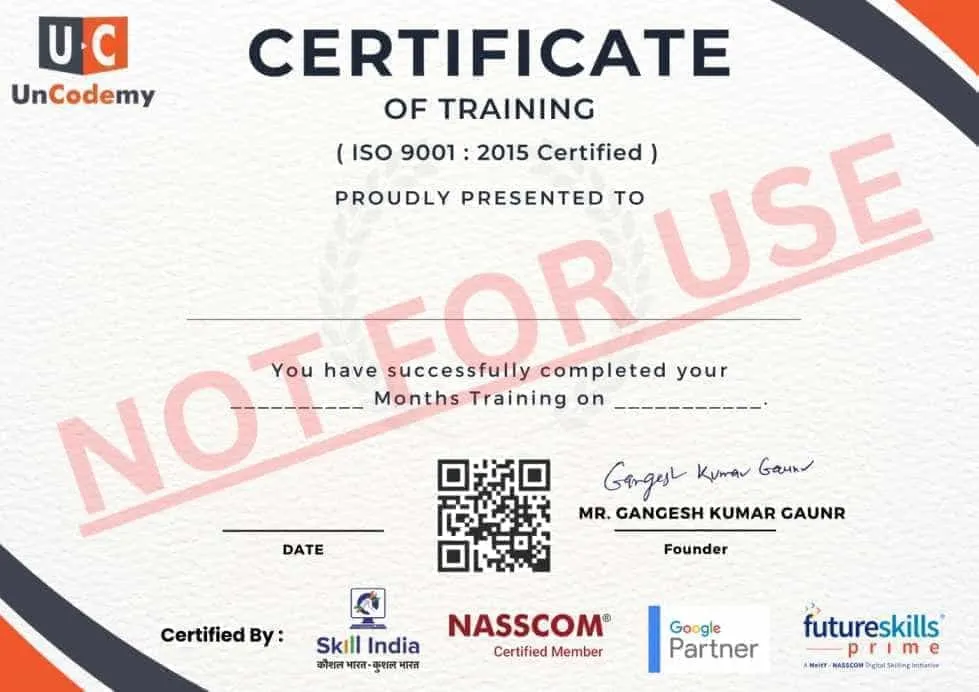
On completing all 13 modules, the assignments and the Robotics & Physical AI capstone project, you receive the Uncodemy Robotics & Physical AI Program Certificate. The certificate records the program name, duration, tools covered and completion date. It is verifiable online at certificate.uncodemy.com and provides a record of successful completion of the Uncodemy Robotics & Physical AI program.

The certificate is tied to the practical work completed during the program — including hands-on robotics simulation work, perception and navigation projects and the Robotics & Physical AI capstone project. Learners work with Python, C++, ROS 2, OpenCV, PyTorch, TensorFlow, Gazebo, NVIDIA Isaac Sim, Isaac ROS, RViz, SLAM Toolbox, Nav2, Git/GitHub, Docker and Linux.

Key Benefits of Our Robotics & Physical AI Certification:

  • Program Completion :Provides a record of successful completion of the Robotics & Physical AI program.
  • Online Verification :Certificate is verifiable online at certificate.uncodemy.com.
  • Practical Learning :Training includes hands-on robotics simulation work, perception/navigation projects and a capstone.

This is an independent Uncodemy certificate. It is not affiliated with, endorsed by, or a credential of NVIDIA, Open Robotics (ROS) or any other vendor whose tools are taught in this course. Certificate verification process pending confirmation.

Uncodemy Certificate Verification Online Certificate Verification & Download certificate.uncodemy.com
IIBA Endorsed Education Provider certificate — Uncodemy
Uncodemy Robotics & Physical AI Program Certificate
Uncodemy MSME registration certificate

Tools and Technologies Covered

Apply Now

Introducing Uncodemy


Portfolio/capstone project review:Your hands-on simulation work, perception/navigation projects and robotics capstone are reviewed and refined into a portfolio an interview will find credible.

Resume & LinkedIn:We build your resume around robotics and physical AI keywords and measurable outcomes, and align your LinkedIn profile to match.

Interview preparation:ROS architecture questions, SLAM/navigation problem-solving, simulation-to-real-world discussion and robotics case studies specific to robotics hiring.

Mock interviews:Sessions with industry trainers, followed by written feedback on what to fix.

Opportunity sharing:Relevant openings from our hiring network of 850+ companies are shared with you, with support through the application and interview process.

Continued support:This is active assistance, not a guarantee of employment — no training institute can honestly promise a job. Support continues after your program ends for learners who stay engaged with the process.

Instructors

The people who actually teach this course

Uncodemy separates two roles that most institutes combine. Trainers deliver the live sessions. Domain reviewers — separate specialists who don't teach the batch — verify that the curriculum is technically accurate and current. For this program, curriculum and technical content are reviewed by Mr. Irshad, with additional review by Mr. Upendra Kumar Tiwari. It means the person teaching a course is not the only person checking whether its content is correct.

Every trainer and domain reviewer associated with Uncodemy is published by name, with their domain and background — you can look them up before you enrol rather than after.

Enroll in Our Robotics & Physical AI Training for Pune Learners Today!

Enroll in Uncodemy's Robotics & Physical AI course for Pune learners today! Build practical skills in ROS 2, computer vision for robotics, SLAM, navigation and reinforcement learning through instructor-led live online training, hands-on simulation labs and a robotics capstone. Start learning robotics and physical AI through structured training and career preparation.

Robotics & Physical AI Jobs and Career Scope in Pune+

Pune's engineering ecosystem — spanning automotive R&D, manufacturing-tech, industrial automation, IT services, captive centres and SaaS — is a natural base for robotics and physical AI work. Companies in Hinjewadi, Magarpatta, Kharadi, Baner, Chakan and Viman Nagar work on autonomous systems, industrial automation, computer-vision-driven products and warehouse/logistics robotics, and they need engineers who understand ROS architecture, perception pipelines, SLAM and motion planning. Pune's automotive and manufacturing clusters in particular are investing in robotics for quality control, predictive maintenance and flexible automation. Interviews for robotics roles tend to weight ROS architecture knowledge, perception/navigation problem-solving and simulation experience most heavily, followed by hands-on debugging of sensor and actuator data. Candidates with software engineering or computer vision experience plus robotics skills are well-positioned for these roles.

Job Roles After This Course+

Robotics Engineer, Robotics Software Engineer, Computer Vision Engineer, Autonomous Systems Engineer, Robotics/AI Engineer and Simulation Engineer (Junior) are the roles this course maps to. Each role involves building or testing systems that perceive and act in the physical world, but they differ in the specific robotics components and tools used.
Role Core Tools
Robotics Engineer ROS 2, Python, C++, Gazebo
Robotics Software Engineer ROS 2, Python, C++, Linux
Computer Vision Engineer OpenCV, PyTorch, TensorFlow
Autonomous Systems Engineer SLAM Toolbox, Nav2, ROS 2
Robotics/AI Engineer PyTorch, Isaac Sim, Isaac ROS
Simulation Engineer (Junior) Gazebo, NVIDIA Isaac Sim, Docker
Most graduates start as a Robotics Engineer, Robotics Software Engineer or Computer Vision Engineer and move into the others with two to four years of experience, as they build depth in a specific robotics domain. Progression typically involves owning larger robotics systems, leading projects, and specialising in autonomous navigation, perception or simulation-to-real transfer.

Robotics Engineer Salary in Pune — Role-wise+

Salaries in Pune vary by experience level, sector and how strong your robotics and physical AI skills are. The gap between the lowest and highest earners at the same title is often wider than freshers expect, especially for candidates with simulation and perception experience.
Role Salary Range
Entry-Level Robotics Engineer₹4–8 LPA
Robotics Software Engineer₹7–14 LPA
Computer Vision Engineer₹6–14 LPA
Robotics / AI Engineer₹8–18 LPA
Autonomous Systems Engineer₹10–20 LPA
Senior Robotics Engineer₹15–28 LPA
Robotics & Physical AI Lead₹20–35 LPA
Sources reviewed: AmbitionBox, Glassdoor, Indeed and Uncodemy placement records. Reviewed: September 2026.

Salary ranges are indicative market ranges and should not be presented as guaranteed placement outcomes. Actual offers vary by role, skills, experience, employer and market conditions. Uncodemy does not guarantee any specific salary or employment outcome.

Top Sectors Hiring Robotics & Physical AI Talent in Pune+

Uncodemy works with 850+ companies in our hiring network across India, spanning large enterprises, mid-size firms and fast-growing startups, which gives learners exposure to more than one kind of hiring process and interview style. In Pune specifically, robotics and physical AI demand is emerging in:
  • Automotive and manufacturing-tech — robotics for quality control, flexible automation and predictive maintenance
  • Industrial automation and warehouse robotics — AMRs, AGVs and automated material handling systems
  • Product companies and SaaS startups — computer-vision-driven products, drones and autonomous systems
  • IT services and global capability centres — robotics and physical AI R&D for global clients
  • Healthcare, agriculture and logistics — robotics for diagnostics, precision agriculture and delivery
Each of these sectors tends to weight skills slightly differently, so as you get closer to placement, it helps to tailor your capstone project toward the one or two sectors you're most interested in.

How to Become a Robotics Engineer — Step by Step+

Becoming a robotics engineer is a step-by-step skill build, not a single course, and skipping steps usually shows up later as gaps in interviews or on the job.
  • Python & C++ fundamentals— syntax, data structures, OOP and debugging for robot software.
  • Math for robotics— linear algebra, transforms, probability and optimization.
  • Sensors & hardware basics— LiDAR, cameras, IMUs, actuators and calibration.
  • ROS 2— nodes, topics, services, actions, launch files and the ROS 2 toolchain.
  • Computer vision & perception— OpenCV, deep learning and sensor fusion.
  • SLAM, navigation & motion planning— localization, mapping, Nav2 and trajectory generation.
  • Simulation, RL & capstone— Gazebo, Isaac Sim, reinforcement learning and the capstone project.
Typical timeline: 5–6 months of consistent study to reach interview-ready standard, assuming focused hours most days rather than occasional binge sessions.

How This Course Compares to Other AI/Tech Courses in Pune+

Pune has dozens of AI and tech training options at very different price points, ranging from short workshops to multi-month bootcamps. Here is an honest comparison, so you can judge the fit yourself rather than relying on marketing claims alone.
Factor This Program
Duration5–6 months
Learning hours160+ (pending confirmation)
Live sessions100+
Tools15+
CapstoneRobotics & Physical AI Capstone project
Career supportDedicated Career & Placement Assistance
Compared to Uncodemy's LLM Engineering course (5–6 months, focused on building, fine-tuning and deploying LLM-powered applications), RAG Engineering course (5–6 months, focused on retrieval-grounded AI systems) and AI Security course (5–6 months, focused on securing AI/LLM systems), this Robotics & Physical AI program is the only one that involves hardware/simulation work — it includes dedicated modules on sensors and actuators, ROS 2, computer vision, SLAM and motion planning, with practicals delivered through simulation environments. If your goal is a robotics or physical AI career, this is the right fit. If you are purely interested in software-based AI roles, LLM Engineering or RAG Engineering is a closer match. If your interest is specifically computer vision without robotics hardware, a computer-vision-focused module may be a better fit.

Where we are not the cheapest option: shorter self-paced courses cost less. If your goal is a quick robotics awareness rather than a full career transition, a shorter program may suit you better, and it's worth being honest with yourself about which of the two you actually need.

Online vs Offline vs Hybrid — Which Should You Choose?+

This program needs special care when it comes to mode, because robotics hardware modules (sensors, actuators, robot kits) are genuinely different from software-only AI courses. Live online is the default for Pune learners, and the curriculum's practicals are delivered through simulation environments (Gazebo, NVIDIA Isaac Sim), which run on a capable laptop — you do not need physical robot hardware to complete the labs or the capstone. Offline classroom and physical hardware/lab access are available at our Delhi and Noida centres for learners who want in-person exposure to sensors, actuators and robot platforms. Hybrid is not currently offered for this program. If physical hardware access is important to you, contact a counsellor before enrolling to confirm the current arrangement — do not assume that live online and in-person hardware access are interchangeable for the hardware-focused modules.

Is this course right for you?+

If you want... Recommend
Full robotics / physical AI career transition This program
Already strong in software AI, want to add hardware/robotics skills This program
Purely software-based AI roles (no hardware interest) Consider LLM Engineering or RAG Engineering instead
Computer vision specifically without robotics hardware Consider a computer-vision-focused module

Frequently Asked Questions

1. What is the duration of the Robotics & Physical AI course in Pune?▼

The program runs for 5–6 months and includes 160+ hours of learning across 100+ live sessions. Weekday and weekend batches are both available.

2. Do I need prior robotics hardware experience?▼

No prior robotics hardware experience is required — most learners start from the fundamentals in Module 4. Basic Python/programming background is helpful and built up in Module 2, and basic math is built up in Module 3.

3. What tools are covered in this course?▼

15 tools including Python, C++, ROS 2, OpenCV, PyTorch, TensorFlow, Gazebo, NVIDIA Isaac Sim, Isaac ROS, RViz, SLAM Toolbox, Nav2, Git/GitHub, Docker and Linux.

4. Does the course cover SLAM and navigation?▼

Yes. Module 9 covers SLAM & Navigation (14 hours). It is a core component of the curriculum with hands-on simulation exercises.

5. What is the capstone project?▼

The capstone is Module 13: Robotics & Physical AI Capstone Projects (15 hours). You build a simulated robotics or physical AI application applying perception, localization, navigation, motion planning and reinforcement learning.

6. Are the classes live or pre-recorded?▼

All 100+ sessions are live and instructor-led, with recordings available afterwards for revision.

7. What is the fee for the Robotics & Physical AI course in Pune?▼

The program fee is ₹17,500 plus 18% GST. Total fee is ₹20,650. The same fee applies in all modes and cities.

8. Are EMI options available?▼

EMI starts from ₹4,032 per month. The exact amount, tenure and eligibility depend on the applicable payment or financing option — a counsellor can confirm your plan.

9. Is there a demo or trial class before I enrol?▼

Yes. You can attend a demo session to see the teaching style, meet the trainer and review the curriculum before deciding. Contact us to book a demo.

10. Do you provide placement assistance?▼

We provide Dedicated Career & Placement Assistance — resume building, LinkedIn optimisation, portfolio review, interview preparation, mock interviews and opportunity sharing through our network of 850+ companies. We do not guarantee employment.

11. Can I get an entry-level Robotics Engineer role after this course?▼

Entry-level Robotics Engineer roles in the market range around ₹4–8 LPA (indicative). Outcomes vary by skills, experience, employer and market conditions. Uncodemy does not guarantee any specific salary or employment outcome.

12. What is the salary of a Robotics Engineer in Pune?▼

Indicative market ranges: Entry-Level ₹4–8 LPA, Robotics Software Engineer ₹7–14 LPA, Senior Robotics Engineer ₹15–28 LPA, Robotics & Physical AI Lead ₹20–35 LPA. Actual offers vary by role, skills, experience, employer and market conditions. Uncodemy does not guarantee any specific salary.

13. What job roles can I apply for after this course?▼

Robotics Engineer, Robotics Software Engineer, Computer Vision Engineer, Autonomous Systems Engineer, Robotics/AI Engineer and Simulation Engineer (Junior).

14. Who is eligible for this Robotics & Physical AI course?▼

Software engineers wanting to move into robotics, computer vision/AI engineers adding physical-AI specialisation, mechanical/electronics engineering graduates adding software skills, and aspiring autonomous-systems engineers.

15. Are the salary, placement and review figures on this page guaranteed?▼

Statistics are based on Uncodemy's internal records and publicly available review-platform information. Placement and salary outcomes vary by learner, skills, experience, location, employer and market conditions. Career and placement assistance does not constitute a guarantee of employment or a specific salary package.

16. Is classroom training available in Pune, and do I need to attend in person for the hardware modules?▼

This course is delivered live online nationwide, including for Pune learners, with practicals delivered through simulation environments. Classroom and physical hardware/lab access is available at our Delhi and Noida centres for learners who want in-person hardware exposure. Contact a counsellor to confirm the current hardware-access arrangement before enrolling if physical robot access is important to you.

17. Is Uncodemy's Robotics & Physical AI certificate affiliated with NVIDIA or Open Robotics (ROS)?▼

No. This is an independent Uncodemy certificate. It is not affiliated with, endorsed by, or a credential of NVIDIA, Open Robotics (ROS) or any other vendor whose tools are taught in this course.

Why Trust This Page? Discover Why Students Choose Uncodemy

How we maintain this page

  • Content written by:Mr. Rahul
  • Content rechecked and verified by: Mr. Irshad
  • Course curriculum verified by: Mr. Irshad
  • Technical content verified by: Mr. Irshad
  • Fee verified by: Admin Department
  • Placement figures sourced from internal placement records
  • Review counts verified against respective third-party platforms
  • Last reviewed:
Application Form
Visit Us

Nearest Classroom Training Centres

The Robotics & Physical AI course is delivered live online for Pune learners, with practicals delivered through simulation environments (Gazebo, NVIDIA Isaac Sim) that run on a capable laptop. For learners who want physical hardware and lab access — sensors, actuators and robot platforms — our nearest centres are in Delhi and Noida. Uncodemy's Delhi centre is located on the 2nd & 3rd Floor, Maa Katyayni Complex, MB-1E, Madhuban Road, Shakarpur Extension — a 10–15 minute walk from Nirman Vihar Metro Station and Laxmi Nagar Metro Station. Uncodemy's Noida centre is at B 14-15, Udhyog Marg, Block B, Sector 1, Noida. Please confirm the current hardware-access arrangement with a counsellor before enrolling if in-person hardware exposure is important to you.

Open now
Delhi Centre
2nd & 3rd Floor, Maa Katyayni Complex, MB-1E, Madhuban Rd, next to DSEU Ambedkar College, Laxmi Nagar, Shakarpur Extension, Shakarpur, Delhi, 110092
Noida Centre
B, 14-15, Udhyog Marg, Block B, Sector 1, Noida, Uttar Pradesh 201301
Free demo classWalk-ins welcomeWheelchair accessible
⇧