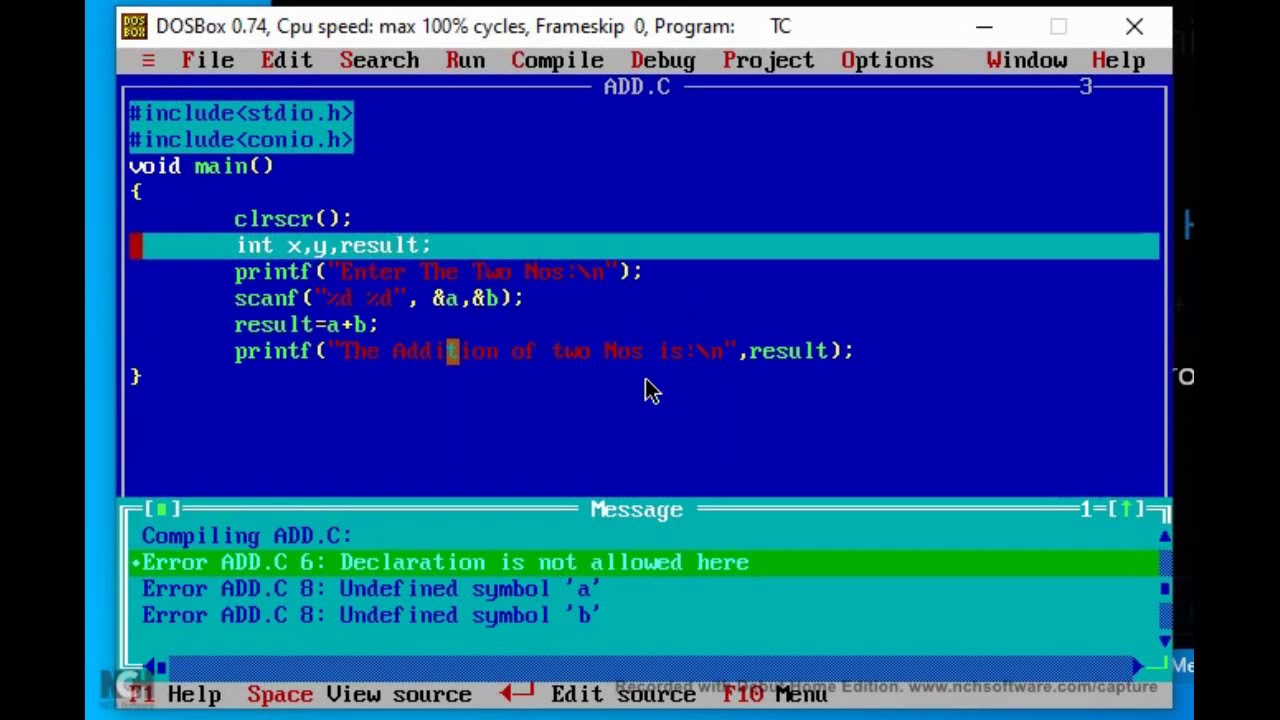
Option 1: C Program to Add Two Numbers Using Standard Input/Output
Copy Code
#include <stdio.h> // Including standard input-output header

int main() {

    int num1, num2, sum;  // Declaring variables

    // Asking the user to input two numbers

    printf("Enter two integers: ");

    scanf("%d %d", &num1, &num2);

    // Calculating the sum

    sum = num1 + num2;

    // Displaying the result

   printf("Sum: %d", sum);

    return 0;

}
Output:
Enter two integers: 7 5
Sum: 12
Explanation:
This basic program asks the user to enter two integers using scanf(), stores them in num1 and num2, then adds them using the + operator and stores the result in sum. Finally, it prints the result using printf().
Option 2: Add Two Floating-Point Numbers in C
Copy Code
#include <stdio.h>

int main() {

    float num1, num2, sum;

   printf("Enter two numbers: ");

    scanf("%f %f", &num1, &num2);

    sum = num1 + num2;

   printf("Sum: %.2f", sum);

    return 0;

}
Output:
Enter two numbers: 3.7 6.2
Sum: 9.90
Explanation:
Here we’re using float instead of int, so the program can handle decimal numbers. The format specifier %.2f ensures the result is displayed with two decimal places handy for cleaner outputs.
Option 3: Addition Using a Function
Copy Code
#include <stdio.h>

// Function to add two integers

int add(int a, int b) {

    return a + b;

}

int main() {

    int num1, num2, sum;

   printf("Enter two integers: ");

    scanf("%d %d", &num1, &num2);

    sum = add(num1, num2);  // Calling the function

   printf("Sum: %d", sum);

    return 0;

}
Output:
Enter two integers: 9 4
Sum: 13
Explanation:
Breaking things into functions makes your code modular and clean. The add() function takes two integers as arguments and returns their sum. This way, you can reuse the logic elsewhere too.
Option 4: Add Two Numbers Using Pointers in C
Copy Code
#include <stdio.h>

int main() {

    int num1, num2, sum;

    int *p1, *p2;

   printf("Enter two integers: ");

    scanf("%d %d", &num1, &num2);

    p1 = &num1;

    p2 = &num2;

    sum = *p1 + *p2;

   printf("Sum: %d", sum);

    return 0;

}
Output:
Enter two integers: 11 13
Sum: 24
Explanation:
This method introduces pointers yes, they sound scary at first, but they’re just variables that store memory addresses. We point p1 and p2 to num1 and num2, and then access the actual values using the * operator (dereferencing).
Option 5: Add Two Numbers Using Arrays
Copy Code
#include <stdio.h>

int main() {

    int nums[2], sum;

   printf("Enter two integers: ");

    scanf("%d %d", &nums[0], &nums[1]);

    sum = nums[0] + nums[1];

   printf("Sum: %d", sum);

    return 0;

}
Output:
Enter two integers: 6 3
Sum: 9
Explanation:
This time, instead of declaring two separate variables, we’re using an array to store both numbers. Arrays help when you’re dealing with lots of values but for just two, it’s mostly a learning exercise.
Frequently Asked Questions (FAQs)
Q1. Why should I learn how to add two numbers in C?
Because it’s your first step into programming logic! It teaches you variable declaration, input/output handling, and basic arithmetic in C.
Q2. What's the difference between int and float in C?
int is for whole numbers like 3, 10, or -5. float is for numbers with decimals like 3.14 or -0.5.
Q3. When should I use functions for simple operations like addition?
Whenever you want reusable, modular code. Even small tasks benefit from being separated logically—it helps with readability and maintenance.
Q4. Is it necessary to use pointers for simple addition?
Not really, but it helps you get comfortable with one of C's core concepts. Pointers are essential for advanced topics like memory management and dynamic arrays.
Q5. Can I use cin and cout instead of scanf and printf?
Not in C. cin and cout belong to C++ C uses scanf and printf for input and output.
If you're just getting started with C, playing around with small programs like this one is the best way to build a strong foundation. Try modifying the code, use different data types, and make small errors (yes, that’s a good thing!) you’ll learn much faster.
If you're serious about mastering C programming and building a strong foundation in coding, check out Uncodemy’s C Programming Course.