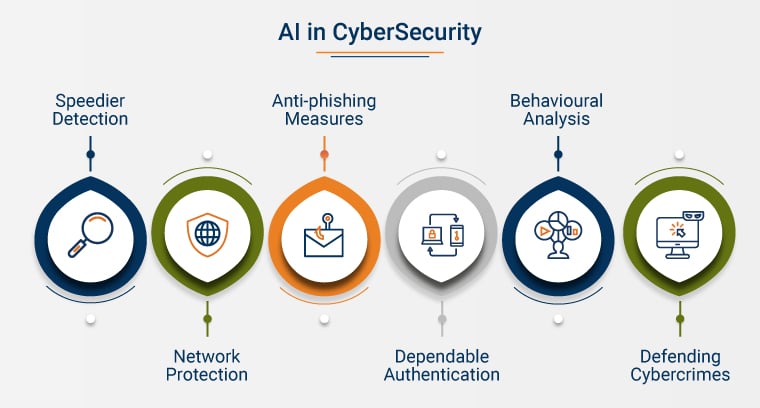
AI in Cybersecurity: Threat Detection and Response
In the 58-day Digital era, where businesses as well as individuals,s just rely on cloud and interconnected systems, cybers5 has become quite important. As cyber threats are just going on scaling, sophistication, and traditional methods are just getting outdated. Entering into artificial intelligence, a game-changing era where cybersecurity is transforming how to prevent, detect, and respond to these types of threats.
In this blog, we will particularly explore how AI is revolutionizing the cyber world. We will also learn the latest tools and techniques involved, benefits, real-world cases, limitations, and the future of this AI-powered threat detection and response system.
AI in Cybersecurity: Threat Detection and Response
Mr. Irsad 3 days ago
15
11 min read
Why is AI required in cybersecurity?
Before diving into applications and other know-how, it's also important to know why, so let's see some of the reasons below :
Sheer volume of threats observed - Cybersecurity teams often face millions of threats daily. All this includes everything from phishing attacks and other malware to ransomware and insider threat attacks. It's just impossible for analysts to process this massive data on a manual basis.
Evolving attack techniques - Attackers are now leveraging and taking advantage of automation, machine learning, and AI by themselves. Polymorphic malware, zero-day exploits, and sophisticated sense of phishing campaigns have little to bypass conventional security systems.
Huge shortage of skilled employees - The Global shortage of cybersecurity experts is another area of concern. As per ISC², this industry just faces a shortfall of about 3.5 million professionals. AI can help in this by automation repetitive and other complex sets of tasks.
Some of the AI techniques powering Cybersecurity
Machine learning ( ML ) - These ML algorithms just work with the help.of historical ta. They use this type of data to identify patterns. In cybersecurity, they are often used for below reasons :
Detecting anomalous behaviour in network traffic
Here, normal vs anomalous traffic can be found out using the isolation forest feature
Python Program code :
                                From sklearn.ensemble import IsolationForest
                                import numpy as np

                                # Simulated network traffic data: [duration, packets per second]
                                data = np.array([
                                    [2, 20], [3, 22], [1.5, 19], [2.1, 21], [3.2, 20],  # Normal
                                    [10, 100], [12, 120]  # Anomalies
                                ])

                                # Train Isolation Forest
                                model = IsolationForest(contamination=0.3)
                                model.fit(data)

                                # Predict anomalies
                                predictions = model.predict(data)

                                # Display results
                                for i, point in enumerate(data):
                                    status = "Anomaly" if predictions[i] == -1 else "Normal"
                                    print(f"Data Point: {point}, Status: {status}")

                                Output :
                                Data Point: [ 2. 20.], Status: Normal
                                Data Point: [ 3 22.], Status: Normal
                                Data Point: [ 1.5 19. Status: Normal
                                Data Point: [ 2.1 21. Status: Normal
                                Data Point: [ 3.2 20. Status: Normal
                                Data Point: [ 10. 100.], Status: Anomaly
                                Data Point: [ 12. 120.], Status: Anomaly
Supporting malicious files based on features
Files will be classified as benign or malicious based on some of the best features li, like file size, entropy, and ale number of API calls.
Python Program code :
                                    From sklearn.tree import DecisionTreeClassifier

                                # Sample data: [file_size_MB, entropy, api_calls]
                                X = [
                                    [2.1, 4.5, 50],   # benign
                                    [1.8, 4.3, 47],   # benign
                                    [0.5, 7.2, 120],  # malicious
                                    [0.7, 6.9, 110],  # malicious
                                    [2.0, 4.6, 52],   # benign
                                    [0.6, 7.0, 130],  # malicious
                                ]

                                y = ['benign', 'benign', 'malicious', 'malicious', 'benign', 'malicious']

                                # Train model
                                clf = DecisionTreeClassifier()
                                clf.fit(X, y)

                                # Predict on a new file
                                new_file = [[0.6, 7.1, 125]]
                                prediction = clf.predict(new_file)

                                print(f"Predicted label for new file: {prediction[0]}")

                                Output :

                                Predicted label for new file: malicious
Predicting future attacks by using historical trends
Historical Attack frequency data is used alongside linear regression to predict future attacks.
Python Program code :
                                From sklearn.linear_model import LinearRegression
                                import numpy as np

                                # Historical data: [day number], attacks
                                X = np.array([[1], [2], [3], [4], [5]])  # days
                                y = np.array([5, 7, 9, 11, 13])  # attacks

                                # Train model
                                reg = LinearRegression()
                                reg.fit(X, y)

                                # Predict the number of attacks on days 6 and 7
                                future_days = np.array([[6], [7]])
                                predictions = reg.predict(future_days)

                                for i, pred in enumerate(predictions, start=6):
                                    print(f"Predicted attacks on day {i}: {int(pred)}")

                                Output :

                                Predicted attacks on day 6: 15
                                Predicted attacks on day 7: 17
Natural language processing ( NLP ) - This NLP helps in analysing threat intelligence from a different set of sources, such as blogs, forums, and also dark sources. All this will help in getting actionable insights.
Deep learning - Widely used in image and search recognition, this deep learning. De learning is also. Applied in cybersecurity. You can use them for advanced tasks like detecting deepfake content or even some complex malware signatures.
Behavioural analytics - AI can monitor as well as learn some user behaviour patterns. When deviations occur, like accessing some files at unusual hours or even from some unknown devices, an alert will be raised.
Threat detection with AI
AI is quite exceptionally good, which helps in spotting anomalies and also detecting threats on real real-time basis.
Anomaly detection - AI tools just help in the baseline of this normal behaviour, as well as system activity or low traffic.
Example - Imagine if a user suddenly just downloads 100GB of data at approximately 2 a.m. This is done from a foreign IP. So AI can flag this for investigative purposes.
Intrusion detection system ( IDS ) - This AI-powered tool of IDS can scan network traffic for other sorts of malicious activities. Unlike this rule-based system AI AI-powered IDS can easily detect novel threats.
Example tools -
Darktrace
Vectra AI
Cisco Secure Network Analytics
Malware Detection - AI models can examine a file's code and execution behaviour to determine if it's malicious. This is seen even if it's not there in the known virus database. Use case - AI can often detect polymorphic malware that will keep changing its signature to evade detection.
Phishing detection - AI helps in scanning emails for signs of phishing. This includes fake URLs, spoofed addresses of the sender, and also age anomalies. They will be blocked even before reaching the sender's box.
AI in threat response times
Detection is simply only half the battle. AI will respond to them effectively and quickly.
Automatic Incident Response - Once you identify a threat, 8tyen AI will trigger an automatic response like
Block all suspicious IPs.
Roll back all unauthorised changes.
Start isolating affected systems.
Alert the SOC system with a detailed report.
SOAR platforms - Security Orchestration, Automation, and Response is the full form of this. The platform will just use AI to integrate multiple tools and also automate the complex workforce.
Some of the popular SOAR tools are as follows :
IBM QEadar
Splunk Phantom
Palo Alto Cortex XSOAR
Threat hunting - AI often assists all cybersecurity team in just proactively searching for all threats across the organisation. By analysing all logs and also telemetry data, AI will uncover hidden threats that humans might ignore at times.
Real-world use cases of AI in cybersecurity.
Microsoft Defender and AI - In its defender platform, Microsoft will use AI to process over 8 trillion daily signals and also block 1000+ cyberattacks on a send basis.
IBM Watson for cybersecurity - NLP and AI is used by Watson to scan all necessary reports, threat databases, and research papers. All this will help in mitigating and taking precise steps to analyse.
Benefits of AI in cybersecurity
Speed - AI will process data and identify threats on real real-time basis. This is also significantly faster than human analysts.
Cost efficiency -The Need for large SOAC teams will be reduced by just automating routine tasks.
Scalability - The AI system will help in handling terabytes of data without any degradation in performance.
Accuracy - ML models can improve over time and also reduce false positives, which will allow analysts to focus on real threats in particular.
Challenges and limitations
Biasness in data - AI is simply as good as the data it learns from. If this training data is biased or inaccurate, then detection will be incomplete.
Implementation cost - Deploying this AI-powered system often requires a huge investment in infrastructure, talent, and integration.
Privacy concerns - AI systems' primary requirement is a large dataset. This contains user data that raises concerns about data protection and surveillance.
False positives - This early-stage AI model might even flag legitimate behaviour as suspicious, which will overwhelm analysts with alerts.
Future of AI in cybersecurity
AI-powered Risk scoring - Organizations will just use AI to assess real-time cyber risk scores for different assets and users. This just shows dynamic access control.
Self-healing networks - Future systems may have the ability to automatically isolate, detect, and also repair cyber issues without any human involvement.
Conclusion :
Getting yourself updated to stay relevant in the current changing industry landscape is essential. So, for this, you can enroll in or take a training of Artificial Intelligence certification that will help you a lot.If you are confused pr unable to decide about your career in AI, then AI career Guidance will help you a lot.