C Arrays explained
A C array is an ordered group of similar data objects kept at ascending memory locations. They are able to maintain primitive data such as integers, characters and floats and also derived and user-defined types such as pointers and structures. Arrays offer an effective approach to work with data sets relying on the combination of one variable and an index.
Array Declaration
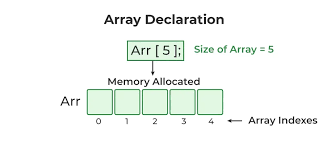
Array declaration is an operation to declare the data type of the array, the name of the array and the size of the array. In C, arrays, as other variables, are to be declared prior to their use. A one-dimensional array in general syntax is data_type array_name;.
data_type: It defines the type of elements that the array would hold, e.g. int, float, or char.
array_name: This is the tag of the array.
array_size: This is the specification of the number of elements that an array will contain and it must be a positive integer.
When an array is declared the compiler reserves a block of memory of this specified size with it. After the array type and size have been specified, it never can contain objects of different types and its size is also fixed; we cannot add or remove elements. An example would be int numbers; which makes an array of integer type called numbers that can hold five integer values. Equally, the float prices; an array containing float data is declared and char name; character array that can hold 20 characters is declared.
Array Initialization
Array initialization consists of initially assigning values to the elements of an array, commonly within the declaration process. Arrays are not initialized by default, the result is an array of garbage values hence initialization is important in its utilization.
Initializer List
A typical initialization way is by employing an initializer list where the elements are assigned values in the list order.
Full Initializing: Initially, you are able to initialize all the items in an array. An example is int arr = {1, 2, 3, 4, 5}; which will set the array with a size of 5, and having the elements passed as it will be arr = 1, arr = 2 and so on.
Partial Initialization: Partial initializing is also possible where only a sub set of array elements are initialized. As an example, int arr = {1, 2, 3}; initializes the first three elements, and the rest will automatically become 0, until you initialize it or not of the numeric type. You can initialize them to avoid garbage values stored in the elements, but be careful since the un-initialized elements may contain dangling pointers.
Implicit Size Determination: In case everything was initialized at its declaration, the size of the array may be omitted. The size of the compiled object will be automatically established on the basis of the number of applied elements in the initializer list. Consider an example; int arr = {1, 2, 3, 4, 5}; initializes an array of length 5.
Zeroing of All Elements: To set all the elements of an array to 0 the initializer list can simply be {0} but again size should be given. The rest will get zero initialized.
Array initialization of Character: another common initialization where a character array can be initialised using string literal, which is automatically appended with the null terminator \0. e.g. char name = Alice;.
Loop-based initialization
It is also possible to initialize arrays with the help of loops, like a for loop to give every element a value. The approach can be very handy when values are patterned or are based on user valued input.
GCC Specific Designated Initializers (GCC-specific)
Designated initializers With GCC compilers one can assign specific sections or items in an array to a given value. This can be intersected with initializer lists of flexible initialization.
Array Usage
Arrays are flexible and they can be utilized in a number of operations such as access, update and traversal of elements.
Getting the elements of an Array
Accessing elements The index of array elements begins at 0 with the first element and ends with array_size - 1 with the last one. The syntax used is array_name;. i. e. arr[0] will give us the first element, and arr[2] the third. Reading or writing an index that is out of the specified range might cause the undefined behavior.
Updating of Array Elements
The content of a particular member of an array can be modified by making a reference with the help of the index and assignment operator (=). An example, myNumbers = 33; will alter the value of the first element to 33.
Array Traversal
Array traversal means traversing through all the elements of an array in a particular order usually via loops. It is normal to iterate through each element using a for loop. It can come in handy when printing the elements, calculating, or searching of a certain value.
Multidimensional Arrays
Multidimensional arrays generalize one dimensional arrays to having multiple dimensions in which data is stored in the form of tables or a matrix.
Two-Dimensional Arrays (2D): These are arrays that group data in columns and rows, and are perfect in displaying a matrix. The syntax of declaration is data_type array name;. They may be initialized within one block, and their elements are kept in row.
Three-Dimensional Arrays (3D): 3D arrays are those in which an extra dimension is added, e.g. a three-dimensional array is represented as a stack of 2D arrays. After it is declaration data_type array_name;.
Arrays and Pointers
Pointers and arrays are very similar in C. An array name is a pointer that cannot change to the first element of the array. This relationship enables use of pointer arithmetics to refer to array elements. When a function accepts an array, that array decays to a pointer to its first element, that is, passed by reference. Hence, the dimension of the array should also be an independent variable to the function.
Uncodemy Uncourses C Programming
Uncodemy has relevant courses to help people who need to advance their knowledge of C programming and syntax of arrays. Uncodemy offers "C with Data Structure certificate course in Noida" with a focus on the practical training with an application-oriented training by corporate people.
Uncodemy provides convenient learning opportunities including online courses, offline courses, as well as extensive preparation which also includes an interview training. They possess a track record, their graduates are employed on reputable companies, and their connections with the industry are of good standing since some work on fortune 100 companies. In addition to C with Data Structure, Uncodemy specialised courses available in Data Science, AI, Machine learning, Full Stack Development, and Python among others.