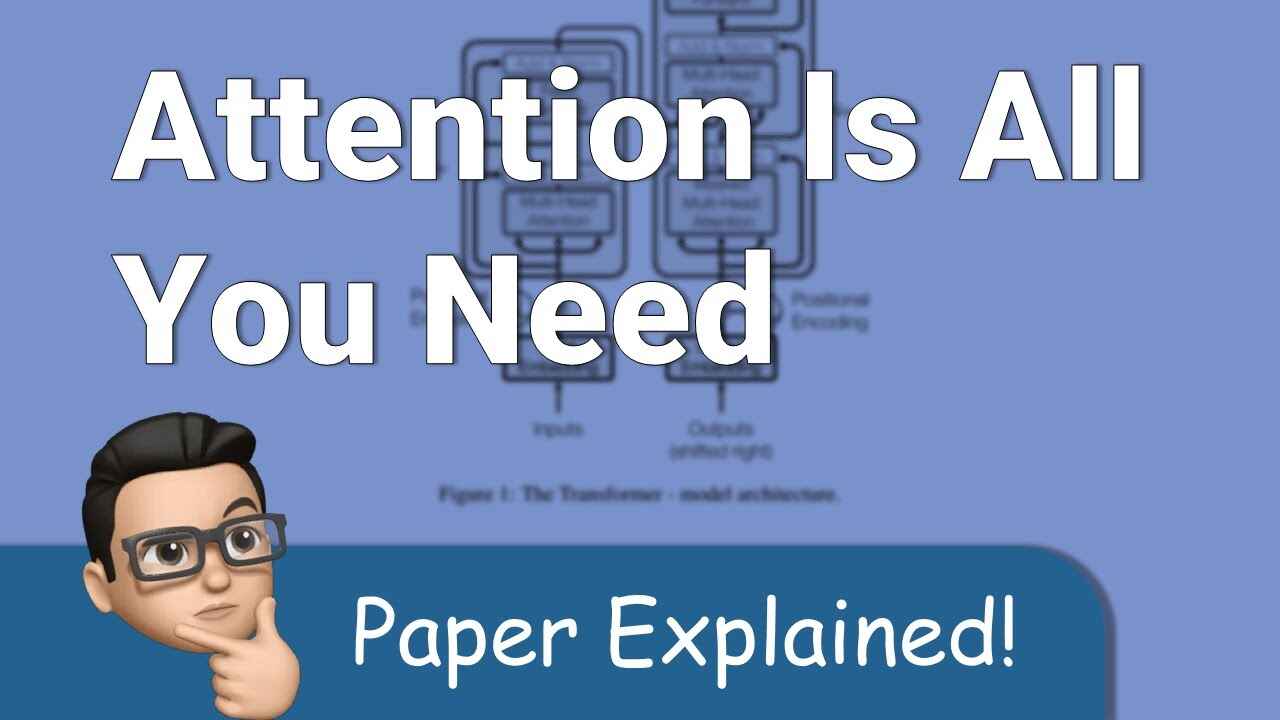
Before Transformers, natural language processing (NLP) systems relied heavily on RNNs (Recurrent Neural Networks) and LSTMs (Long Short-Term Memory). While powerful, these models struggled to handle long sequences and parallel processing. The Transformer changed everything by focusing entirely on one concept: Attention.
In this blog, we’ll break down what “Attention Is All You Need” really means, how Transformers work, why they replaced RNNs, and how you can start learning this revolutionary concept step-by-step.
What Is the Transformer Model?
The Transformer is a deep learning architecture based solely on attention mechanisms without using any recurrence or convolution. This design allows the model to process input sequences in parallel, rather than sequentially, leading to faster training and improved performance on large-scale data.
In simpler terms, the Transformer reads an entire sentence at once instead of word-by-word. It understands the relationships between all words in a context, making it incredibly powerful for language understanding, translation, and generation.
This architecture paved the way for large-scale models like BERT, GPT, T5, and PaLM, all of which rely on the same foundational design introduced in “Attention Is All You Need.”
Why Traditional Models Needed a Change
Before Transformers, AI models like RNNs and LSTMs processed words one after another. While that seems natural, it created several challenges:
1. Slow Training:
Sequential processing made it impossible to parallelize computations, slowing down training on large datasets.
2. Vanishing Gradients:
When sequences became long, models struggled to retain earlier context — losing important information.
3. Limited Context Understanding:
Even LSTMs couldn’t effectively remember relationships between distant words in long sentences.
4. Complex Dependencies:
Modeling interactions between all words was computationally expensive and inefficient.
The Transformer architecture solved all of this by introducing attention mechanisms that capture relationships between every pair of words — regardless of their position in the sequence.
The Core Idea: What Is Attention?
The attention mechanism allows the model to “focus” on relevant parts of the input while processing a specific word or token.
For example, when translating the sentence “The cat sat on the mat” into another language, the model must understand that “cat” relates to “sat” and “mat,” even if they are separated by words in between.
Attention assigns weights to different words, helping the model decide which parts of the input are most important for each output.
This means the Transformer doesn’t just read a sequence — it understands relationships and context dynamically.
The Transformer Architecture: A Simplified Overview
The Transformer consists of two main components — the Encoder and the Decoder — each built using attention layers and feed-forward neural networks.
1. Encoder
- Takes the input text sequence.
- Uses self-attention to understand how each word relates to others in the sentence.
- Generates contextual embeddings for each token.
2. Decoder
- Takes the encoded information and predicts the next word (or token) in the output sequence.
- Uses masked self-attention to prevent the model from seeing future tokens.
- Employs encoder-decoder attention to connect input and output meaningfully.
Each encoder and decoder layer also includes positional encoding, which helps the model retain the order of words — something RNNs handled naturally but Transformers don’t inherently have.
Types of Attention in Transformers
Transformers rely on multiple forms of attention to process and generate text effectively:
1. Self-Attention:
The model pays attention to other words in the same sequence to build context.
2. Cross-Attention (Encoder-Decoder Attention):
The decoder focuses on relevant parts of the encoder’s output while generating predictions.
3. Multi-Head Attention:
Instead of one attention process, multiple heads operate in parallel, each learning different linguistic relationships like grammar, meaning, or sentence structure.
This multi-head attention is what allows the Transformer to understand complex dependencies efficiently.
Positional Encoding: Understanding Word Order
Since Transformers process sentences in parallel, they lack the inherent sense of order that RNNs have. To fix this, the architecture uses positional encoding, which adds information about word position using mathematical patterns (like sine and cosine functions).
This way, even when the model reads all words simultaneously, it still knows which word came first, next, or last — preserving sentence meaning.
Advantages of the Transformer Model
1. Parallel Processing:
The biggest breakthrough — Transformers can process entire sentences or documents simultaneously, making training significantly faster.
2. Better Long-Range Dependencies:
Attention mechanisms allow the model to relate distant words effectively.
3. Scalability:
The architecture scales well with more data and computation — perfect for training massive models like GPT-4 or PaLM.
4. Higher Accuracy in NLP Tasks:
From translation and summarization to question answering, Transformers consistently outperform older models.
5. Transfer Learning:
Pre-trained Transformer models can be fine-tuned for specific tasks, saving both time and resources.
Impact of “Attention Is All You Need” on AI
The Transformer model has been a foundation for almost every major NLP and generative AI development since 2017.
Here’s how it transformed the field:
- BERT (Bidirectional Encoder Representations from Transformers): Used for understanding context in sentences.
- GPT (Generative Pretrained Transformer): Designed for generating human-like text.
- T5 (Text-to-Text Transfer Transformer): Converts every NLP problem into a text-to-text format.
- Vision Transformers (ViT): Extended the same concept to images.
Essentially, “Attention Is All You Need” introduced the architecture that now powers everything from chatbots and translators to image generators and voice assistants.
How to Learn Transformers and Attention Mechanisms
If you want to build AI models that understand or generate human-like text, you must master Transformers, Attention Mechanisms, and Deep Learning fundamentals.
A great place to start is the Artificial Intelligence Course in Noida.
This course covers everything from neural networks and deep learning to Transformer architectures and real-world AI applications — helping you understand not just how these models work but how to build and fine-tune them for your own projects.
By the end of the course, you’ll be equipped to explore models like GPT, BERT, and T5 — the direct descendants of the “Attention Is All You Need” paper.
Real-World Applications of Transformers
1. Machine Translation:
Google Translate and similar systems now use Transformers for faster and more accurate translations.
2. Chatbots and Conversational AI:
Models like ChatGPT are based on the Transformer’s attention mechanism.
3. Text Summarization:
Transformers can summarize long documents while preserving meaning.
4. Sentiment Analysis:
Businesses use Transformer models to understand customer feedback at scale.
5. Content Generation:
AI tools for writing, coding, and design all leverage Transformer-based architectures.
Challenges and Limitations
Despite their success, Transformers have some drawbacks:
- High Computational Cost: Training large Transformers requires powerful GPUs or TPUs.
- Data Dependency: They need massive datasets to achieve optimal performance.
- Bias in Data: Since models learn from human-generated data, they can sometimes inherit biases.
Researchers continue to optimize architectures with smaller, faster, and more ethical models.
Conclusion
The phrase “Attention Is All You Need” wasn’t just a catchy title — it was a prediction that reshaped AI forever. By introducing the Transformer architecture, the paper showed that attention alone could outperform complex recurrent systems.
Today, Transformers power almost every generative model you interact with — from language models to image generators. Understanding this concept is no longer optional for AI enthusiasts — it’s essential.
If you’re looking to dive deeper into AI and build your expertise in attention mechanisms, neural networks, and Transformers, Artificial Intelligence Course is a perfect place to begin. It bridges theory and real-world application — helping you stay ahead in the fast-evolving world of AI.
FAQs
Q1. What is the main idea behind “Attention Is All You Need”?
It introduced the Transformer model, which uses attention mechanisms instead of recurrence or convolution to process sequences efficiently.
Q2. Why is attention important in AI models?
Attention helps models focus on the most relevant parts of input data, improving understanding and output accuracy.
Q3. How do Transformers differ from RNNs?
Transformers process entire sequences simultaneously (parallel), while RNNs process them step-by-step (sequentially).
Q4. What are the main applications of Transformer models?
They’re used in machine translation, chatbots, text summarization, and generative AI models like GPT and BERT.
Q5. Where can I learn about Transformers and attention mechanisms?
You can learn throughArtificial Intelligence Course, which covers deep learning, Transformers, and modern AI architectures in detail.