In the world of data structures and algorithms, maintaining balance in trees is crucial for optimizing the performance of operations like insertion, deletion, and search. Among the many types of self-balancing binary search trees, the AVL Tree stands out for its simplicity and efficiency. For any student pursuing a Python Programming Course in Noida, understanding AVL trees is indispensable due to their real-world applicability in databases, file systems, and memory management.
AVL trees were named after their inventors Adelson-Velsky and Landis. An AVL tree is a type of binary search tree that maintains balance after every insertion or deletion. It ensures that the height difference (also known as the balance factor) between the left and right subtrees of any node is not more than one. This structural adjustment ensures that the time complexities for basic operations such as search, insertion, and deletion remain O(logn)O(log n), even in the worst-case scenarios.
When a node is inserted or removed, the AVL tree performs specific rotations to maintain its balanced state. These rotations are the heart of AVL trees and understanding them is key to mastering this topic.
Understanding Balance Factor
Before diving into avl tree examples, one must grasp the concept of the balance factor. For any node in an AVL tree:
Balance Factor = Height of Left Subtree - Height of Right Subtree
The allowed balance factor for any node is -1, 0, or 1. If the balance factor goes beyond this range, the tree becomes unbalanced and rotations are required to rebalance it.
Types of Rotations in AVL Trees
There are four types of rotations used to rebalance the tree:
Left Rotation (LL Rotation)
Right Rotation (RR Rotation)
Left-Right Rotation (LR Rotation)
Right-Left Rotation (RL Rotation)
Each rotation serves to restore the AVL property and keep the tree operations efficient.
AVL Tree Examples with Code and Rotations
To truly understand how AVL trees work, let’s explore a few avl tree examples. These will help in visualizing how different types of rotations come into play when the tree becomes unbalanced.
Example 1: Right Rotation (LL Rotation)
Consider inserting the values: 30, 20, 10
Insert 30: Tree has only one node.
Insert 20: 20 is less than 30, so it goes to the left.
Insert 10: 10 is less than 20, so it also goes to the left.
Now, the tree looks like:
                                30
                                /
                             20
                            /
                          10
The balance factor of 30 becomes 2 (2 - 0), indicating left-heavy. To fix this, we perform a right rotation.
After Right Rotation (RR):
                             20
                            /  \
                          10    30
The tree is now balanced.
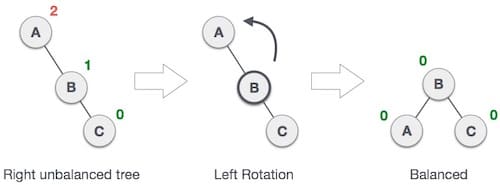
Example 2: Left Rotation (RR Rotation)
Insert values: 10, 20, 30
10 is root
20 goes to right of 10
30 goes to right of 20
Tree before rotation:
                            10
                             \
                             20
                               \
                                30
Balance factor of 10 is -2. This is a right-heavy scenario that requires a left rotation.
After Left Rotation (LL):
                             20
                            /  \
                          10    30
Again, the tree regains its balance.
Example 3: Left-Right Rotation (LR Rotation)
Insert values: 30, 10, 20
30 is root
10 goes to the left of 30
20 goes to the right of 10
Tree before rotation:
                                30
                                /
                              10
                                \
                                20
This creates a zigzag imbalance. First, we do a left rotation on node 10, followed by a right rotation on node 30.
Step 1: Left Rotation on 10
                            30
                            /
                         20
                        /
                      10
Step 2: Right Rotation on 30
                             20
                            /  \
                          10    30
Example 4: Right-Left Rotation (RL Rotation)
Insert values: 10, 30, 20
10 is root
30 goes to the right of 10
20 goes to the left of 30
Tree before rotation:
                             10
                                \
                                30
                                /
                             20
This is also a zigzag. First, we do a right rotation on 30, followed by a left rotation on 10.
Step 1: Right Rotation on 30
                              10
                                \
                                 20
                                    \
                                    30
Step 2: Left Rotation on 10
                             20
                            /  \
                          10    30
Real-World Applications of AVL Trees
AVL Trees are more than just an academic concept; they are widely used in real-life applications that require fast lookups and sorted data.
Databases:AVL trees are used in indexing where frequent insertions and deletions happen. Balancing ensures quick data retrieval.
Memory Management: In operating systems, AVL trees help manage memory efficiently by maintaining sorted memory blocks.
Search Engines:AVL trees can manage search indexes and ensure quick query responses.
Networking:In routers and switches, they are used in routing table management where balance ensures optimal path finding.
AVL Trees in Python
Python, being an accessible and powerful language, is a popular choice to implement AVL trees. Students enrolled in a Python Programming Course in Noidaoften encounter AVL trees during their coursework and assignments. While Python’s built-in data structures like dict or set do not use AVL internally, understanding how to implement such structures from scratch helps in mastering the underlying principles.
Here is a simplified implementation sketch in Python (for educational clarity):
                            class Node:
                            def __init__(self, key):
                                self.key = key
                                self.left = None
                                self.right = None
                                self.height = 1

                            class AVLTree:
                            def insert(self, root, key):
                                # Insert like BST
                                if not root:
                                    return Node(key)
                                elif key < root.key:
                                    root.left = self.insert(root.left, key)
                                else:
                                    root.right = self.insert(root.right, key)

                                # Update height
                                root.height = 1 + max(self.getHeight(root.left), self.getHeight(root.right))

                                # Check balance
                                balance = self.getBalance(root)

                                # Apply rotations
                                if balance > 1 and key < root.left.key:
                                    return self.rightRotate(root)

                                if balance < -1 and key > root.right.key:
                                    return self.leftRotate(root)

                                if balance > 1 and key > root.left.key:
                                    root.left = self.leftRotate(root.left)
                                    return self.rightRotate(root)

                                if balance < -1 and key < root.right.key:
                                    root.right = self.rightRotate(root.right)
                                    return self.leftRotate(root)

                                return root

                                def leftRotate(self, z):
                                y = z.right
                                T2 = y.left
                                y.left = z
                                z.right = T2
                                z.height = 1 + max(self.getHeight(z.left), self.getHeight(z.right))
                                y.height = 1 + max(self.getHeight(y.left), self.getHeight(y.right))
                                return y

                               def rightRotate(self, z):
                                y = z.left
                                T3 = y.right
                                y.right = z
                                z.left = T3
                                z.height = 1 + max(self.getHeight(z.left), self.getHeight(z.right))
                                y.height = 1 + max(self.getHeight(y.left), self.getHeight(y.right))
                                return y

                               def getHeight(self, node):
                                if not node:
                                    return 0
                                return node.height

                               def getBalance(self, node):
                                if not node:
                                    return 0
                                return self.getHeight(node.left) - self.getHeight(node.right)
This code demonstrates the basic structure of an AVL tree, complete with insertion logic and the necessary rotations.
Learning and Practice Tips for Students
Students aiming to master AVL trees should follow a practice-based approach:
Draw the tree at every step of insertion and observe balance factors.
Manually perform rotations to develop intuition.
Implement AVL trees from scratch in Python to internalize the process.
Compare AVL with other tree structures like Red-Black Trees and B-Trees to appreciate the efficiency.
Use online platforms and quizzes to reinforce concepts through application.
A Python Programming Course in Noidatypically offers modules on data structures, where AVL trees are taught using real-life use cases and coding assignments. Practicing these examples regularly will make AVL trees intuitive and less intimidating.
Conclusion
AVL trees are a cornerstone of advanced data structures and are essential for creating efficient and balanced systems. By exploring avl tree examples, one can clearly understand how rotations maintain balance and support efficient operations. Whether it’s in memory optimization or search indexing, AVL trees find their place in critical applications. Students enrolled in a Python Programming Course in Noida benefit greatly from grasping these foundational structures as they form the basis for more complex algorithms and systems.
Mastery of AVL trees not only deepens algorithmic thinking but also prepares students for technical interviews and real-world development challenges. With proper visualization, coding practice, and conceptual clarity, the journey from understanding to application becomes significantly smoother.