Introduction
Pradyumn Singh / 2 months - 0
- 10 min read
- Backend Developer Roadmap
- Backend Development
- Backend Development in 2026
- Databases
Thinking about becoming a backend developer? We’ve all been there – starting fresh in web development with no clue where to begin. But if you’re set on becoming a backend web developer, congratulations! You’ve already made it past the first step.
Now, it’s time to dive into the world of backend development. Don’t worry – we’re here to guide you through it. In this article, we’ll walk you through the programming languages, tools, and technologies you’ll need to learn for backend development.
We’ll also share a clear roadmap so you can understand the steps and skills required to become a successful backend web developer.
Let’s jump right in!
What is Backend Development?
Backend development is all about the parts of a website that users don’t see, but are crucial for everything to run smoothly. It’s the behind-the-scenes work that makes a website or web app function properly. Backend developers create and maintain the code that keeps things running.
There are three main components in backend development:
- Database – This is where all the information is stored. It helps organize and manage large amounts of data much better than a simple text file could.
- Server – A server is a computer that gets requests from users (through the front-end) and sends back the right information based on what’s been asked.
- Application – The application is the program that listens for requests on the server, gets data from the database, and sends back a response to the user.
A backend web developer’s job is to build and manage the technology that powers the behind-the-scenes functionality of a website. Common programming languages used in backend development include Python, Java, Ruby, PHP, and JavaScript. Additionally, backend developers work with database management systems like MySQL to organize and manage data effectively.
Who is a Backend Developer?
Web development has become a hot career path in recent years. With more and more businesses recognizing the importance of a strong online presence to attract leads, they’re hiring talented developers to create high-performing web applications.
Before we dive into the backend developer roadmap, let’s first understand who a backend developer is.
The backend refers to the server-side of a web application, where all the behind-the-scenes work happens. This is where the backend developer comes in.
A backend developer writes the code that makes web applications work as intended. They’re responsible for powering the web server and making sure everything runs smoothly. In addition to writing backend code, they also create APIs and manage databases.
For example, if you wanted to send an email every time someone subscribes to your company’s newsletter, a backend developer would write the code for that functionality, using languages like PHP, Python, or others.
If this sounds interesting and you’re eager to become a backend developer, you’ll need to learn some key skills. Don’t worry, we’ll cover all of them in the backend developer roadmap!
Backend Developer Roadmap 2026
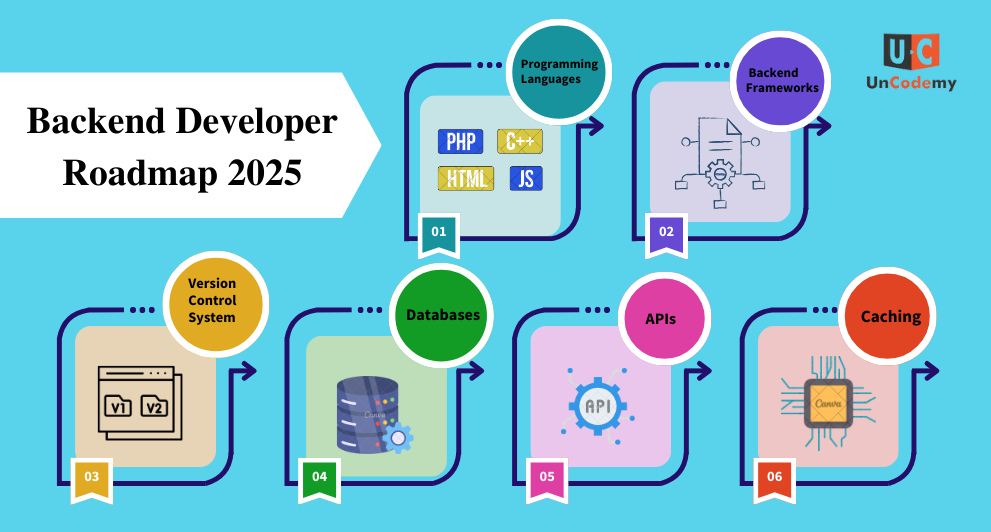
To become a successful backend developer, you need to focus on understanding several key areas and technologies. Here’s a simplified roadmap for 2026:
1. Basic Knowledge of Internet, OS, and Frontend
First, it’s important to understand how the internet works. This includes concepts like browsers, DNS, and protocols such as HTTP and HTTPS. Once you’re clear on that, you should dive into Operating Systems (OS). This involves learning about memory management, using the terminal, basic commands, threads, concurrency, and I/O management.
Next, you should learn some basics of frontend development. While your focus will be on the backend, knowing how the frontend connects with the backend will give you a better understanding of how the whole system functions.
2. Learning Programming Languages
As a backend developer, your main job will be to write code, so mastering programming languages is essential. Java is often recommended, but you don’t have to stick to it. You can also choose from languages like JavaScript, Python, Ruby, C#, or PHP.
Becoming proficient in any language takes time and dedication. Remember, it’s okay to start slow and learn at your own pace. Once you’re comfortable with one language, it becomes easier to pick up others. The key is to stay consistent and practice regularly.
3. Learn Backend Frameworks
Frameworks are essential for backend development because they provide pre-written code and templates that make development faster and more efficient. They help reduce the amount of code you need to write and let you focus on solving problems rather than reinventing the wheel.
Here are some popular backend frameworks:
- ASP.NET: A framework from Microsoft for building dynamic websites and web applications using C#.
- Laravel: A PHP framework that simplifies building web applications with elegant syntax.
- Ruby on Rails (ROR): A free, open-source framework in Ruby that reduces the complexity of web development.
- Django: A Python-based framework for building high-quality web applications.
- Node.js: A runtime environment that allows JavaScript to be used for backend development.
- Spring Boot: A Java-based framework that simplifies application setup and configuration.
4. Version Control System
Version control systems (VCS) help developers track changes in code and collaborate more easily. They allow developers to work together without overwriting each other’s work and to keep a history of changes. Some popular VCS tools include:
- Git: A tool for tracking changes in code.
- GitHub, GitLab, BitBucket: Platforms for hosting Git repositories and collaborating with others.
5. Databases
Databases are crucial for backend development because they store and manage data. There are two main types of databases:
- Relational Databases: Examples include PostgreSQL, MySQL, and Oracle, which organize data in tables and use SQL to interact with it.
- NoSQL Databases: Examples include MongoDB and DynamoDB, which store data in a flexible, non-tabular format.
As a backend developer, you should understand database concepts like:
- ORMs (Object-Relational Mapping): Tools that allow you to interact with databases using object-oriented programming languages.
- ACID: A set of properties that guarantee reliable database transactions.
- Normalization: The process of organizing data to reduce redundancy.
- Indexes: Tools that speed up database queries.
6. APIs (Application Programming Interfaces)
APIs are used to enable communication between different software systems. Backend developers use APIs to ensure that services and applications can talk to each other efficiently. Common API types include:
- REST (Representational State Transfer): A standard way of creating APIs.
- JSON: A format for exchanging data between systems.
- SOAP: A protocol for exchanging structured information.
- WebSocket: A protocol for creating two-way communication between clients and servers in real-time.
7. Caching
Caching helps improve the performance of applications by storing copies of frequently accessed data in a temporary storage location, so it can be retrieved quickly. Common caching methods include:
- CDN (Content Delivery Networks): Distribute content closer to users for faster access.
- Redis: A popular in-memory data store used for caching.
8. Testing
Backend testing ensures the server-side functionality of your application works properly. Common testing methods include:
- Unit Testing: Tests individual parts of the application.
- Integration Testing: Tests how different parts of the application work together.
- Functional Testing: Ensures that the backend works as expected.
9. Code Analysis Tools
Code analysis tools help backend developers identify issues in the code and ensure it runs smoothly. Some common tools include:
- SonarQube: Analyzes code quality.
- JUnit: A testing framework for Java applications.
- PMD: Analyzes code for potential issues.
10. Architectural Patterns
Backend development often involves choosing the right architectural pattern to solve problems effectively. Common patterns include:
- Monolithic: A single, unified application.
- Microservices: An architecture that splits the application into smaller, independent services.
- Event Sourcing: A pattern that stores changes to application state as a sequence of events.
11. Message Brokers
Message brokers help different parts of a system communicate with each other by managing messages. Some popular message brokers include:
- RabbitMQ
- Kafka
- JBOSS Messaging
12. Containerization
Containerization packages an application and its dependencies in a lightweight container, making it easier to run on different environments. Docker is the most widely used tool for containerization.
13. Design Patterns
Design patterns provide solutions to common problems that occur during development. Examples include:
- Singleton: Ensures a class has only one instance.
- Factory: Defines an interface for creating objects.
- Observer: Allows an object to notify others when it changes.
14. Authentication Methods
Authentication is the process of verifying the identity of a user. Common methods include:
- MD5: A widely used hashing algorithm.
- Bcrypt: A hashing algorithm designed for securely storing passwords.
- RSA: A widely used encryption standard.
15. Webhooks
A webhook is a way for applications to send real-time data to each other without requiring constant requests. Unlike traditional APIs, webhooks push data automatically when available.
16. WebSocket
WebSockets provide a continuous, two-way communication channel between clients and servers. They’re useful for applications that require real-time updates, like chat apps.
17. Practicing with Real-World Applications
Finally, to truly master backend development, you need to practice. Work on small projects, such as creating a blog or a business website. This will help you apply what you’ve learned and deepen your understanding of backend tools and technologies.
Conclusion
The world of backend development is always evolving with new tools and technologies. As a backend developer, you’ll have the chance to explore and work with these innovations.
Once you’ve gone through the steps outlined in this roadmap, it’s time to put your knowledge into practice. You can start by contributing to an open-source project or applying for an entry-level job to gain real-world experience.
Congratulations! You now have a clear understanding of the backend developer roadmap.
Remember, you’re not alone in this journey. There are plenty of resources and courses available to help you learn these skills in a structured way. You can also consider joining a full-stack development program, like the one offered by Scaler Academy, to strengthen your foundation and ensure a bright future.
This roadmap was designed to help you progress quickly and efficiently in your backend development career. Stay focused on these steps, and you’ll be well on your way to success.
FAQs Based on the Backend Developer Roadmap
1. What is the first step to becoming a backend developer?
To become a backend developer, the first step is to understand the basics of how the internet works, including HTTP/HTTPS, DNS, and web browsers. Then, you should gain knowledge of operating systems, including memory management and basic terminal commands. Once you have this foundation, learning about backend and frontend technologies will help you understand how to connect the two.
2. What programming languages should I learn for backend development?
Some popular programming languages for backend development include Java, Python, PHP, Ruby, C#, and JavaScript. While Java is widely recommended, any of these languages can be a good starting point. Once you get comfortable with one language, it becomes easier to learn others.
3. Why are frameworks important in backend development?
Frameworks are important because they provide pre-written code that helps developers save time and effort. They allow you to build applications more efficiently by reducing the amount of repetitive code you need to write. Popular backend frameworks include Django, Laravel, Node.js, and Spring Boot.
4. What is the role of a version control system in backend development?
A version control system (VCS) helps developers track and manage changes to their code over time. It allows you to collaborate with others without overwriting each other’s work and keeps a history of all changes. Git is the most commonly used VCS, and platforms like GitHub, GitLab, and BitBucket make collaboration even easier.
5. How can I gain practical experience as a backend developer?
To gain practical experience, you can start by working on small projects, such as building a blog or a simple web application. Contributing to open-source projects is also a great way to practice your skills. Additionally, applying for entry-level jobs or internships will give you real-world experience and help you further hone your abilities.



















