C Programming Principles
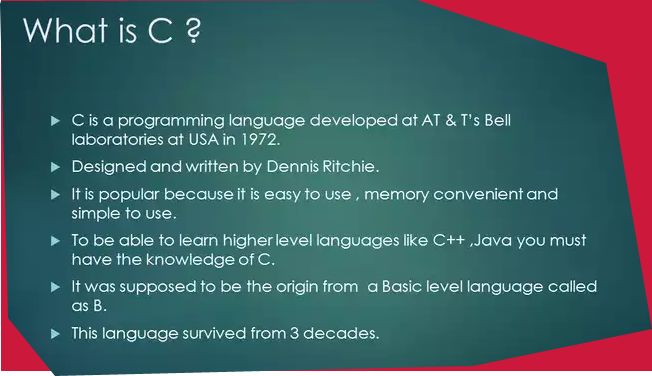
C is a mid-level, structured-oriented, and general-purpose programming language invented by Dennis Ritchie in Bot Labs back in 1971 to 1973. It is among the oldest and most common programming languages which are applicable in the language compilers, operating systems and network drivers as well as databases. C is said to be a mid-level language since it enables both high and low features through its syntax and also has low features as it uses assembly language.
Simple Data Types and Tokens
Basic data types form the fundamental units in C programming where one uses them to declare variables and assign memory, the type of data that a variable can hold and the amount of data that it can hold. C programs consist of a sequence of different tokens, which are the smallest meaning component that the compiler identifies. Such tokens are:
Keywords: These are the reserved and pre-defined words in C and there are 32 identifiers one may use and each identifier has a certain job in C. These would be auto, else, if, long, int, switch and typedef.
Identifiers: names given }by the user, composed of letters, digits or underscores, with the first character an underscore or a letter, requiring no reservation of keywords.
Constants: They are also referred to as literals and they are values which can not be changed once it is defined in a program.
Strings: sequence of characters ending with null character (\0) which marks the end of the string.
Special symbols: such symbols as #, =, {}, (), ,, *, ;, and `` which have a particular meaning and are not offered to be used in a different capacity.
Operators: Characters that cause an action as they are used on an object or variables, which are put in unary, binary, and ternary.
Variables Scope
Scope of a variable in C is the block of an area within a program, within which a variable is defined and accessible. Outside this region the variable is automatically annihilated. Variables may be declared in three chief locations:
Local Variables: These variables are defined within a block or a given function; they can only be used in the defined block or function. The default value stored in local variables is garbage value.
Global Variables: These variables are declared outside, that is, that they are not within any function, but rather available globally within the program. Global variables are set at zero as their initial value and their life belongs until the end of program executing.
Formal Parameters: Parameters constituting a variable in a signature of a function.
Preprocessor Directives
C coded preprocessor directives: are functions or macros, and they are instructions issued to the compiler, before compilation of the program. Important ones are macros, file inclusion (e.g. #include <stdio.h>), conditional compilation and other directives such as #undef and #pragma. As an example, stdio.h is a header file, which includes a function such as scanf() and printf() to read or write something.
Static Variables
C has static variables that are the same as those in Python with the exception that such data will remain in the same form until it is out of scope. They do not lose their values and they can be reused without getting to be uninitialized again. Static variables have the default initial value as 0.
Memory and Pointers
Memory management forms a very crucial part of C programming.
Dynamic Memory
Runtime usages such as malloc() and calloc() are called dynamic memory allocation achieved through the heap portion of memory. These operations are simplified by using the stdlib.h header file.
Dangling Pointer and Memory Leakage
Dangling pointers: These are pointers referring to freed blocks of memory space. When a variable has been deleted, but still there is a pointer that points at the old memory address, then it is a dangling pointer.
Memory Leaks: These happen when the memory has been allocated by malloc() or calloc() and has not been released with free(). The result of it is that the program will use an unknown quantity of RAM, causing it not to be able to have memory available to other programs and risk crashing. In order to avoid memory leaks dynamically allocated memory must be freed when it is not required.
Pointers
Pointers are references of variables in memory or variables. They are mostly used to save memory and more time. Pointers are utilized:
- Passing in by reference.
- Retrieval of array elements.
- The functions which can provide more than one result.
- Dynamic memory.
- Instituting data structures.
- System programming in which memory addresses are critical.
-
C is also used to indicate the various pointers:
- Near pointers: Store 16 bit addresses.
- Far Pointers: Far Pointers are 32-bit pointers, which may refer to information external to the current memory segment.
- Huge Pointers: They are usually 32-bit pointers whose bits can be accessed freely or stored outside segments.
typedef Keyword
The typedef keyword in C declares a name alias of an existent data type, either it is an integer, function parameter or structure declaration thus devising the name shorter. As an example, typedef long long ll introduces a name ll, which is an alias of long long.
Flow of Control and Procedures
C supports many flow-control constructions, and facilities to structure code in the form of functions.
Loops
Loops perform a set of instructions till a given condition is achieved. C allows the entry and exit controlled loops. An infinite loop is some piece of code that does not have a working exit, which repeats itself indefinitely. It may be planned or may arise due to incorrectly or unsatisfied break conditions. These are for loops, while loops and do-while loops.
Functions
A function is a reusable piece of code which is used to perform a given task. Functions prevent duplication of codes, enhance the readability of programs, and make the programs easier to modify, thus minimize mistakes. The functions exist in two major forms:
User-defined Functions: The user-defined functions are the combination of functions that are developed by the programmer to solve the particular problem and make the program simple.
Built-in Functions: Built-in functions are the special functions having pre-defined meaning, which the compiler package provides to the programmers in which one can make use of a function without defining it.
Macros Virus Functions
Macros are the blocks of C statements, which are given names by pre-processor directives, and they are processed before a compiler runs them. Direct compilation instead happens with functions.
Innovative Theory and Practice Test Problems
One of the tests you may have prior to an interview based in C programming is solving code problems as a test of your knowledge of both algorithms and data structures.
General Coding pitfalls
Many writing interview questions often include C program writing to perform some tasks:
Printing Hello World without Semicolon: one of the approaches is an if statement with printf as the condition, as printf returns the number of characters and this number is not zero thus has a true value.
Prime Number Check: To check whether a number is prime or not, a process of dividing it by smaller numbers in order to reach the square root is commonly factored in.
Fibonacci Series: Programs to print the Fibonacci series may be realized both by recursion and iteration (loops). Recursion is a process where a function makes a call in itself.
Data Structures
A struct (struct): A keyword such as struct is used to define types of user-defined data which enables storing various types of data in a unit. Structure members are reached by means of a structure variable.
Unions( union): A union is also a user-defined data type which allows storing more than one data type in a single one; however , a union just occupies the space of its largest member. This implies that you can access one member at a time.
Enumerations (enum): Enums store user-defined pieces of data types to name the appropriate integral constant, making the programs easier to understand and maintain.
Other Note worthy ideas
sleep() Function: The sleep() enables the current thread of a program to wait on a given period of time and returns 0 in the event that the required time has passed.
volatile Keyword: This keyword is used to get the compiler to not optimize the variable that the value may change unexpectedly due to some code in another scope.The current value is read in each case (instead of a register) to the system.
Uncodemy Learning and Preparation
Uncodemy provides different training programs both to those who want to learn more about C programming and to those who want to get ready for interviews. Uncodemy, based in Noida, in Delhi NCR region in India offers a C With Data Structure certification training course that has made many students successful in their careers. They have tutors who are good people in the MNCs and startups.
Uncodemy features special batches in order to enable those students who are keen on speeding up their professional progress. They also offer live online classes to busy students or those who are at a distance and these are considered equal to doing conventional classroom training. Besides C with Data Structure training, Uncodemy takes special training in Data Science, Data Analytics, Full Stack Development, Python, Software Testing, Automation Testing, Business Analytics, Digital Marketing, AWS, Cloud Computing, Azure Training, Artificial Intelligence, Machine Learning, Manual Testing, and Search Engine Optimization.
The alumni have been absorbed in top employers that include CISCO, Adobe, McKinsey & Company, AWS and IBM as a number of the students have been placed in these companies. Uncodemy gives everyone an opportunity to learn tech skills and confidently enter the world of tech with their professional courses focused on a job.
Conclusion
C programming is one of the prerequisites in software development. Through knowledge of the fundamental principles and practicing of the problems frequently asked during interviews and coding, you can establish a firm base. Practice resources such as geeksforgeeks, w3resource, codechef and hackerrank include a lot of practicing problems and their solutions on varying skill levels. Furthermore, training organizations such as Uncodemy can give you organized education and sufficient practice to allow you to succeed in C programming and acquire the job of your choice.