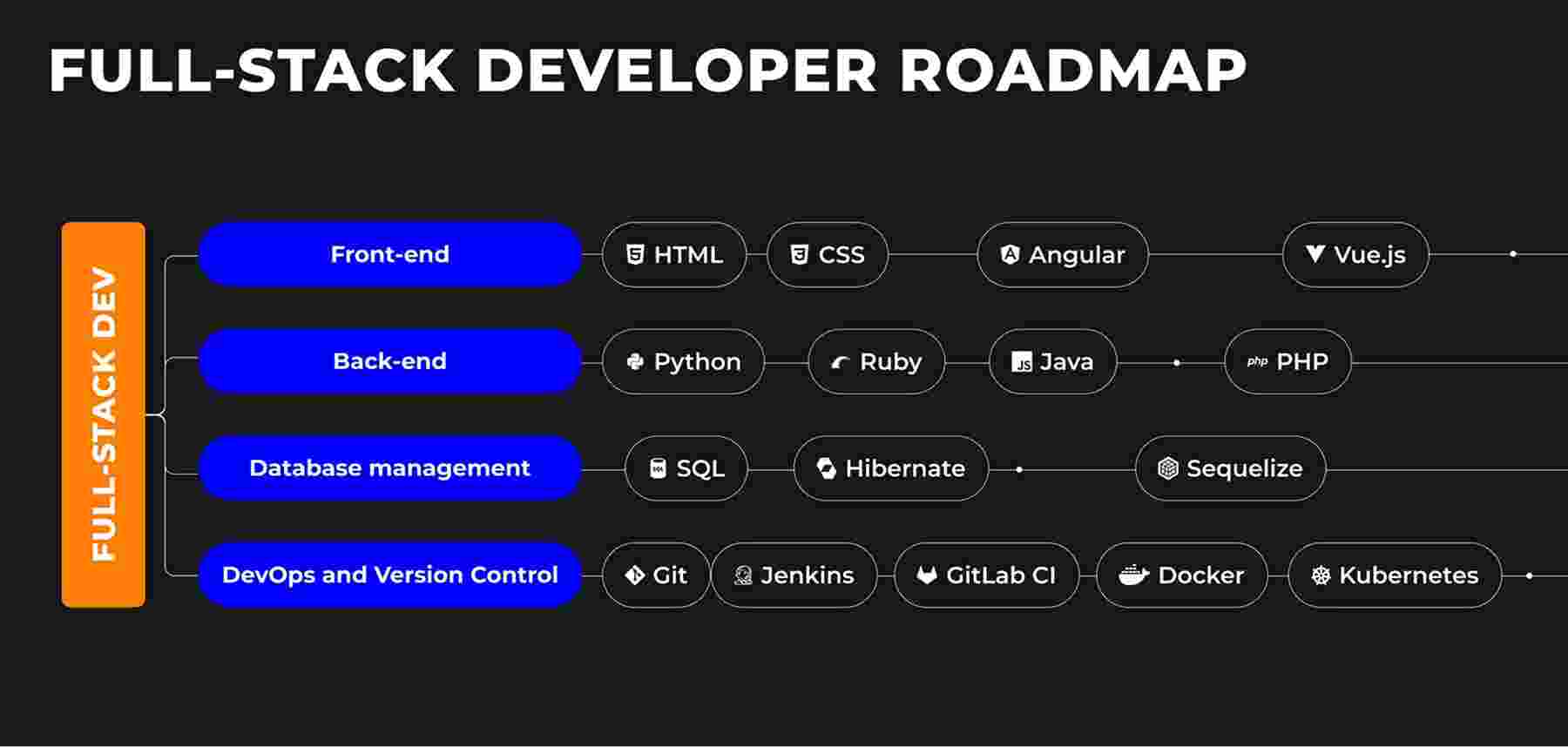
This article provides a detailed roadmap for fresh graduates aspiring to become full stack developers. It covers essential skills, tools, technologies, project ideas, and strategies to succeed in the industry. Following this roadmap step by step will help you build a strong foundation, work on practical projects, and impress potential employers.
What is a Full Stack Developer?
A full stack developer is someone who is proficient in both front-end and back-end development. The front-end deals with the user interface, user experience, and overall look and feel of the application. The back-end focuses on server-side logic, databases, and APIs. By understanding both, a full stack developer can design, develop, and maintain complete web applications.
Key responsibilities of a full stack developer include:
- Designing and implementing user interfaces using HTML, CSS, and JavaScript.
- Developing server-side logic and APIs to handle application functionality.
- Managing databases to store, retrieve, and update information securely.
- Integrating front-end and back-end components seamlessly.
- Optimizing applications for performance and scalability.
- Collaborating with designers, developers, and product managers to deliver projects on time.
Full stack developers are highly versatile, allowing companies to hire fewer specialists while maintaining quality across the software development lifecycle.
Step 1: Learn the Basics of Programming
Before diving into full stack development, it is essential to have a solid understanding of programming. Fresh graduates should focus on:
- HTML: The structure of web pages. Learn how to create headings, paragraphs, lists, tables, and forms.
- CSS: Used for styling web pages, including layouts, colors, fonts, and responsive design.
- JavaScript: Adds interactivity to web pages. Learn basic syntax, data types, loops, conditional statements, and functions.
Practicing small projects such as creating a personal website or a simple interactive webpage will help reinforce your understanding of these technologies. Building a strong foundation in HTML, CSS, and JavaScript is critical before moving to advanced topics.
Step 2: Master Front-End Development
Front-end development focuses on what the user sees and interacts with. A full stack developer must master several skills in this area:
- Advanced JavaScript: Learn ES6 features, asynchronous programming, promises, and event handling. These concepts are crucial for modern web applications.
- Front-End Frameworks: React, Angular, and Vue.js are widely used. React is popular for its component-based architecture and is highly recommended for beginners.
- Responsive Design: Learn CSS Flexbox, Grid, and media queries to make websites work on various devices.
- Version Control: Git and GitHub are essential for tracking changes, collaborating with teams, and showcasing your work.
Practical front-end projects to build:
- Personal portfolio website showcasing your skills.
- Interactive to-do list application with dynamic updates.
- Weather app fetching live data from an API.
These projects will help you understand front-end principles and demonstrate your skills to employers.
Step 3: Learn Back-End Development
Back-end development is about building the server-side logic and managing data. Key skills include:
- Programming Languages: Node.js, Python, Java, and Ruby are popular options. Node.js is particularly useful because it allows you to use JavaScript for both front-end and back-end development.
- Server Management: Learn how servers process requests, handle responses, and manage application deployment.
- Databases: Learn SQL databases such as MySQL or PostgreSQL and NoSQL databases like MongoDB.
- API Development: RESTful APIs and GraphQL allow communication between the front-end and back-end.
- Authentication and Security: Learn to implement secure login systems, protect sensitive data, and prevent common attacks.
Back-end project ideas:
- User authentication system with login and registration.
- CRUD application to manage tasks or products.
- Blog platform with database integration and content management.
Working on these projects will give you practical experience and prepare you for real-world scenarios.
Step 4: Combine Front-End and Back-End
Once you have knowledge of both front-end and back-end development, it is time to become a full stack developer. Key steps include:
- Learn Full Stack Frameworks:
- MERN Stack: MongoDB, Express.js, React, Node.js.
- MEAN Stack: MongoDB, Express.js, Angular, Node.js.
- LAMP Stack: Linux, Apache, MySQL, PHP.
- Integrate Components: Connect front-end and back-end by fetching data from APIs and displaying it on the user interface.
Full stack project ideas:
- E-commerce website with products, cart, and checkout.
- Social media platform with posts, comments, and authentication.
- Online learning platform with courses, quizzes, and progress tracking.
Building these projects demonstrates your ability to manage complete applications, which is highly valuable to recruiters.
Step 5: Learn DevOps Basics
Understanding DevOps makes you a more versatile developer. Key areas include:
- Version Control: Git and GitHub for collaborative coding.
- CI/CD Pipelines: Automate testing and deployment using Jenkins, GitHub Actions, or GitLab CI.
- Containerization: Docker allows packaging applications with all dependencies.
- Cloud Platforms: AWS, Azure, and Google Cloud help deploy and manage applications.
Practical DevOps projects:
- Deploy a full stack application on a cloud server.
- Set up automated testing for a web application.
- Manage containerized applications with Docker.
DevOps skills make you more employable and capable of handling end-to-end development workflows.
Step 6: Strengthen Problem-Solving and Algorithms
Even as a full stack developer, problem-solving and algorithms are essential. Recruiters often assess these skills in interviews.
Focus on:
- Arrays, strings, and linked lists.
- Stacks, queues, and hash tables.
- Sorting and searching algorithms.
- Trees and graphs basics.
Practice coding challenges on LeetCode, HackerRank, or CodeSignal. Solving algorithmic problems improves logical thinking and coding efficiency.
Step 7: Build a Portfolio
A strong portfolio demonstrates your skills and practical experience. Include:
- Front-end and back-end projects.
- Live applications hosted online.
- GitHub repositories with clean and documented code.
Your portfolio should show your understanding of full stack development and problem-solving capabilities.
Step 8: Prepare for Interviews
Technical interviews test both knowledge and practical skills. Preparation tips:
- Data Structures and Algorithms: Solve coding challenges regularly.
- Project Knowledge: Be ready to explain your projects, challenges, and technologies used.
- Behavioral Questions: Practice answering questions about teamwork, problem-solving, and adaptability.
- Mock Interviews: Participate in mock interviews to improve confidence and communication.
Step 9: Stay Updated with Industry Trends
The technology field evolves rapidly. Full stack developers must keep up with trends such as:
- Serverless architecture.
- JAMstack for fast and scalable websites.
- Microservices for modular applications.
- Cloud-native development and DevOps automation.
Follow industry blogs, attend webinars, and join online communities to stay current.
Step 10: Join Communities and Contribute
Being part of developer communities helps in learning, networking, and career growth. You can:
- Contribute to open-source projects.
- Join forums and discussion groups.
- Attend hackathons and workshops.
Participation enhances skills and makes you more attractive to employers.
Conclusion
Becoming a full stack developer in Delhi as a fresh graduate may seem challenging due to the wide range of technologies and frameworks involved. However, a structured roadmap can make the journey manageable. Start with programming basics, master front-end and back-end development, combine them into full stack projects, learn DevOps fundamentals, practice algorithms, build a portfolio, and prepare for interviews.
Consistent practice and real-world projects are crucial. By following this roadmap, fresh graduates can acquire the necessary skills to become proficient full stack developers. Staying updated with industry trends and engaging in communities will further enhance your knowledge and career opportunities.
A career in full stack development offers opportunities for growth, creativity, and problem-solving. Fresh graduates who follow this roadmap can build strong technical skills, practical experience, and confidence, positioning themselves as valuable assets in the tech industry. Full stack development is not only a highly rewarding career but also a path that allows continuous learning and professional advancement.
With dedication, consistent learning, and practical experience, any fresh graduate can become a skilled full stack developer, ready to contribute to innovative projects and grow in the rapidly evolving tech world. The combination of technical expertise, problem-solving ability, and practical experience will make you a well-rounded full stack developer capable of taking on diverse challenges.