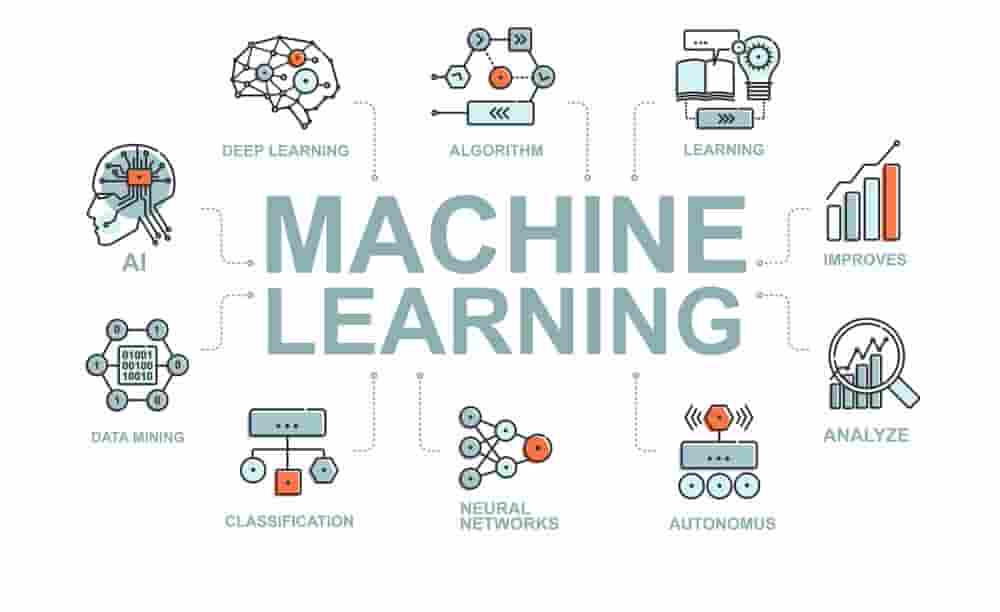
Types of Machine Learning
Machine learning algorithms can be of three major types:
Supervised Learning: Algorithms are developed on labeled data to make predictions based on the learning acquired on the data. This method is the main one when it comes to the prediction using labeled data.
Unsupervised Learning: These algorithms determine the patterns and relationships in unlabeled data. This contains such techniques as k-means clustering, and dimensionality reduction techniques such as PCA and t-SNE.
Reinforcement Learning: Algorithms are taught by getting involved in an environment and getting feedback from the environment in terms of rewards or punishment. The most important concepts are the knowledge of agents, environments, rewards, and policies, and such algorithms as Q-learning and SARSA are the most famous.
Machine Learning Requirements Before You Get Started.
A firm grasp of a number of background concepts is important before getting into machine learning.
Mathematics and Statistics
To come up with and interpret machine learning models, one will require a solid understanding of mathematics and statistics.
Linear Algebra: The notions of vectors, matrices, eigenvalues, and eigenvectors are the key concepts to learn about algorithms, such as Principal Component Analysis (PCA). Linear algebra forms the basis of most ML algorithms, and is used in computer graphics and cryptography.
Calculus: Gradients, derivatives are essential to optimization methods such as gradient descent. The discipline of calculus is the basis of optimization methods in machine learning model training.
Probability and Statistics: This encompasses such concepts as probability distributions, hypothesis testing, and statistical inference, which are crucial to the performance of the model and guarantee the validity. Probability and statistics are used to measure uncertainty and assist in testing a hypothesis, and also in other areas such as finance and weather forecasting.
Programming Skills
One should know about programming to apply machine learning algorithms and handle data.
Python: Python is the most popular machine learning language, with some of the best libraries, including NumPy, pandas, and Scikit-learn. It is very simple and versatile, which is why it is an ideal option to both novice and professional users. Numerous recent frameworks have been written in Python, and its application is growing to AI/ML.
R: R is commonly used in statistical analysis and data visualization, which makes it a powerful tool to use in data science.
SQL: SQL is essential in querying, handling and accessing information in relational data bases which are also frequently employed in data preprocessing.
Simple Rules to Master Machine Learning.
Data Collection and Cleaning: This deals with the process of acquiring data with the help of APIs, web scraping, databases, and publicly available data and combining the data of different formats. Data cleaning is important to guarantee quality and consistency by addressing missing values, correcting mistakes, standardizing formats and eliminating duplicates.
Exploratory Data Analysis (EDA): Although it can be explained in various ways, it is generally understood that EDA is an analysis of datasets that aims to summarize the primary characteristics of the data sets, produce summary statistics, and infer patterns, relationships, and trends. Data exploration is done using visual tools such as histograms, scatter plots, and box plots usually generated using Matplotlib, Seaborn, and Plotly.
Feature Engineering: At this stage, one can add new or alter the existing features to better represent the underlying patterns, convert raw data into more useful representations to learn better, as well as improve model interpretation. It is also involved in enhancing the performance of the model by using feature selection and data transformation methods such as normalization, standardization and encoding of categorical variables.
Machine Learning Algorithms.
Once the foundation skills are established, core machine learning algorithms are the next thing to get mastered.
Supervised Learning
The main method of prediction using labeled data is known as supervised learning. Key algorithms include:
Regression: Predictive models Model The outcome to be predicted is a continuous value, e.g. linear regression to predict a dependent variable by an independent variable.
Classification: Algorithms group data based on established sets or classes such as K-Nearest Neighbors, Decision Trees, Random Forests and Support Vector Machines.
Unsupervised Learning
Unsupervised learning is concerned with discovery of latent patterns in unlabeled data.
Clustering: The clustering methods such as k-means, hierarchical clustering, and DBSCAN cluster data which are similar, which are used in customer segmentation and detecting anomalies.
Dimensionality Reduction: Dimensionality reduction methods like PCA and t-SNE simplify data yet retain significant characteristics.
Anomaly Detection: This detects anomalies or deviations in data, which is critical in detecting fraud and network security.
Reinforcement Learning
Reinforcement learning conditions the agent to decide based on trial and error. The fundamental ideas are the knowledge of agents, environments, rewards, policies, algorithms (Q-learning, SARSA, and deep reinforcement learning, such as deep Q-networks (DQN). Applications are in game playing, robotics, and autonomous systems.
Model Evaluation and Tuning
It is crucial to evaluate the performance of the model to determine the effectiveness and robustness.
Evaluation Metrics: Metrics are used to evaluate classification models such as precision, recall, F1-Score, and ROC-AUC. In regression, such measures are MSE or RMSE.
Cross-validation: This method is significant to interpret and successfully prevent overfitting in estimating model performance in unknown data.
Addressing Imbalanced Datasets: When faced with imbalanced datasets, it is essential to train a strong model, and this can be done by resampling (such as oversampling or under sampling) or by artificially generating data (such as SMOTE).
Model Performance optimization: This is the process of determining and optimizing significant hyperparameters such as the learning rate or the number of layers, and applying optimization techniques such as Grid Search and Random Search.
More Sophisticated Machine Learning.
You may want to explore more advanced subjects as you get along.
Deep Learning: This makes use of multilayered neural networks to characterize complicated patterns. An introduction to neural networks is suggested as the specialization of Andrew Ng.
Natural Language Processing (NLP): NLP involves the processing and the understanding of human language. This encompasses text processing and embeddings (Word2Vec and BERT), and sentimental analysis as well as machine translation.
Computer Vision (CV): CV helps machines to analyze and comprehend visual data. It entails image processing methods such as normalization and data augmentation, and state-of-the-art architectures such as object detection, image classification and facial recognition.
MLOps: MLOps is an area that assists in the creation of a homogenous workflow to develop models and deploy them. It includes model registry, experiment monitoring, ML pipelines, and model monitoring. Docker is also a core tool that is used to build, share, and execute reproducible container applications.
Real-World Projects
Practice on real world projects is necessary for the application of theoretical knowledge.
Simple Projects: Some examples are learning to predict housing prices with a regression model, learning to classify handwritten digits, and learning to analyze simple data.
Intermediate Projects: It can include the construction of recommendation systems, sentiment analysis of social media data, or image classification with the help of deep learning applications.
Advanced Projects: Advanced projects could include developing an autonomous driving algorithm, building real-time language translation systems, or building generative adversarial networks (GANs).
Uncodemy Courses
Uncodemy also provides a number of courses that may be useful to those who are new to machine learning:
Complete course on machine learning Part I: This course targets beginners and has no co-requisites, so that it is taught up to an advanced level.
Introduction To Machine Learning: This consists of similar lessons on the introduction to machine learning and learning methods in machine learning.
"Data Science And Machine Learning": This course will equip one with a deep understanding of Data Science and Analytics Course.
Introduction to Machine Learning for Data science: Taught in English, this course is about machine learning in data science.
"Comprehensive Course on Machine Learning": Like in Part I, the course is given at the beginner level, without any requirements, and then moves to the advanced level. In general, the courses of data science at Uncodemy encompass key areas, including machine learning, Python programming, and data visualization.
Machine Learning Trends in the Future.
Machine learning is a rapidly expanding field, and a number of important trends define its future.
Edge Computing and ML: As IoT devices continue to proliferate, more and more ML models will be run on edge devices to minimize latency, improve privacy, and facilitate real-time decision-making in fields such as autonomous vehicles and smart homes.
Explainable AI: ML models are becoming increasingly more elaborate, but transparency is required, and explainable AI (XAI) is meant to help explain how the models actually operate and make decisions, particularly in high-stakes areas like healthcare and finance.
Federated Learning: This model enables ML models to be trained on decentralized devices without the need to exchange data, improving privacy and security, especially in healthcare and finance.
Quantum Machine Learning: Quantum computing can transform ML to be able to solve problems that cannot be solved by classical computers, as well as provide faster training and enhance performance in high-level tasks.
Integration with NLP and CV: ML solutions with natural language processing and computer vision will create more intelligent AI systems, enhancing the applications of virtual assistants, real-time translation, and content moderation.
AI Ethics and Fairness: Ethical, transparent and unbiased algorithms will be more focused, to resolve problems of discrimination, privacy and accountability.
Industry-Specific Applications: ML will still be industry-specific to enhance the quality of diagnoses in healthcare, fraud detection in the financial sector, and supply chain optimization in retail.
There is a strong basis in pursuing a career in machine learning as it means having a solid framework, applied experience, and lifelong learning. This is a roadmap that will assist you to develop the required skills to succeed in this booming line of work.