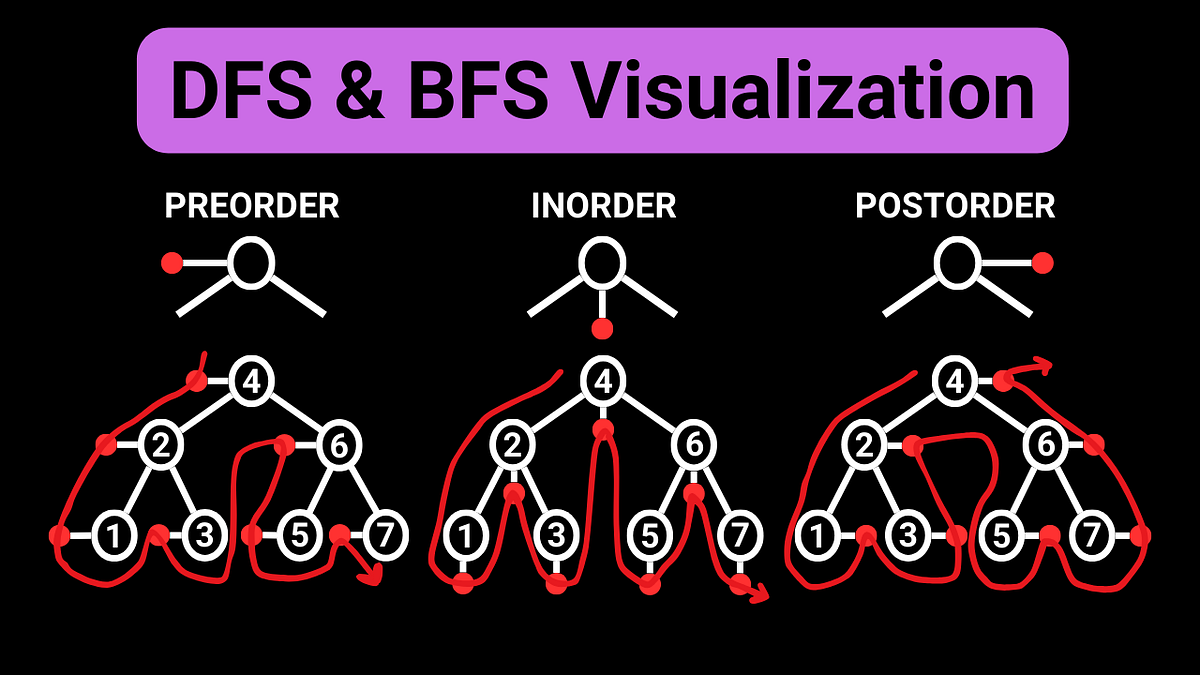
BFS and DFS Example: Traversal Algorithms in Graphs
When you're diving into Data Structures and Algorithms, graphs are one of the most exciting yet confusing concepts you'll face. But here's a trick once you understand BFS and DFS with solid examples, graphs stop being scary and start making sense.
In this blog, we’ll break down both BFS (Breadth-First Search) and DFS (Depth-First Search) using clear examples, C code, and real-world analogies. By the end, you’ll not just understand how to implement them you’ll know exactly when and why to use them.
Imagine a network of cities connected by roads. Each city is a node (vertex), and the road connecting two cities is an edge. That’s a graph.
Now, how do you explore all the cities in a smart way? That’s where graph traversal comes into play.
The two most common algorithms to explore graphs:
BFS (Breadth-First Search)
DFS (Depth-First Search)
Let’s break them down with real, working examples.
BFS (Breadth-First Search) with Example
How BFS Works:
BFS starts from a node and explores all immediate neighbors first, before moving deeper into the graph.
It uses a Queue (FIFO) data structure.
Real-Life Analogy:
Imagine spreading a rumor in a classroom. You tell your first-row friends. Then they tell their friends in the next row. The rumor spreads level by level that’s BFS!
BFS Algorithm (Steps):
1. Start from a source node.
2. Add it to the queue.
3. Mark it as visited.
4. While the queue is not empty:
Remove the first node.
Add all its unvisited neighbors to the queue.
Mark them as visited.
BFS Example Graph:
0
/ \
1 2
| |
3 4
BFS C Code Example:
Copy Code
#include <stdio.h>

#include <stdlib.h>

#define SIZE 5

int visited[SIZE] = {0};

int queue[SIZE], front = 0, rear = -1;

void enqueue(int value) {

    queue[++rear] = value;

}

int dequeue() {

    return queue[front++];

}

void bfs(int graph[SIZE][SIZE], int start) {

    visited[start] = 1;

    enqueue(start);

    while (front <= rear) {

        int current = dequeue();

        printf("%d ", current);

        for (int i = 0; i < SIZE; i++) {

            if (graph[current][i] && !visited[i]) {

                enqueue(i);

                visited[i] = 1;

            }

        }

    }

}

int main() {

    int graph[SIZE][SIZE] = {

        {0,1,1,0,0},

        {1,0,0,1,0},

        {1,0,0,0,1},

        {0,1,0,0,0},

        {0,0,1,0,0}

    };

    printf("BFS Traversal: ");

    bfs(graph, 0);

    return 0;

}
Output:
BFS Traversal: 0 1 2 3 4
DFS (Depth-First Search) with Example
How DFS Works:
DFS starts from a node, explores as deep as possible along a branch, then backtracks.
It uses Stack (LIFO) or recursion.
Real-Life Analogy:
Think of exploring a maze you go forward until you hit a wall, then backtrack and try a new path. That’s DFS!
DFS Algorithm (Steps):
1. Start from a source node.
2. Mark it as visited.
3. Explore each unvisited neighbor recursively.
4. Backtrack when needed.
DFS C Code Example:
Copy Code
#include <stdio.h>

#define SIZE 5

int visited[SIZE] = {0};

void dfs(int graph[SIZE][SIZE], int node) {

    visited[node] = 1;

    printf("%d ", node);

    for (int i = 0; i < SIZE; i++) {

        if (graph[node][i] && !visited[i]) {

            dfs(graph, i);

        }

    }

}

int main() {

    int graph[SIZE][SIZE] = {

        {0,1,1,0,0},

        {1,0,0,1,0},

        {1,0,0,0,1},

        {0,1,0,0,0},

        {0,0,1,0,0}

    };

    printf("DFS Traversal: ");

    dfs(graph, 0);

    return 0;

}
Output:
DFS Traversal: 0 1 3 2 4
BFS vs DFS: Quick Comparison
Feature
BFS
DFS
Structure
Queue
Stack/Recursion
Traversal
Level-wise
Depth-first
Path Finding
Finds shortest path
May not find shortest
Space
More (stores levels)
Less (unless deep tree)
Use Case
Social Networks, Maps
Puzzle solving, AI
Where BFS and DFS Are Used
Scenario
Algorithm to Use
Shortest path in unweighted graph
BFS
Maze or puzzle solver
DFS
Detecting cycles in a graph
DFS
Crawling search engine results
BFS
Topological sorting
DFS
Interview Tip
“How do you detect a cycle in a directed graph?”
Answer: Use DFS with recursion stack tracking.
“How to find shortest distance between two nodes?”
Answer: Use BFS it guarantees the shortest path in unweighted graphs.
How to Practice BFS and DFS
Try solving problems on:
LeetCode (Problems: 102, 200, 207)
HackerRank Graph section
GFG BFS & DFS practice sets
Frequently Asked Questions (FAQs)
Q1. Which is better: BFS or DFS?
Depends on the problem. Use BFS for shortest paths; use DFS for exploring all paths.
Q2. Can DFS be implemented iteratively?
Yes, using a stack instead of recursion.
Q3. Does DFS or BFS use more memory?
BFS usually uses more memory because it stores all neighbors at each level.
Q4. Are BFS and DFS only for graphs?
Nope. Trees, grids, mazes anything with nodes and connections.
Q5. Can BFS and DFS fail?
They can loop infinitely if you forget to mark nodes as visited. Always handle that.
Final Thoughts
Whether you’re prepping for a coding interview or just trying to level up your DSA game, understanding BFS and DFS with actual examples is essential. They’re more than just theory they’re part of your problem-solving toolbox.