BFS and DFS in Data Structure: Concepts and Differences
If you’ve ever tried to navigate through a maze or looked for the shortest route in Google Maps, then knowingly or not you’ve experienced graph traversal. In the world of Data Structures and Algorithms (DSA), this concept shows up as BFS (Breadth First Search) and DFS (Depth First Search).
These two traversal techniques are core to mastering not just graphs, but also trees, networks, and even puzzles like Sudoku.
So let’s unpack everything: how BFS and DFS work, where they shine (and where they don’t), their differences, and how to implement them with real code examples in C.
Think of a graph as a network of connected dots cities on a map, friends in a social network, or links on a webpage.
Graph traversal simply means visiting each node (or vertex) in some defined order. That’s where BFS and DFS step in.
What is BFS (Breadth-First Search)?
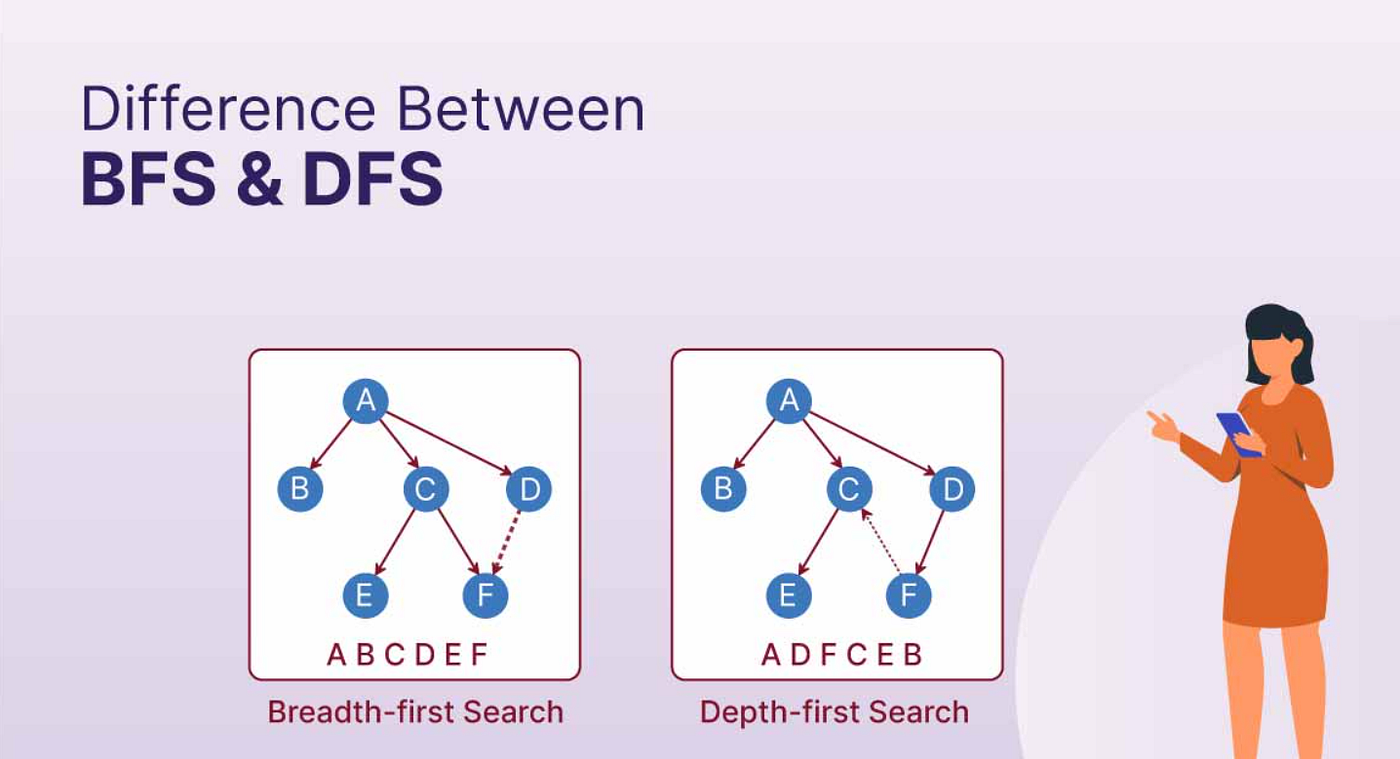
BFS is like checking all neighbors before going deeper.
Imagine you’re in a building looking for someone BFS is like visiting every room on the ground floor first before climbing the stairs to the next.
Characteristics:
Traverses level by level
Uses a queue data structure (FIFO)
Great for finding the shortest path
BFS Real-Life Uses:
GPS navigation (shortest path)
Social network friend suggestions
Crawling web pages
BFS Algorithm (Concept)
1. Start from a selected node (source)
2. Visit and mark it as visited
3. Enqueue all adjacent unvisited nodes
4. Dequeue the first element, repeat from step 2
BFS Code in C
Copy Code
#include <stdio.h>

#include <stdlib.h>

#define SIZE 100

int queue[SIZE], front = -1, rear = -1;

int visited[SIZE];

void enqueue(int value) {

    if (rear == SIZE - 1)

        return;

    if (front == -1)

        front = 0;

    queue[++rear] = value;

}

int dequeue() {

    if (front == -1 || front > rear)

        return -1;

    return queue[front++];

}

void bfs(int graph[][SIZE], int vertices, int start) {

    enqueue(start);

    visited[start] = 1;

    while (front <= rear) {

        int current = dequeue();

        printf("%d ", current);

        for (int i = 0; i < vertices; i++) {

            if (graph[current][i] && !visited[i]) {

                enqueue(i);

                visited[i] = 1;

            }

        }

    }

}
What is DFS (Depth-First Search)?
DFS dives deep before backtracking. It's like following one hallway all the way to the end before checking the others.
Characteristics:
Traverses deeply before backtracking
Uses a stack (or recursion)
Great for exploring all paths
DFS Real-Life Uses:
Puzzle solving (Sudoku, Maze)
Detecting cycles in graphs
Topological sorting
DFS Algorithm (Concept)
1. Start at the root
2. Mark it as visited
3. Visit an unvisited neighbor recursively
4. Backtrack when needed
DFS Code in C (Recursive)
Copy Code
#include <stdio.h>

int visited[100];

void dfs(int graph[][100], int vertex, int nodes) {

    printf("%d ", vertex);

    visited[vertex] = 1;

    for (int i = 0; i < nodes; i++) {

        if (graph[vertex][i] && !visited[i]) {

            dfs(graph, i, nodes);

        }

    }

}
Key Differences Between BFS and DFS
Feature
BFS
DFS
Data Structure Used
Queue
Stack or Recursion
Traversal Style
Level-by-Level
Depth-first
Memory Usage
High (stores all neighbors)
Lower in many cases
Optimal for
Shortest Path
Exploring complete paths
Example Applications
GPS, Social Networks
Puzzles, Dependency Graphs
When to Use BFS vs DFS?
Scenario
Use BFS or DFS?
Finding shortest path
BFS
Solving mazes/puzzles
DFS
Detecting cycles in graphs
DFS
Web crawlers
BFS
Analyzing dependencies
DFS
Still confused when to pick which? Uncodemy's expert-led DSA course covers such decision-making with real projects and live sessions.
Common Mistakes to Avoid
Not marking nodes as visited: Leads to infinite loops
Incorrect queue/stack usage: Wrong traversal order
Assuming graphs are trees: Not all graphs are hierarchical
Skipping disconnected components: In BFS/DFS, always account for all nodes
Hybrid Approaches: When BFS Meets DFS
Sometimes, problems require a mix. For example:
Use BFS to find the shortest path.
Then apply DFS to list all possible paths.
Think of it like Google Maps showing the fastest route (BFS) and also giving you alternate routes (DFS-style depth search).
BFS vs DFS in Interview Questions
You’ll often find questions like:
“How would you detect a cycle in a directed graph?” → DFS with visited + recursion stack.
“How would you find the shortest path between two nodes?” → BFS from the source node.
“Write a function to traverse all components in a disconnected graph.” → Use a loop to call BFS/DFS for unvisited nodes.
So, understanding the depth vs breadth distinction isn’t just theory it’s a toolset you’ll use across coding rounds.
Practice platforms: LeetCode, HackerRank, Codeforces
Frequently Asked Questions (FAQs)
Q1. Which is faster: BFS or DFS?
It depends. BFS is usually faster for shortest path problems, while DFS can be faster in deep graph traversal scenarios.
Q2. Is DFS always recursive?
Nope! DFS can also be implemented using a stack (iterative version), though recursion is more common.
Q3. Do both BFS and DFS work on trees?
Yes — in fact, tree traversals like level-order or in-order are specialized versions of BFS/DFS.
Q4. Which one consumes more memory?
Typically, BFS uses more memory due to queue usage and level-wise storage.
Q5. Can BFS or DFS work on weighted graphs?
They can traverse them, but for shortest paths in weighted graphs, use Dijkstra’s or A* algorithm instead.
Final Thoughts
BFS and DFS are not just academic topics they’re practical problem-solving tools. Whether you’re building a game, working on AI pathfinding, or cracking coding interviews, knowing when and how to use them is a game changer.
And let’s be real graph questions show up everywhere in tech interviews. The more hands-on practice you do, the more intuitive these algorithms become.
Ready to master graph algorithms like BFS & DFS with mentorship, notes, and live doubt sessions? Check out Uncodemy’s Data Structures Course and start building your DSA foundation today.