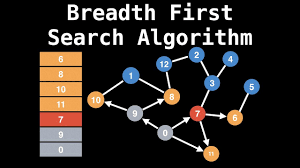
What Breadth-First Search (BFS) is
Breadth-first Search (BFS) is a critical algorithm to traverse or search trees or graphs. In contrast to Depth-First Search (DFS), which searches as deep as it may down a branch then recursively backtracks, BFS visits nodes systematically on a level by level basis. BFS is especially appropriate in determining the shortest path in graphs that are not weighted. Starting at a root node or an arbitrary starting node the algorithm traverses all of its immediate neighbors before proceeding to their immediate but unvisited neighbors at the next neighbourhood level.
The Operation of BFS How BFS Works
The fundamental concept of BFS is based on the data structure of a queue, it works on the attribute, First-In, First-Out (FIFO). This queue has been used to order the visits to the vertices so that all the vertices of the given level are traversed first before proceeding to the next level.
This is a step-by-step description of the way how the BFS algorithm usually works:
Initialization: The first step should be to place the start node in the queue and to mark it as visited. The remaining nodes are originally noted as unvisited.
Traversal Loop: repeat the process until the queue is finished.
Processing of the nodes: Process the Nodes by un-queueing the front of the queue in every iteration of the process. This dequeued node is regarded as the currentVertex.
Neighbor Exploration: Find out all the adjacent nodes (neighbors) of the currentVertex.
Putting In the Queue: If an adjacent node is not already visited then visit it and enqueue it.
Termination: The loop is repeated until the queue becomes empty, which means that all the nodes accessed have become visited. In case a certain node is searched, the procedure may stop when it has been located.
C: implement BFS
When using BFS in the C programming language, there is the idea of forming a queue data structure by hand since C lacks an inbuilt queue. This is normally equipped with both enqueue (inserting an element to the back) and dequeue (removing an element to the front) functions. The queue is usually an array, and it has back and front pointers to control the status of the queue. Moreover, there is an array of visited to remember explored nodes containing the nodes already visited to avoid cycles and duplicate computations.
The implementation of Adjacency Matrix and Adjacency List
Several kinds of graph representation may be used to implement BFS:
Adjacency Matrix: The Adjacency Matrix is a 2-dimensional array adj[n][n], where n is the number of nodes. adj[i][j] = 1 when there is an edge between node i and node j; adj[i][j] = 0 otherwise. The BFS operation uses adj to identify unvisited neighbors.
Adjacency List: Linked list An array of other linked lists, in which each element i in the array contains the head of a linked list of all the nodes adjacent to node i. This is usually more memory-consuming on sparse graphs.
Time Complexity and Space Complexity
Like all implementations of breadth-first search, the BFS algorithm has a time complexity of O(V + E), where V is the number of vertices (nodes), and E is the number of edges. The reason behind this is as a result each vertex and each edge of the graph will be visited at maximum one time. Time complexity of the representations using an adjacency matrix representation may be O(N*N) in which the N denotes the number of nodes. BFS requires space O(V) since in the worst case every vertex may be contained in the queue.
Uses of BFS
BFS finds multiple useful applications and they include:
Shortest path: Discovering the shortest path in unweighted graph. It can be applied to GPS navigation systems or game pathfinding algorithms.
Web Crawlers: Constructing the search virtual document of web pages.
Network Broadcasting: Finding all nodes accessible about a source node using spanning trees.
Graph Connectivity: testing whether a graph is connected or determines connected components.
Detection of cycles in a graph: Finding cycles in an undirected graph.
Mazes and Puzzles: Sudoku, Pacman, mazes, shortest paths, covering a grid (as in the theme of the Rotting Oranges problem)
Minimum spanning tree: In Prim MST algorithm.
Topological Sorting: It involves determining the order of the tasks in some project (e.g. Course Schedule on LeetCode).
Image Processing: Recovering connected components in a binary image or flood fill algorithms.
Courses related to Uncodemy
To those who want to master data structures and algorithms, such as BFS, Uncodemy provides an extensive training offer. Uncodemy in the city of Noida and Delhi NCR in India offers quality C With Data Structure bootcamp (with advanced practitioners as instructors).
On the searching site, no particular courses that teach the BFS algorithm in C language are mentioned, and thus, the Uncodemy certification training program in Noida named C With Data Structure would naturally include such underlying algorithms. The Data Structures and Algorithms course syllabus may have an outline about topics such as linear algebra, programming, and other algorithms.
The main features of what Uncodemy is offering are:
Professional Tutors: Tutors are recruited among the well-recognised MNCs and startups.
Flexible Learning: Working students or students who live far away have the options of live sessions and online delivery of the classes and this mode is intended to be equal to classroom training.
Special Batches: The availability of special batches to the students, who want to accelerate their professional lives.
Placement Assistance: Uncodemy is associated with fortune 500 companies and has been successfully placing students in companies such as CISCO, Adobe, Deloitte, IBM, and Capgemini just to mention but a few.
In addition to C With Data Structure, Uncodemy has courses in Data Science, Data Analytics, Full Stack Development, Python, Software Testing, and Artificial Intelligence, meaning its training encompasses a wide range of technical subjects. These classes allow students to learn how to debug, programming principles, algorithms, data structure, and system programming, which is essential knowledge when solving and building algorithms like BFS.
Conclusion
Breadth-First Search is an excellent and multi-purpose algorithm that is essential when traversing a graph structure or tree structure especially to locate the shortest paths. The basic programming principles are demonstrated through its implementation in C, usually using special queue data structures and visited arrays. There are also reliable institutions such as Uncodemy that have training courses, which could help learners achieve the required knowledge on how to use algorithms and data structures in the real world.