Binary Search Time Complexity Explained with Code Samples
Knowing algorithms and their efficiency is one of the basic requirements to becoming a quality programmer. Out of all the searching algorithms, binary search is probably the most efficient algorithm of all, so binary search time complexity is an important topic for anyone hoping to take programming seriously. Whether you are doing a DSA course in Noida or studying DSA on your own, you will certainly have to learn binary search as well as binary search time complexity analysis, for both technical interviews and problem solving.
There are a few examples of how great algorithm design can be more effective in performance than binary search. A simple linear search can look at all of these elements one at a time; binary search uses a divide-and-conquer approach that will make searching extremely fast. What differentiates the algorithm the most will set the stage for why binary search time complexity is so important in computer science.
The elegance of the binary search algorithm extends not only to its performance but also to its performance characteristics. Understanding the time complexity of binary search allows programmers to make more informed decisions on when and how to use a binary search approach. This becomes increasingly valuable as programmers are implementing solutions to more complex problems with large datasets that can base user experience on the performance differences from using a linear search to a binary search approach.
For students taking any comprehensive DSA course in Noida, binary search serves as an excellent introduction to algorithm analysis and complexity theory. It demonstrates fundamental concepts like logarithmic growth, worst-case analysis, and the importance of data structure prerequisites in a clear, understandable way.
What Makes Binary Search Special?
Mr. Pradyumn Singh / 12 day ago
9
10 min read
Binary search changes the searching problem from a very long one to an efficiently short one. To understand binary search time complexity, we must first appreciate what is fundamentally different about this type of algorithm compared to a more basic searching technique.
The valuable realization regarding binary search is that it requires sorted data but it rewards performance that is exceptional. Rather than transitioning through each element one by one, binary search eliminates half of the remaining opportunities with each comparison of two different elements. It is this progression of halving down to the single correct answer that provides the efficiency in binary search.
Think about the last time you searched for a word in a dictionary. You wouldn't have just started on the next page and then checked each word one by one sequentially. Your search would have started in the middle, saw that it was either before or after that word, and proceeded to check the next half. This is precisely what binary search does in code.
This divide and conquer is what makes the time complexity of binary search so much better. Each step eliminates half of the problem size, causing a logarithmic time complexity that will provide performance to make it usable despite the data size continuing to grow exponentially.
Students in a quality DSA course in Noida learn that binary search exemplifies how mathematical insights can transform algorithm performance. The relationship between the number of comparisons and the data size follows a clear mathematical pattern that makes binary search predictable and reliable.
Understanding Time Complexity Fundamentals
Before we delve into the binary search time complexity, we should address the concept of time complexity and its significance first. The definition of time complexity implies how an algorithm runs about the input size, which provides us with a measure to make sense of the runtime behavior of different algorithms.
As algorithms have progressively complicated running time behavior, time complexity uses Big O notation to help us express the relationship of the input size to the number of operations. This notation allows the programmer to analyze algorithms in terms of their impact on execution runtimes without worrying about the actual implementation or the specifications of a computer.
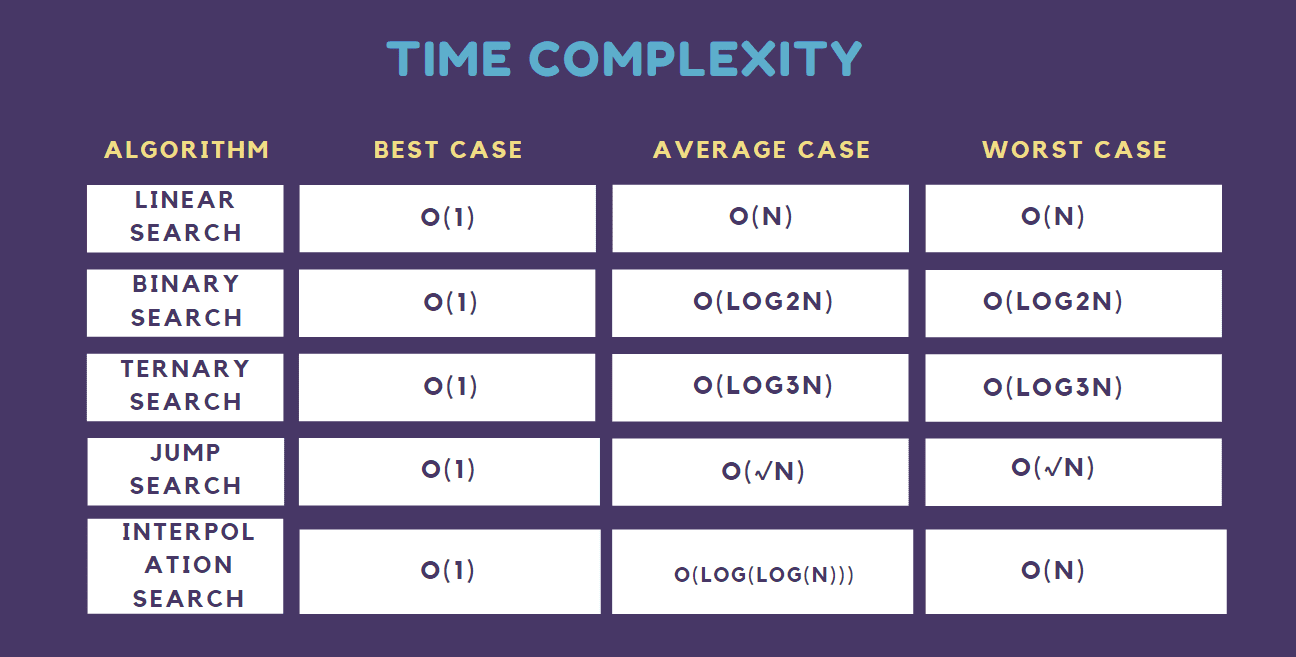
For binary search, the binary search time complexity can be denoted as O(log n) - where n is the number of elements in the already sorted array. This notation demonstrates how logarithmic time complexity is only one more step in the process when the data size is doubled, which indicates that the scalability of binary search is significant.
By knowing how to look at binary search time complexity, it can also help explain how it would be the best choice for large data due to the sheer differences in algorithm performance for progressively larger data sizes. For small arrays, the difference in runtime performance between linear search and binary search would look small, however, it quickly becomes dramatic with additional data sizes. An important principle in computer science is the scalability of an algorithm, which is one of the early concepts that students will grasp from any reputable DSA course in Noida.
The mathematical time complexity aspect of binary search also allows the student to get acquainted with important concepts of best case, average case, and worst case analyses. These concepts help programmers understand algorithm behavior under different conditions and make informed decisions about algorithm selection.
Binary Search Algorithm Walkthrough
To truly understand binary search time complexity, let's walk through how the algorithm actually works. This step-by-step approach helps illustrate why the time complexity is logarithmic and how each operation contributes to the overall efficiency.
Binary search starts by examining the middle element of a sorted array. If this middle element matches the target value, the search is complete. If the target is smaller than the middle element, the algorithm focuses on the left half of the array. If the target is larger, it focuses on the right half.
This example demonstrates why binary search time complexity is O(log n). With 10 elements, binary search found the target in just 3 steps. Linear search might have taken up to 6 steps in this case, and could take up to 10 steps in the worst case.
The key insight is that each step eliminates half of the remaining possibilities. This halving process continues until either the target is found or the search space is exhausted. The number of times you can divide n by 2 until you reach 1 is precisely log₂(n), which explains the logarithmic time complexity.
Students learning about algorithms in a DSA course in Noida often find this visual approach helpful for understanding why binary search is so efficient and how binary search time complexity relates to the algorithm's structure.
Code Implementation and Analysis
Understanding binary search time complexity becomes clearer when you see the actual code implementation. The structure of the code directly reflects why the time complexity is logarithmic.
Here's a simple iterative implementation:
python
def binary_search(arr, target):
    left = 0
    right = len(arr) - 1

    while left <= 1 2 right: mid="(left" + right) if arr[mid]="=" target: return elif < left="mid" else: right="mid" - -1 # target not found pre>
This code demonstrates the binary search time complexity through its structure. The while loop continues as long as there are elements to search, and each iteration eliminates half of the remaining search space by updating either the left or right boundary.
The recursive implementation shows the same complexity pattern:
python
def binary_search_recursive(arr, target, left=0, right=None):
    if right is None:
        right = len(arr) - 1

    if left > right:
        return -1

    mid = (left + right) // 2

    if arr[mid] == target:
        return mid
    elif arr[mid] < target:
        return binary_search_recursive(arr, target, mid + 1, right)
    else:
        return binary_search_recursive(arr, target, left, mid - 1)
Both implementations have the same binary search time complexity of O(log n). The recursive version makes the divide-and-conquer nature more explicit, while the iterative version is often preferred for its space efficiency.
Analyzing these implementations helps students in a DSA course in Noida understand how code structure directly relates to time complexity. Each recursive call or loop iteration represents one step in the logarithmic progression that defines binary search efficiency.
Master Algorithm Efficiency Through Understanding
Understanding the time complexity of a binary search allows you to appreciate the efficiency of algorithms and the mathematical basis for computer science. This knowledge should be invaluable, whether it's for completing coding exercises, making a software application run faster, or architecting software.
The step from understanding basic binary search to analyzing the time complexity of binary search is important in your journey of developing algorithmic thinking. It doesn't matter whether you have enrolled in a DSA course in Noida or you are self learning, this understanding will help develop your understanding of more advanced algorithms and data structures.
Understand, the time complexity of binary search is not just a theoretical concept, it is also a way to build efficient software that is scalable with the increasing sizes of data. As you continue your programming journey, the ideas you learn when you're analyzing a binary search will give you clarity and insight into other efficient algorithms that run computer systems that we use every day.
Frequently Asked Questions (FAQs)
Q: Why is binary search time complexity O(log n) instead of O(n)?
A: Binary search eliminates half of the remaining search space with each comparison, requiring at most log₂(n) comparisons. Linear search checks elements one by one, potentially requiring n comparisons in the worst case.
Q: Can binary search work on unsorted arrays?
A: No, binary search requires sorted data to work correctly. The algorithm's efficiency depends on being able to eliminate half of the possibilities based on comparison results, which only works with sorted data.
Q: Is recursive or iterative binary search better?
A: Both have the same time complexity, O(log n). Iterative uses O(1) space while recursive uses O(log n) space. Iterative is often preferred for its space efficiency, but recursive is more intuitive for some developers.
Q: How does binary search time complexity compare to hash table lookup?
A: Hash tables offer O(1) average lookup time, which is faster than binary search's O(log n). However, hash tables require more memory and can degrade to O(n) in worst-case scenarios with many collisions.
Q: What happens to binary search performance with duplicate elements?
A: The time complexity remains O(log n) even with duplicates. However, you might need modified versions to find the first or last occurrence of a target value, which maintains the same time complexity.