Binary Tree Explained: Structure, Traversal & Implementation
Understanding data structures is crucial for anyone aiming to be a successful programmer. Among the various data structures, trees—particularly binary trees—are essential for organizing hierarchical data. Whether you're tackling challenges in competitive programming or developing real-time applications like compilers, databases, or operating systems, you'll often encounter binary trees in different forms.
In this comprehensive guide, we’ll dive into what a binary tree is, how it’s structured, the different types, various tree traversal methods, and how to implement it in code. If you’re studying data structures or gearing up for interviews, grasping this concept is vital. Plus, if you’re seeking a structured learning experience, the Data Structures Course in Noida (uncodemy.com) offers hands-on training from industry experts to help you master binary trees and more.
What is a Binary Tree?
Mr. Snehank Singh / 15 days
19
9 min read
A binary tree is a hierarchical data structure where each node can have up to two children, known as the left child and the right child.
Each node consists of three components:
- Data (the value stored in the node),
- A pointer/reference to the left child, and
- A pointer/reference to the right child.
Why Use Binary Trees?
Binary trees offer efficient methods for storing, retrieving, and manipulating data in a hierarchical manner. Some of the benefits include:
- Quick searching and sorting
- Efficient insertions and deletions
- Simplified implementation for recursive algorithms
Structure of a Binary Tree
A binary tree begins with a root node. Each node can connect to two other nodes:
- Left child: Usually holds a smaller value
- Right child: Typically contains a larger value (in binary search trees)
The tree expands by adding new nodes as children. The depth of the tree is determined by the number of layers it has, while the height is the longest path from the root to any leaf node.
Key Terminologies
Term
Description
Root
Topmost node of the binary tree
Leaf
Node with no children
Internal Node
Node with at least one child
Height
Number of edges from root to the deepest leaf
Depth
Number of edges from root to a particular node
Types of Binary Trees
Binary trees can be categorized into several types based on their structure:
1. Full Binary Tree
This is a binary tree where every node has either 0 or 2 children.
2. Complete Binary Tree
In this type, all levels are fully filled except possibly the last one, and all nodes are positioned as far left as they can be.
3. Perfect Binary Tree
Here, every internal node has two children, and all the leaves are at the same level.
4. Balanced Binary Tree
For every node, the height difference between the left and right subtrees is no more than one.
5. Binary Search Tree (BST)
Each node adheres to the rule: left subtree < root < right subtree, which allows for quick search and retrieval operations.
Binary Tree Traversal Techniques
Traversal is the process of visiting each node in the tree exactly once. There are two primary types:
1. Depth-First Traversal
This method explores as far as possible down each branch before backtracking.
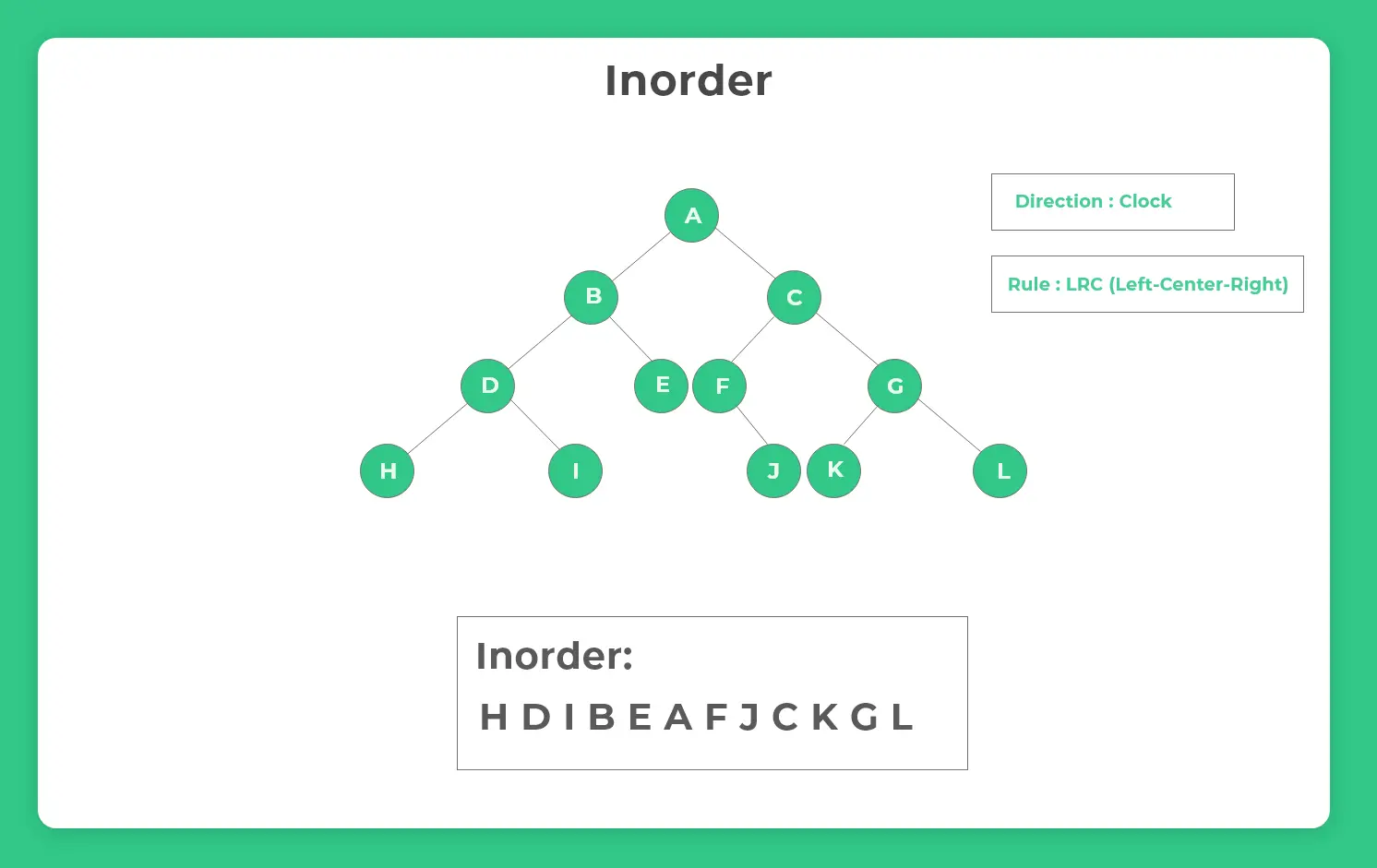
· Inorder Traversal (Left, Root, Right)
- Commonly used in BSTs
- Outputs nodes in ascending order
· Preorder Traversal (Root, Left, Right)
- Useful for copying the tree
· Postorder Traversal (Left, Right, Root)
- Handy for deleting the tree
2. Breadth-First Traversal
Also known as Level Order Traversal, this technique visits nodes level by level using a queue.
Code Example (Inorder Traversal in Python)
class Node:
	def __init__(self, data):
        self.data = data
        self.left = None
        self.right = None

def inorder_traversal(root):
	if root:
        inorder_traversal(root.left)
        print(root.data, end=' ')
        inorder_traversal(root.right)

# Creating a simple binary tree
root = Node(10)
root.left = Node(5)
root.right = Node(20)

inorder_traversal(root)  # Output: 5 10 20
def insert(root, key):
	if not root:
        return Node(key)

	q = deque([root])

	while q:
        temp = q.popleft()

    	if not temp.left:
            temp.left = Node(key)
            break
        else:
            q.append(temp.left)

    	if not temp.right:
            temp.right = Node(key)
            break
        else:
            q.append(temp.right)
3. Searching in a Binary Search Tree
def search_bst(root, key):
	if root is None or root.val == key:
        return root

	if key < root.val:
        return search_bst(root.left, key)
	return search_bst(root.right, key)
4. Deletion in a Binary Search Tree
This situation gets a little tricky because we have to deal with three different scenarios:
- A node that has no children
- A node that has one child
- A node that has two children
Applications of Binary Trees
Binary trees play a crucial role in many areas of computer science:
- Expression parsing: They help in representing arithmetic expressions.
- Databases: They're essential for indexing, especially with B-trees and B+ trees.
- Routing algorithms: Binary tree structures are commonly used.
- Machine learning: Decision trees are a popular application.
- Games and AI: Minimax trees are utilized for strategic decision-making.
- File systems: They provide a hierarchical structure for organizing files.
Advantages of Using Binary Trees
- Their hierarchical representation aligns closely with real-world problems.
- They allow for efficient searching, inserting, and deleting in binary search trees.
- They serve as foundational elements for more complex trees like AVL, Red-Black, and B-Trees.
Challenges in Binary Trees
- Balancing: Unbalanced trees can significantly impact performance.
- Memory overhead: Managing pointers and references can be tricky.
- Complex algorithms: Traversal and manipulation can be quite intricate.
Why Choose Uncodemy for Data Structures?
Uncodemy has established itself as a reliable name in tech education, offering expertly curated courses that blend theory with practical training. Here’s why learners choose Uncodemy :
- Hands-on Training: Tackle real-world problems while learning data structures.
- Expert Faculty: Gain knowledge from professionals with extensive industry experience.
- Placement Support: Get help with resume building and interview preparation.
- Live Classes: Enjoy interactive sessions with personalized mentorship.
- Certification: Receive an industry-recognized certification upon course completion.
Whether you’re a college student, a job seeker, or a working professional, the Data Structures Course in Noida (uncodemy.com) is designed to help you thrive in your career.
Conclusion
A binary tree is an incredibly versatile data structure that underpins a wide range of real-world applications. Whether it’s in databases, compilers, or AI algorithms, you’ll find its influence everywhere. By learning how to create, traverse, and manipulate binary trees, you not only sharpen your problem-solving abilities but also gear up for technical interviews and software development hurdles.
If you’re eager to get a grip on binary trees and other essential programming concepts, consider enrolling in the Data Structures Course in Noida (uncodemy.com). It’s a fantastic way to boost your tech career with the right guidance and learning journey.
FAQs: Binary Tree Explained
Q1. What’s the key difference between a binary tree and a binary search tree?
Ans. A binary tree allows nodes to be arranged in any way, while a binary search tree (BST) follows a specific order: left child < parent < right child. This structure makes searching in a BST much quicker.
Q2. Which traversal method gives you nodes in sorted order?
Ans. Using inorder traversal on a binary search tree will access the nodes in sorted ascending order.
Q3. Does every binary tree need to be balanced?
Ans. Not every binary tree is balanced. However, balanced binary trees enhance performance, especially for search operations, by keeping the height low.
Q4. What are some practical applications of binary trees?
Ans. Binary trees find their use in compilers, expression evaluation, decision-making systems (like decision trees in machine learning), routing tables, and databases.
Q5. Can a binary tree have more than two children?
Ans. No, a binary tree can have at most two children by definition. Trees with more than two children are referred to as general trees or n-ary trees.
Q6. Where can I get practical training in data structures?
Ans. You can join the Data Structures Course in Noida (uncodemy.com), which offers instructor-led sessions, hands-on coding, and real-world projects to help solidify your understanding of data structures and algorithms.