Binary Tree Traversal in Data Structure : Types and Code
One of the most important and often used data structures in computer science is the binary tree. Understanding the idea of binary tree traversal in data structures is essential, whether you are learning programming or getting ready for an interview.The foundation of many algorithms and applications,including file system representation,syntax parsing,and expression evaluation, is tree traversal.
This article will describe binary tree traversal, its types, how to use the C programming language to create it, and why it is a crucial subject for students taking C programming courses in Noida.This comprehensive tutorial, which contains real-world use examples, code snippets, and visual representations for a thorough understanding.
What is Binary Tree Traversal ?
Mr. Pradyumn Singh / 4 days ago
0
10 min read
The technique of methodically going over each node in a binary tree is known as binary tree traversal. Binary trees cannot be iterated over like an array or linked list since they are hierarchical and non-linear structures. Rather, we require certain ways to reach every node.
What makes Traversal Important ?
In order to find a node
To use a certain format when printing the tree
To alter, remove, or duplicate a tree
To transform the tree into linked lists or arrays, among other data types.
Types of Binary Tree Traversal in Data Structure
Traversals are mainly categorized into :
Depth – First Traversal (DFS)
Breadth – First Traversal (BFS)
Each of these has its own subtypes and practical implementations. Let’s explore each in depth.
Operating systems in 2026 have evolved with enhanced security, AI integration, and improved performance. Leading the market are Windows 11/12, macOS (latest version), Linux Distros (Ubuntu, Fedora), and Chrome OS for PCs. Android 15, iOS 18, and Harmony OS dominate mobile devices, while Windows Server, Ubuntu Server, and Red Hat Enterprise Linux lead in cloud computing.
Depth – First Traversal (DFS)
Before backing up,The traversal in DFS travels as far as it can along each branch. DFS comes in the following varieties :
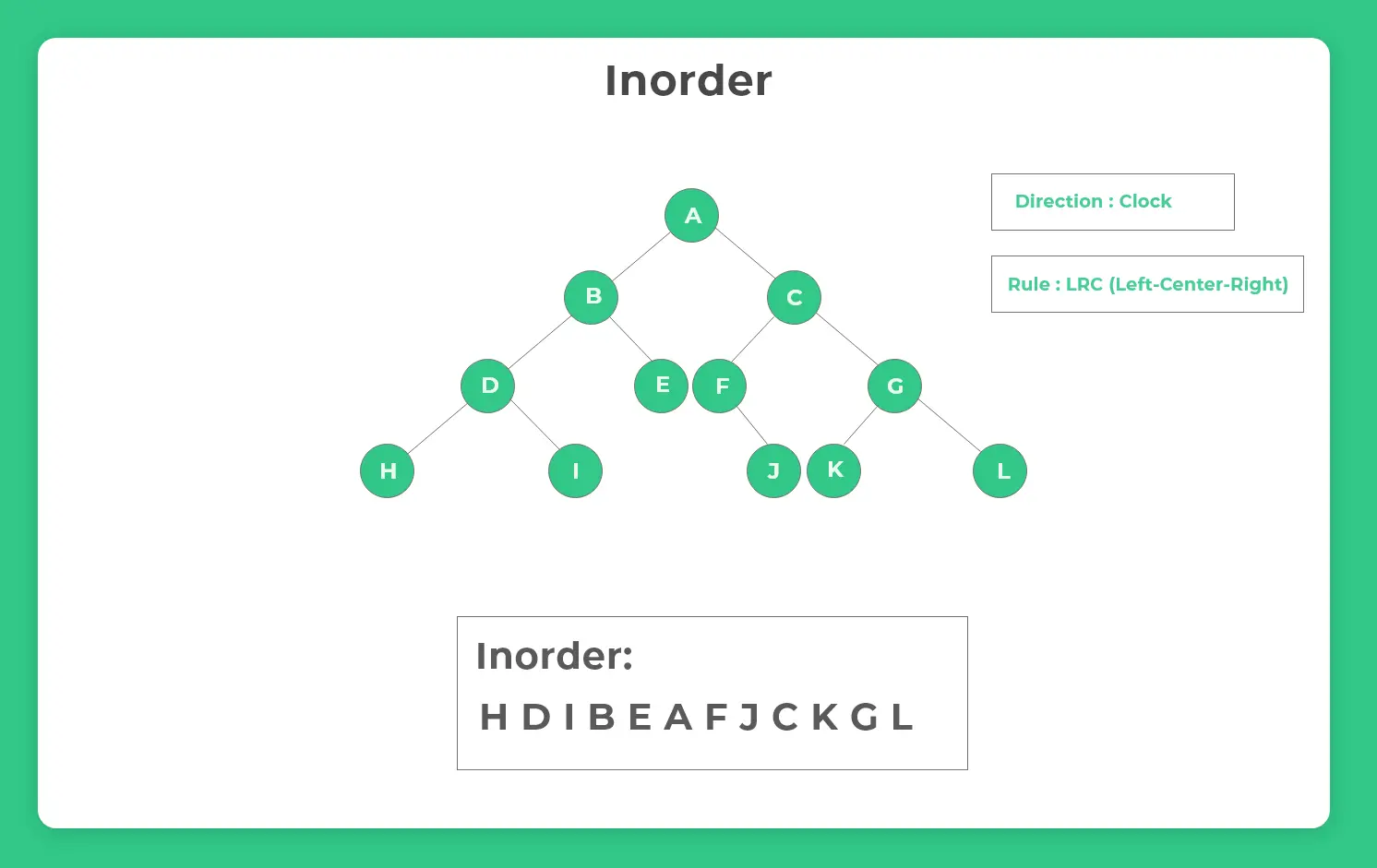
Inorder Traversal (Left – Root – Right)
Use case : To obtain data in sorted order, Binary Search Trees (BST) use this technique.
In contrast to DFS, BFS uses a queue to go from top to bottom and left to right, visiting nodes level by level.
void  levelOrder(struct  Node*  root)   {
     if  (root  ==  NULL)   return;

     struct   Node*  queue [100];
     int  front   = 0,  rear  =  0;
     queue[rear++]  =  root;

     while  (front  <  rear)   {
             struct  Node*  current  = queue [front++];
             print (“%d   “ ,  current ->data);
             if  (current ->left  !=  NULL)  queue[rear++] =     current ->left;
             if  (current ->right != NULL)  queue[rear++]  = current ->right;
         }
}
Applications of Binary Tree Traversal
Compilers use expression trees to evaluate expressions.
File systems: Tree – like structures are used in hierarchical file paths.
Databases: Indexing with variations and B – trees.
AI Decision Tree: For jobs involving regression and classification.
Syntax trees are used in the parsing of computer languages.
Data transport and storage use serialization and deserialization.
Binary Tree Traversal in C programming Course in Noida
This subject is essential if you’re enrolled in or intend to enroll in a C programming course in Noida. The majority of classes stress :
The creation of iterative and recursive traversals routines.
Memory control (free,malloc).
Traversal implementation in lab assignment.
Resolving tree – related interview issues.
Gaining an understanding of binary tree traversal improves your coding abilities and gets you ready for coding interviews and real - world applications.
Time and Space Complexity
Traversal Method
Time Complexity
Space Complexity
Inorder
O(n)
O(h)
Preorder
O(n)
O(h)
Postorder
O(n)
O(h)
Level Order
O(n)
O(n)
n = number of nodes
h = height of the tree
Recursive vs Iterative Traversal
Recursive:
Easier to put into practice
Makes use of the system stack
Stack overflow risk for big trees.
Iterative:
Use a manual stack or queue
Greater control over memory
A little more intricate
Edge Cases to Test in Binary Tree Traversal
One – node tree.
Empty Tree
Unbalanced tree (linked list structure) in its entirety.
Trees with just children on the left or right.
These edge cases guarantee the stability of your implementation.
Binary Tree vs Binary Search Tree (BST)
Feature
Binary Tree
Binary Search Tree
Structure
Each node has less than or equal to 2 children.
Same
Ordering
No specific order.
Left < Root < Right
Use Case
Generic tree problem
Fast search, insert,delete.
Common Mistakes and Debugging Tips
Dereferencing a NULL pointer is typically the source of segmentation faults.
Ignoring to release nodes is a memory leak.
Failure to check the NULL condition results in infinite recursion.
Incorrect Traversal Order: This is a common error made by novices when using traversal logic.
During practical sessions, teachers in C programming courses in Noida will frequently draw attention to these problems.
Conclusion
In data structures, the idea of binary tree traversal is much more than a theoretical subject limited to textbook pages or lectures. It is a cornerstone of the fields of software development, algorithm design,and programming. Binary tree traversal is an essential ability for every developer,whether they are a novice studying data structures in C programming courses in Noida or a seasoned developer getting ready for an interview or working on real time systems.
The sorts of tree traversals – Inorder, Preorder, Postorder, Level Order, and even more complex variations like Morris and Zigzag traversal – were thoroughly examined in this article. Recursive and iterative implementations were covered, along with useful C code samples that are necessary to grasp this topic in programming courses.
However, the usefulness of traversal extends beyond syntax and implementation. Artificial intelligence and machine learning algorithms, as well as file systems, databases, and XML processing, all rely on trees.We can systematically access and alter data thanks to traversals, which makes it possible to do tasks like :
Searching
Sorting
Deletion
Serialization
And even evaluating complex arithmetic expressions
Furthermore,effective traversal can greatly improve application performance in the actual world.The method you traverse a tree affects the result and effectiveness of your program, whether you are using in order traversal to optimize a search in a BST or post order logic to render decision trees in AI.
This subject is frequently included in core assignments, viva questions, and interview preparation modules for students and prospective students enrolled in C programming courses in Noida. Gaining a competitive edge in academics and placements may be achieved by mastering each traversal technique, comprehending its time and space complexity; And using it to solve actual situations.
Therefore, don't simply read about traversal; write, debug, and master it If you are serious about becoming a well-rounded programmer or becoming ready for tech employment at prestigious businesses. Additionally, if you are enrolled in a C programming course in Noida, be sure to utilize the lab sessions, project possibilities, and faculty assistance to put these ideas into practice.
Gaining a solid grasp of binary tree traversal is more than just mastering a subject; it’s laying the groundwork for sophisticated algorithms and scalable software design.
Frequently Asked Questions (FAQs)
Q. What are there multiple types of binary tree traversal?
Each type serves a different purpose - Preorder is used for copying trees or creating prefix expressions, post order is perfect for deleting trees or creating postfix expressions, Level order is helpful for breadth – first problems like shortest path, and inorder retrieves sorted data from a BST.
Q. How is tree traversal used in real – life applications ?
Tasks like file searches, expression evaluation, syntax parsing, compiler development, database indexing, and AI decision making systems are all added by tree traversal. Tree traversal is used in the background by DOM parsers, file directories, and expression trees.
Q. Can we perform traversal without recursion ?
Yes, depending on the type, traversal can be carried out repeatedly using a queue or stack. By employing temporary threaded connections, sophisticated techniques such as Morris Traversal may even carry out inorder traversal without recursion or stack.
Q. What is the difference between DFS and BFS in tree traversal ?
Before advancing laterally, DFS (Depth – First Search) investigates deeper levels using Inorder, Preorder, Postorder traversals. BFS (Breadth – First Search), also known as Level Order traversal, investigates nodes from top to bottom and left to right, level by level.
Q. Is tree traversal possible for trees with more than two children?
Indeed! N – ary trees, Which are employed in file systems and compilers, employ similar traversal techniques to binary trees, which concentrate on nodes with a maximum of two offspring. Recursive DFS or BFS modified for several child nodes are options.
Q. Can two different binary trees have the same Inorder traversal ?
It is possible for many binary trees to have distinct Preorder or Postorder traversals yet the same Inorder traversal. To reconstruct a tree in a unique way, you need either Inorder + Preorder or Inorder + Postorder.