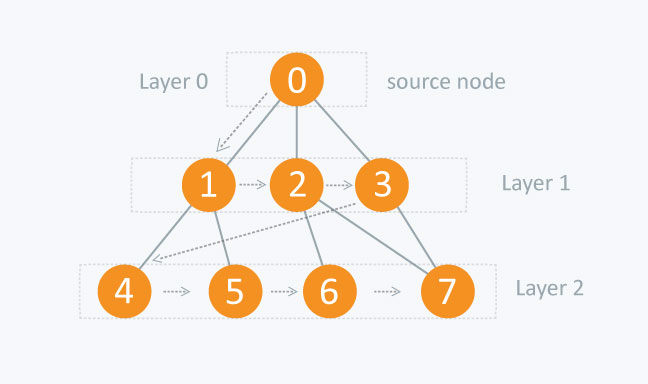
Breadth First Search (BFS) is a key algorithm in the realms of graph theory and computer science. It's particularly handy when you want to explore every node or vertex of a graph, level by level. Whether you're navigating through a maze, mapping out routes in GPS systems, or crawling the web, BFS is an essential tool. In this blog, we’ll take a closer look at the Breadth First Search algorithm, break down its logic, walk through its implementation in C, and uncover its real-world uses.
Breadth First Search (BFS) is an algorithm designed to traverse or search through nodes in a graph or tree structure. It kicks off from a chosen node (often called the source node), explores all its neighboring nodes first, and then continues to the next level of neighbors.
BFS relies on a queue data structure to keep track of which nodes need to be visited, ensuring that nodes are explored in the order they were discovered.
Key Characteristics of BFS
- Level-wise Traversal: BFS checks all nodes at the current depth level before moving on to the next one.
- Queue Based: It employs a First-In-First-Out (FIFO) queue to maintain the order of node visits.
- Shortest Path: In unweighted graphs, BFS can find the shortest path from the source to all other nodes.
Applications of BFS
- Discovering the shortest path in unweighted graphs
- Web crawlers that sift through pages level-by-level
- Social networking platforms to identify friends-of-friends
- Network broadcasting algorithms
- AI applications for solving puzzles like the Rubik’s Cube and various games
How Does BFS Work?
How Does BFS Work? Let’s break it down step by step:
1. Start with a node and mark it as visited.
2. Add that starting node to a queue.
3. Keep repeating these steps until the queue is empty:
- Remove a node from the queue.
- Check out all its neighboring (unvisited) nodes.
- Mark those neighbors as visited and add them to the queue.
Visual Representation of BFS
Copy Code
   0

  / \

 1   2

 |   |

 3   4
BFS starting from node 0 would follow this order:
0 → 1 → 2 → 3 → 4
BFS Algorithm in C
Let’s implement the BFS algorithm in the C programming language.
C Program to Perform BFS on a Graph
Copy Code
#include <stdio.h>

#include <stdlib.h>

#define SIZE 100

int queue[SIZE], front = -1, rear = -1;

int visited[SIZE];

void enqueue(int value) {

if (rear == SIZE - 1)

        printf("Queue is Full\n");

else {

     if (front == -1)

            front = 0;

     rear++;

        queue[rear] = value;

}

}

int dequeue() {

int item;

if (front == -1 || front > rear) {

     return -1;

} else {

     item = queue[front];

     front++;

     return item;

}

}

void bfs(int adj[SIZE][SIZE], int n, int start) {

int i, node;

    enqueue(start);

    visited[start] = 1;

while (front <= rear) {

     node = dequeue();

        printf("%d ", node);

     for (i = 0; i < n; i++) {

         if (adj[node][i] == 1 && !visited[i]) {

                enqueue(i);

                visited[i] = 1;

         }

     }

}

}

int main() {

int n, i, j, start;

int adj[SIZE][SIZE];

    printf("Enter the number of vertices: ");

    scanf("%d", &n);

    printf("Enter the adjacency matrix:\n");

for (i = 0; i < n; i++)

     for (j = 0; j < n; j++)

            scanf("%d", &adj[i][j]);

    printf("Enter the starting vertex: ");

    scanf("%d", &start);

    printf("BFS Traversal: ");

bfs(adj, n, start);

return 0;

}
Time and Space Complexity
Factor
Complexity
Time Complexity
O(V + E)
Space Complexity
O(V) (for visited array and queue)
Where:
- V = number of vertices
- E = number of edge
BFS vs DFS (Depth First Search)
Criteria
BFS
DFS
Strategy
Level-by-level
Depth-based
Data Structure
Queue
Stack (recursive or manual)
Path Finding
Shortest path in unweighted graph
May not find shortest path
Memory Usage
More due to queue
Less (recursive calls)
Advantages of BFS
- Shortest Path: It guarantees the shortest path in unweighted graphs, which is pretty handy.
- Simplicity: It's straightforward to implement and easy to grasp.
- Used in AI: BFS is ideal for finding the closest solution in various AI challenges.
Disadvantages of BFS
- Consumes More Memory: It tends to use more memory because of its queue structure and the need to track visited nodes.
- Less Efficient for Deep Searches: It can be slower when the goal node is far from the starting point.
Practical Use Cases of BFS
1. Pathfinding Algorithms
- BFS is often utilized in:
- Google Maps for calculating the shortest routes.
- Game AI to navigate through maps effectively.
2. Web Crawling
- Search engines employ BFS to crawl websites in a level-by-level manner:
- Starting from the Homepage → then Category Pages → and finally Product Pages.
3. Network Broadcasting
In computer networks, BFS is a great way to efficiently broadcast messages to all nodes.
Why Should You Learn BFS?
Getting a grip on BFS is crucial for:
- Nailing those coding interviews
- Diving into graph analysis
- Crafting algorithms for AI and gaming
Handling Weighted Graphs: When BFS Falls Short
Limitations of BFS in Weighted Graphs
BFS is great for finding the shortest path in unweighted graphs, but it falls short when it comes to graphs with varying edge weights. If the edges have different costs—like distance, time, or energy—the path that BFS finds might not be the best one out there.
For weighted graphs, it’s better to use algorithms like Dijkstra’s or the A* (A-star) search. These methods take edge weights into account and help you find the least-cost path. Knowing when BFS isn’t the right tool and switching to more suitable algorithms is an essential skill for tackling graph-related challenges.
Optimizing BFS for Large-Scale Graphs
As real-world graphs—think social networks or road maps—get larger, BFS can hit some performance snags. Here are a couple of ways to make it better:
- Bidirectional BFS: Instead of just starting from the source node, kick off BFS from both the source and the destination at the same time. When the two search fronts meet in the middle, you can really cut down on the search space and speed things up.
- Avoid Redundant Visits with Visited Sets: Implement a visited set or hash table to keep track of nodes that have already been visited. This helps prevent processing the same node multiple times, which is especially important in dense or cyclic graphs.
These tweaks can help keep BFS efficient and scalable, even in large-scale scenarios.
Learn BFS with Uncodemy
If you’re eager to become proficient in graph algorithms like BFS, DFS, Dijkstra’s, and beyond, think about signing up for Uncodemy’s Data Structures Course in Noida. This course provides a thorough understanding, real-world applications, and hands-on experience with C programming.
Conclusion
The Breadth First Search Algorithm is a fundamental concept in the realm of algorithms, particularly in graph traversal. Its straightforward, level-wise method makes it an invaluable asset in various real-world scenarios, from AI to networking. By mastering BFS and its implementation in C, you’ll be well-equipped to tackle complex graph-related challenges with ease.
Keep honing your BFS skills on various graph types (directed, undirected, weighted) to sharpen your algorithmic thinking. And for a deeper learning journey, don’t miss out on exploring the Data Structures Course in Noida by Uncodemy to elevate your skills to new heights.
Frequently Asked Questions (FAQs)
Q1. What’s the main difference between BFS and DFS?
Ans: BFS, or Breadth-First Search, uses a queue to explore nodes level by level, while DFS, or Depth-First Search, relies on a stack (or recursion) to dive deep into the graph.
Q2. Does BFS always find the shortest path?
Ans: Absolutely! In unweighted graphs, BFS guarantees that you’ll find the shortest path from the starting point to the destination.
Q3. What’s the time complexity of BFS?
Ans: The time complexity is O(V + E), where V represents the number of vertices and E stands for the number of edges.
Q4. Can BFS be used to detect cycles?
Ans: Yes, it can! BFS can identify cycles in undirected graphs by keeping track of which nodes have been visited and their parents.
Q5. Is BFS a recursive algorithm?
Ans: Nope! BFS is an iterative algorithm, and it’s typically implemented using a queue.