Sorting algorithms are a cornerstone of computer science and programming. Among these,
Bubble Sort stands out as one of the most straightforward and easy-to-grasp sorting methods. While it
may not be the fastest option for handling large datasets, it serves as a fantastic starting point for
understanding how sorting functions and how comparisons and swaps work within an array.
In this blog, we’ll take a deep dive into a complete Bubble Sort example in C.
We’ll explore how the algorithm operates, break down its step-by-step logic, and guide you
through implementing it in C with a thorough explanation. Plus, you’ll find sample input and
output, a dry run, optimization tips, and a collection of frequently asked questions at the end.
Whether you’re a student, a newcomer to C programming, or gearing up for coding
interviews, this guide will be an invaluable resource. And if you’re eager to bolster your
programming fundamentals even more, the C Programming Course in Noida by
Uncodemy comes highly recommended.
What is Bubble Sort?
Mr. Irshad Khan / 15
days
11
9 min read
Bubble Sort is a straightforward comparison-based sorting algorithm that
functions by repeatedly traversing the list, comparing adjacent elements, and swapping them if
they’re out of order. This process continues until the list is fully sorted.
The name "bubble" sort comes from the way smaller elements gradually "bubble" up
to the top of the list, while larger elements sink to the bottom through several iterations.
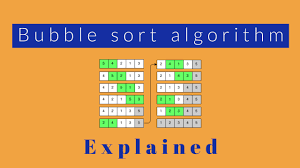
How Bubble Sort Works
Let’s break down how Bubble Sort works:
1. Compare the first two elements in the array.
2. If the first element is greater than the second, swap them.
3. Move to the next pair and repeat the comparison and swap if necessary.
4. Continue this process throughout the array.
5. With each pass, the largest unsorted element is moved to its rightful
position.
6. Repeat the process for the remaining unsorted portion of the array.
7. This continues until no more swaps are needed, signaling that the array is
sorted.
Example of Bubble Sort (Unsorted to Sorted)
Let’s break this down with a straightforward example.
Input Array:
[5, 3, 8, 4, 2]
Pass 1:
First, we compare 5 and 3 → We swap them → [3, 5, 8, 4, 2]
Next, we compare 5 and 8 → No swap needed here.
Then, we look at 8 and 4 → We swap → [3, 5, 4, 8, 2]
Finally, we compare 8 and 2 → Another swap → [3, 5, 4, 2, 8]
Pass 2:
Now, we compare 3 and 5 → No swap.
Next, we check 5 and 4 → We swap → [3, 4, 5, 2, 8]
Then, we compare 5 and 2 → We swap again → [3, 4, 2, 5, 8]
Pass 3:
We start with 3 and 4 → No swap here.
Next, we compare 4 and 2 → We swap → [3, 2, 4, 5, 8]
Pass 4:
Finally, we compare 3 and 2 → We swap → [2, 3, 4, 5, 8]
And just like that, the array is sorted!
Time Complexity of Bubble Sort
Grasping time complexity is crucial when diving into algorithms.
- Worst Case: O(n²)
- Best Case: O(n) – when the array is already sorted
- Average Case: O(n²)
Even though Bubble Sort has a quadratic time complexity, it serves as a great
tool for teaching the fundamental concepts of sorting and comparisons.
Space Complexity
Bubble Sort is an in-place algorithm, which means it only needs a constant amount
of extra space: O(1).
Bubble Sort Algorithm in C
Here's a C program that showcases how the bubble sort algorithm works.
#include

void bubbleSort(int arr[], int n) {
	int i, j, temp;
	for (i = 0; i < n - 1; i++) {
    	// Flag to optimize and break if array is already sorted
    	int swapped = 0;
    	for (j = 0; j < n - i - 1; j++) {
        	if (arr[j] > arr[j + 1]) {
                // Swap adjacent elements if they are in wrong order
                temp = arr[j];
                arr[j] = arr[j + 1];
                arr[j + 1] = temp;
                swapped = 1;
        	}
    	}
    	// If no two elements were swapped in the inner loop, break
    	if (!swapped)
            break;
	}
}

void printArray(int arr[], int size) {
	int i;
	for (i = 0; i < size; i++)
        printf("%d ", arr[i]);
    printf("\n");
}

int main() {
	int arr[50], n, i;

    printf("Enter the number of elements: ");
    scanf("%d", &n);

    printf("Enter the elements:\n");
	for (i = 0; i < n; i++)
        scanf("%d", &arr[i]);

    printf("Unsorted Array:\n");
    printArray(arr, n);

    bubbleSort(arr, n);

    printf("Sorted Array:\n");
    printArray(arr, n);

	return 0;
}
Sample Input and Output
Input
Enter the number of elements: 5 Enter the elements: 5 1 4 2 8
The optimized version of Bubble Sort adds a
little twist by checking if any swaps have taken place during
each pass. If no swaps occur, it means the array is already
sorted, allowing the loop to exit early. This clever tweak helps
cut down on unnecessary comparisons.
In the code provided, the variable `swapped`
keeps track of whether any swaps have happened.
Pros and Cons of Bubble Sort
Advantages
- It's straightforward and easy to grasp.
- Works well for small datasets.
- Achieves linear performance (O(n)) in the
best-case scenario when the array is already sorted.
Disadvantages
- Not ideal for larger datasets.
- Falls short in efficiency compared to other
sorting algorithms like Merge Sort or Quick Sort.
Applications of Bubble Sort
While you won't find Bubble Sort in many
production environments, it does have its moments of usefulness:
- Teaching and learning the basics of sorting
logic.
- Verifying sorting logic in embedded systems
with limited memory.
- Debugging small arrays during the development
of algorithms.
- Practicing optimization techniques and
understanding algorithm complexity.
Related Course
Looking to dive deep into C programming and
tackle advanced sorting algorithms like Merge Sort, Quick Sort,
and Insertion Sort? Check out the C Programming Course
in Noida offered by Uncodemy!
This course is designed to cover the essentials
of programming, data structures, and algorithms, complete with
live coding sessions, real-world projects, and placement
support. Whether you're just starting out or gearing up for tech
interviews, this course will help you build a solid foundation.
Conclusion
Bubble Sort is one of the simplest sorting
algorithms to grasp and implement. While it may not be the most
efficient choice for larger arrays, it serves as a fantastic
introduction to sorting, swapping, and nested loops. The
principles behind Bubble Sort can be applied to more advanced
sorting techniques as you progress in your studies.
In this blog, we took a closer look at how the
Bubble Sort algorithm operates, crafted a complete Bubble Sort
example in C, and guided you through it step-by-step with sample
inputs. We also optimized the algorithm and weighed its
advantages and disadvantages.
If you're eager to move beyond the basics and
gain confidence in writing algorithms in C, consider signing up
for the C Programming Course in Noida at
Uncodemy. It’s a great way to enhance your
programming career with hands-on support!
Frequently Asked Questions (FAQs)
Q1. What is Bubble Sort used
for?
Bubble Sort is primarily used in educational
environments to help students grasp the concepts behind sorting
algorithms and comparisons. It can also be handy for systems
that deal with very small data sets.
Q2. Why is Bubble Sort not
efficient?
It has a time complexity of O(n²) for both the
worst and average cases, which makes it quite inefficient when
working with larger datasets.
Q3. Can Bubble Sort be
optimized?
Absolutely! You can optimize it by introducing a
flag variable to check if any swaps were made during the current
pass. If no swaps occur, it means the array is already sorted.
Q4. Is Bubble Sort stable?
Yes, Bubble Sort is considered a stable sorting
algorithm. It maintains the relative order of elements that have
the same value.
Q5. What is the best-case time complexity
of Bubble Sort?
The best-case time complexity is O(n), which
happens when the array is already sorted.
Q6. What is the space complexity of
Bubble Sort?
It's an in-place algorithm, which means it only
requires O(1) additional space.
Q7. Where can I practice more sorting
algorithms?
You can hone your skills in sorting algorithms by
signing up for the C Programming Course in Noida offered by
Uncodemy. This course provides access to a variety of exercises
and hands-on projects.