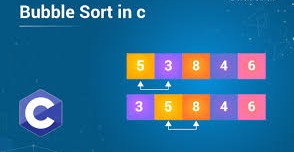
Bubble Sort Program in C with Explanation
Bubble Sort algorithm is an easy comparison sorting method which reiterates through a list,
contrasts neighbors, and swaps them should they be out of sequence order. One goes on with
this until the list is sorted, and bigger elements figuratively bubble up to their
appropriate places.
The Way Bubble Sort Works
The bubble sort algorithm works by making several passes over the array to put the objects
into their desired position which is usually ascending or descending. In the case of sorting
in ascending order, the algorithm will scan elements and compare those that are next to each
other and swap those two elements provided the element first is greater than the second.
Step-by-Step Process
As an example, let there be an array to be sorted in the ascending order:
° First Iteration: Then the comparison of the first and the second elements
of the array starts. The two elements are exchanged in case one of them is greater than the
other one. This comparison and possible swapping then happens with the second and third
elements and so on and so forth until the end of the array is reached.
° Subsequent Iterations: The same procedure of comparison and swapping is
again done again in further iterations. At the end of every complete iteration the largest
unsorted element is shifted to the proper position at the last of the unsorted segment of
the array. The comparisons at every next stage are made only until the last unsorted
element. An array is said to be overflowed when the unordered elements are put in place of
their correct places.
This is illustrated by an example:
- The algorithm compares the first two elements (5 and 1), and swaps them since 5 > 1
hence, the algorithm then leads to.
- then compared 5 and 4, doing a swap to obtain.
- Comparison of 5 with 2 results in a swap giving a yield of.
- Last, 5 and 8 are compared, and there is no exchange since these two numbers are sorted.
This pass relocates the biggest element (8) at the last position in the unsorted
area. This is repeated in the next pass until the end when the array would be fully
sorted.
Time and Space Complexity of Bubble Sort
Knowledge of the performance properties of the sorting algorithms i.e. time and space
complexities of the sorting algorithms plays a very important role in choosing the most
suitable algorithm to be used to perform a certain task.
Time Complexity
Bubble Sort has time complexity that is different when used on an array in different initial
states:
- Worst-Case Complexity: The worst-case scenario of Bubble
Sort:𝑂(𝑛2)O(n2). This is when the array is made of the biggest to smallest value and
is to be made into smallest to the biggest one such that it takes the maximum number of
comparisons and swaps. Here the algorithm traverses the array about n 1 times, and each
in turn, and each makes a smaller and smaller number of comparisons, which added up to
𝑛(𝑛−1)/2 Approximately, a number of n(n-1)/2 comparisons. 𝑛2n2.
- Average-Case Complexity: The average-case time complexity is also
𝑂(𝑛2)O(n2) . This is true in the cases where array elements are in some random (not
ascending or descending) order.
- Best-Case Complexity: Bubble Sort has best-case time complexity: O(n).
This is when the array is almost sorted, and the algorithm has to make only one pass to
be sure that it does not need to make any swaps. Improved versions of Bubble Sort may
terminate early when they find during a pass that no swaps have taken place, so they are
more efficient on already sorted or nearly sorted arrays.
Space Complexity
The space complexity of Bubble Sort is O(1). This is to say that it is an in-place algorithm,
in the sense that it has no more than a constant extra memory needed (to store a temporary
variable used during swaps) no matter what size of input is to be processed.
Sorting with Advantages and Disadvantages Bubble Sort
Despite its simplicity, Bubble Sort has certain advantages and disadvantages that determine
its practice.
Advantages
Simplicity: Based on simplicity, bubble sort is simple to comprehend as well
as easy to implement; hence, a good algorithm to teach a basic sorting algorithm.
Minimal Memory: It needs no more memory than a single temporary variable to
act as a stack to perform swapping, that is, it is an in-place sorting algorithm.
Stability: The Bubble Sort is a stable sorting algorithm i.e. input elements
with same values are ending in their relative order in the result of the sort.
Adaptive: It is able to work effectively on nearly-sorted lists and can beat
other algorithms such as quicksort on these special cases.
Disadvantages
Inefficiency on Large Datasets: Lack of Proper Result in an average and
worst-case setting of time complexity. 𝑂(𝑛2)O(n2) so Bubble sort is extremely slow with
large amounts of data and as such is not practical to most real world uses involving large
amounts of data.
Little Real Life Uses: Bubble Sort has limited practical use in real life
because it has high time complexity and is almost exclusively utilized as a demonstration
method to illustrate how sorting functions. More effective algorithms such as quick sort,
time sort or merge sort are usually used.
Performs many writes and cache misses: Because a wide variety of CPU
hardware may be affected, this may translate into generally worse performance than other
sorting algorithms such as insertion sort.
C Program of Bubble Sort
Bubble Sort in C is done through the use of inner loops to traverse the array taking its
elements two by two, and comparing.
C Code explanation:
° #include <stdio.h>: This is a line that includes the standard
input/output library in C language and gives functions such as the printf to print out the
output.
° void bubbleSort(int array, int size): The function accepts an array as
(integer) parameter and size. It has loops within loops, to apply the sorting logic.
- Outer Loop (for (int step = 0; step < size -1; ++step)): It is
executed size - 1 times. At every iteration, the biggest unsorted element rises to
the top, to its correct location at the end of the unused portion of the array.
- Inner Loop (for (int i = 0; i < - step - 1; +i)): Inner loop
loops through the part of the array that is not sorted. The step - 1 part
guarantees that the element that has been sorted before in the previous passes will not
be compared again.
- Comparison and Swap (if (array > array)): Within the inner loop
adjacent elements array and array are compared. In case array is larger than array
(in case of ascending order) then array and array are swapped through variable
temp. In order to sort in descending order the > sign must be replaced with
<.
° void printArray(int array, int size): It is a helper function and
traverses the array and prints its elements.
° int main(): It is the main part in which the program execution starts.
- int data [{ - 2, 45, 0, 11, - 9 }]: The data is an array of type
integer, which is not sorted.
- int size = sizeof(data)/sizeof(data);: This will
give the amount of data within the array of data.
- bubbleSort(data, size);: This is to invoke bubbleSort.
- printf("Sorted Array in Ascending Order:"");: A line is printed to give
out the resulting message of the sorted array.
- printArray(data, size);: The sorting is printed using the printArray
command.
C Optimized Bubble Sort Program
Bubble Sort may terminate early when a pass completes without any two-way exchanges, thus the
array is already in order. With such an optimization, a boolean variable (or int flag
in C) is added to indicate whether or not there were swaps.
Description of Optimised C Code:
- bool swapped = false;: A swapped boolean is set to false as every
iteration of the outer loop starts.
- swapped = true;: In the inner loop swapped is true in case there is any
element swapping.
- if (swapped == false) { break; }: At the end of every entire run within
the inner loop, this condition ascertains the status of swapped, whether it is false or
not. When no swaps are made the array should already be sorted and the program
breaks the outer loop using break and this will make a huge difference in the running
time of the partially or fully sorted arrays.
Data Structure and Algorithms in C Uncodemy Courses
In case you want to know more about such kinds of data structures and algorithms like Bubble
Sort, Uncodemy has effective training. Uncodemy has a superior quality C With Data
Structure bootcamp in Noida, which is guided by industry veterans. Their C With Data
Structure certification training in Noida has produced many successful professional careers
on the part of their students.
C with Data Structure and Algorithm Training Course: This course aims at
offering a detailed understanding of C programming as well as necessary data structures and
algorithms.
Data Structure and Algorithm Training Course in Delhi: This course
introduces a number of sorting algorithms such as Bubble Sort amongst other basics of data
structures and algorithms.
Uncodemy focuses on applied training that includes individual grooming classes to enable the
students to master the use of C with data structures. They too provide the flexibility
in learning through live and online training which is the same as the conventional classroom
training and serves working professionals and those who are at distant
locations. Uncodemy has established good industry relations, as the tutors are also
working in reputed MNCs and start-ups, whereas placement is secured with companies, such as
CISCO, Adobe, McKinsey & Company, and IBM.