Bubble Sort Program with Code and Explanation: A Beginner’s Guide
Sorting is probably one of the most important concepts in computer science and computer programming. Sorting is used to organize data, search data efficiently, and improve performance. You will need to understand sorting algorithms if you want to be able to organize things well. If you are taking Uncodemy's data structure course in Noida, I can guarantee you will see the bubble sort program early on in your course. Bubble sort is a long-time standard in programming education because it is a friendly algorithm, meaning that it is very easy to understand, and it can be straightforward to code, making it a good algorithm to start with for beginner programmers.
Bubble Sort Program with Code and Explanation: A Beginner’s Guide
Mr. Bambam Kumar Yadav/ 3 days ago
15
11 min read
This article will have a deep dive into the bubble sort program - how it works, sample code, benefits and cons, and real-life situations where you might choose to use a bubble sort program to sort elements. By the end of this article, you should have a complete understanding of bubble sort, which is why I left bubble sort to last in the proper order to learn data structures.
What is Bubble Sort?
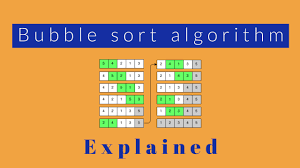
Bubble sort is a simple sorting algorithm that repeatedly swaps adjacent elements if they are in the wrong order. With each complete pass through the list, the largest unsorted element is bubbled into its correct position.
Imagine bubbles rising to the surface of water — similarly, the largest numbers “rise” to the end of the array step by step. This intuitive process is why it’s called bubble sort.
Why Learn Bubble Sort?
You might wonder, “Is bubble sort really useful given its inefficiency?” The answer is yes. This is especially true if you’re starting your journey in data structures, such as in Uncodemy’s data structure course in Noida.
Simplicity: Bubble sort is easy to understand and use.
Foundation: It introduces important concepts like nested loops, swapping, and optimizing algorithms.
Educational: It helps you grasp the basics of algorithm analysis and complexity.
Stability: Bubble sort is a stable sort, which means it preserves the order of equal elements.
Even though bubble sort is not efficient for large datasets, its educational value makes it a standard in beginner courses.
How Does the Bubble Sort Program Work?
At its core, the bubble sort program compares adjacent elements and swaps them if they are out of order. This process repeats until the entire list is sorted.
Step-by-step process:
Start at the beginning of the array.
Compare the current element with the next element.
If the current element is greater than the next, swap them.
Move one position forward and repeat the comparison.
After the first pass, the largest element will be at the end.
Repeat the process for the remaining unsorted elements.
Stop when no swaps are needed in a full pass.
Example
Consider the array: ``
Pass
Compare 5 and 1 → swap → Compare 5 and 4 → swap →
Compare 5 and 2 → swap → Compare 5 and 8 → no swap →
Pass 2:
Compare 1 and 4 → no swap
Compare 4 and 2 → swap → ``
Compare 4 and 5 → no swap
Compare 5 and 8 → no swap
Pass 3:
Compare 1 and 2 → no swap
Compare 2 and 4 → no swap
Compare 4 and 5 → no swap
No swaps in Pass 3 means the array is sorted.
Bubble Sort Algorithm: Pseudocode
                        procedure bubbleSort(array)
                        n = length(array)
                        repeat
                            swapped = false
                            for i = 1 to n-1
                                if array[i-1] > array[i]
                                    swap(array[i-1], array[i])
                                    swapped = true
                            n = n - 1
                        until not swapped
                    end procedure
Bubble Sort Program: Code Examples
Here are implementations of the bubble sort program in three popular programming languages.
Python
                        def bubble_sort(arr):
                        n = len(arr)
                        for i in range(n):
                            swapped = False
                            for j in range(0, n - i - 1):
                                if arr[j] > arr[j + 1]:
                                    arr[j], arr[j + 1] = arr[j + 1], arr[j]
                                    swapped = True
                            if not swapped:
                                break
                        return arr

                    # Example usage
                    numbers = [5, 1, 4, 2, 8]
                    print("Sorted array:", bubble_sort(numbers))
C++
                    #include
                    using namespace std;

                    void bubbleSort(int arr[], int n) {
                        for (int i = 0; i < n - 1; i++) {
                            bool swapped = false;
                            for (int j = 0; j < n - i - 1; j++) {
                                if (arr[j] > arr[j + 1]) {
                                    swap(arr[j], arr[j + 1]);
                                    swapped = true;
                                }
                            }
                            if (!swapped) break;
                        }
                    }

                    int main() {
                        int arr[] = {5, 1, 4, 2, 8};
                        int n = sizeof(arr) / sizeof(arr[0]);
                        bubbleSort(arr, n);
                        cout << "Sorted array: ";
                        for (int i = 0; i < n; i++) {
                            cout << arr[i] << " ";
                        }
                        return 0;
                    }
JAVA
                        public class BubbleSort {
                        public static void bubbleSort(int[] arr) {
                            int n = arr.length;
                            boolean swapped;
                            for (int i = 0; i < n - 1; i++) {
                                swapped = false;
                                for (int j = 0; j < n - i - 1; j++) {
                                    if (arr[j] > arr[j + 1]) {
                                        int temp = arr[j];
                                        arr[j] = arr[j + 1];
                                        arr[j + 1] = temp;
                                        swapped = true;
                                    }
                                }
                                if (!swapped) break;
                            }
                        }

                        public static void main(String[] args) {
                            int[] arr = {5, 1, 4, 2, 8};
                            bubbleSort(arr);
                            System.out.print("Sorted array: ");
                            for (int num : arr) {
                                System.out.print(num + " ");
                            }
                        }
                    }
Advantages and Disadvantages of Bubble Sort
Advantages
Very simple and easy to understand.
Requires no additional memory; it sorts in place.
Stable sort, so it does not change the relative order of equal elements.
Useful for small or nearly sorted datasets.
Helps beginners understand sorting concepts and how to design algorithms.
Disadvantages
Inefficient for large datasets because of O(n²) time complexity.
Performs unnecessary comparisons even if the array is nearly sorted, unless optimized.
Not suitable for applications that need high performance.
Bubble Sort Variations and Optimizations
1. Optimized Bubble Sort with Early Exit
You can improve the standard bubble sort by adding a flag to check if any swaps occurred during a pass. If no swaps happen, the array is already sorted, and the algorithm can stop early. This improvement is shown in the code examples above.
This version sorts in both directions during each pass. It moves the largest elements to the end and the smallest elements to the start.
How it works:
- Move through the list forward, bringing the largest element up.
- Move backward, bringing the smallest element down.
- Repeat until no swaps happen.
This method can be quicker on some datasets.
Bubble Sort in Real-World Applications
Despite its inefficiency, the bubble sort program has some practical applications.
Educational Tool: It’s a great way to introduce sorting concepts in courses like Uncodemy’s data structure course in Noida.
Small Datasets: It works well with very small or nearly sorted data.
Embedded Systems: Sometimes, it is used in systems with very limited memory where simplicity is more important than speed.
Detecting Nearly Sorted Data: The early exit optimization helps determine if the data is already sorted.
Bubble Sort vs Other Sorting Algorithms
Algorithm
Best Case
Average Case
Worst Case
Space Complexity
Stable?
Bubble Sort
O(n)
O(n²)
O(n²)
O(1)
Yes
Insertion Sort
O(n)
O(n²)
O(n²)
O(1)
Yes
Selection Sort
O(n²)
O(n²)
O(n²)
O(1)
No
Merge Sort
O(n log n)
O(n log n)
O(n log n)
O(n)
Yes
Quick Sort
O(n log n)
O(n log n)
O(n²)
O(log n)
No
Bubble sort is often outperformed by more advanced algorithms but remains a valuable learning tool.
Why Choose Uncodemy’s Data Structure Course in Noida?
If you want to master algorithms and data structures, signing up for Uncodemy’s data structure course in Noida is a smart move. Their curriculum explores foundational topics, such as the bubble sort program, in detail. You will get hands-on coding practice, expert guidance, and experience solving real-world problems.
The course helps you:
- Understand key data structures and sorting algorithms.
- Implement algorithms efficiently in various programming languages.
- Prepare for technical interviews with confidence.
- Build a solid foundation for advanced computer science topics.
Wrapping Up Bubble Sort: More Than Just a Bubble
While the bubble sort program may appear simple and slow next to modern algorithms, its role in learning data structures is significant. It's an excellent starting point for beginners to grasp sorting logic, algorithmic thinking, and complexity analysis.
If you're taking Uncodemy's data structure course in Noida, mastering bubble sort will help you tackle more complex algorithms easily.
Frequently Asked Questions (FAQs)
Q: Is bubble sort suitable for large datasets?
A: No, bubble sort’s O(n²) time complexity makes it inefficient for large datasets.
Q: What makes bubble sort stable?
A: It only swaps adjacent elements when necessary, preserving the order of equal elements.
Q: Can bubble sort be optimized?
A: Yes, by adding a flag to detect if no swaps occurred during a pass, allowing early termination.
Q: How does bubble sort compare to insertion sort?
A: Both have similar time complexities, but insertion sort tends to perform better on nearly sorted data.
Q: Where can I practice bubble sort?
A: You can practice on coding platforms like HackerRank, LeetCode, or during your coursework at Uncodemy.