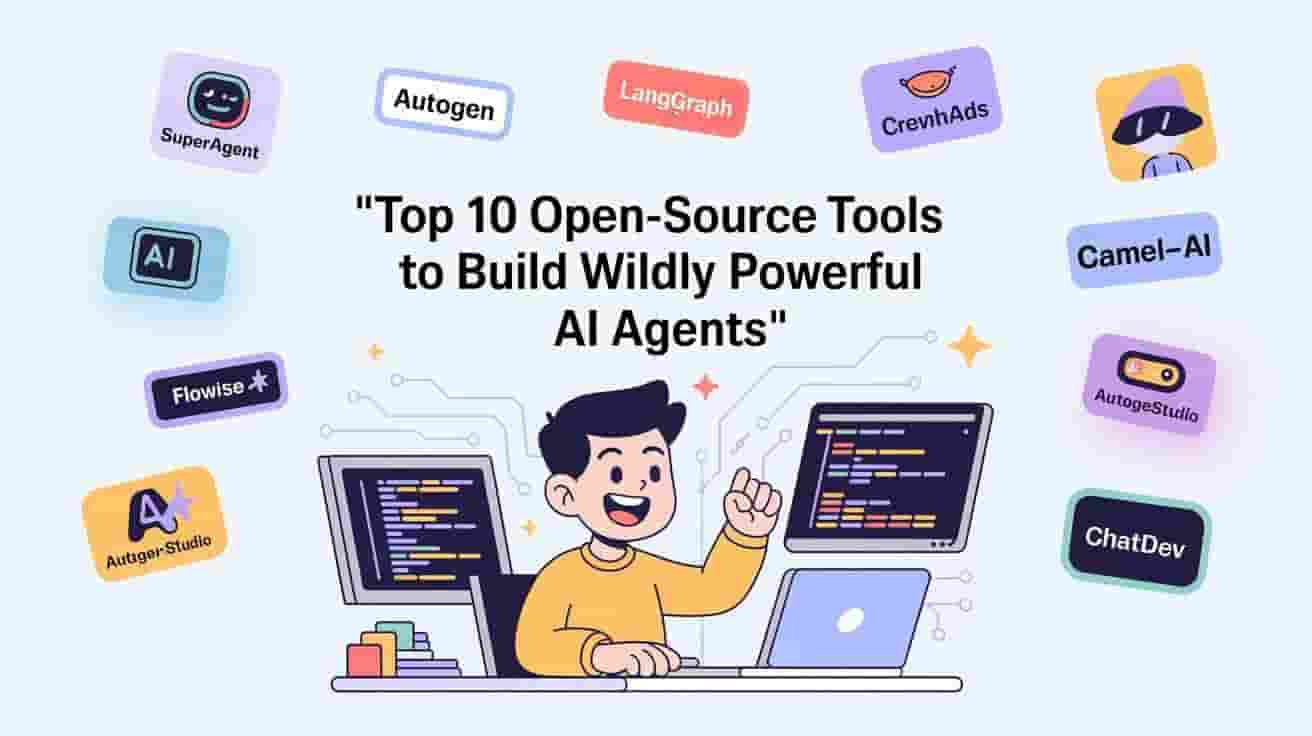
The Advantage of Open-Source AI in Application Development
The open-source movement has profoundly impacted AI development, offering several compelling benefits:
· Accessibility and Cost-Effectiveness: Open-source AI frameworks and models are typically free to use, significantly reducing development costs. This democratizes AI innovation, allowing smaller teams and individual developers to experiment and build without large upfront investments.
· Transparency and Auditability: Unlike proprietary AI, open-source code is publicly available for inspection. This transparency is crucial for understanding how AI models work, identifying potential biases, and ensuring ethical deployment—especially important for applications in sensitive domains.
· Flexibility and Customization: Developers have full control over the code, allowing for deep customization and fine-tuning of AI models to meet specific application requirements. This adaptability is vital for creating highly specialized and performant AI-powered apps.
· Community Support and Innovation: Open-source projects thrive on vibrant communities. This means access to extensive documentation, forums, tutorials, and a global network of developers contributing to continuous improvement, bug fixes, and new feature development.
· Interoperability: Open-source tools often integrate seamlessly with other open-source and proprietary technologies, fostering a more flexible and interconnected development ecosystem.
Key Open-Source AI Tools and Frameworks in 2026
The open-source AI ecosystem is rich and diverse, offering tools for every stage of AI application development:
· Machine Learning Frameworks:
o TensorFlow (Google): A comprehensive open-source platform for machine learning, offering tools, libraries, and community resources for building and deploying ML-powered applications. It's highly flexible and supports various AI models, from simple neural networks to complex Large Language Models (LLMs).
o PyTorch (Meta): Known for its flexibility and ease of use, PyTorch is a popular choice for deep learning research and rapid prototyping. Its dynamic computation graph makes it ideal for experimental AI development.
o Scikit-learn: A foundational machine learning library for Python, providing simple and efficient tools for data mining and data analysis. It's excellent for traditional ML algorithms and serves as a stepping stone to deep learning.
· Natural Language Processing (NLP) Libraries:
o Hugging Face Transformers: This library has become the go-to resource for working with state-of-the-art LLMs and pre-trained transformer models. It provides easy access to models like BERT, GPT-2, T5, and many others, enabling developers to build powerful NLP applications such as chatbots, sentiment analysis tools, and text summarizers.
o NLTK (Natural Language Toolkit): A comprehensive Python library for NLP, offering tools for tokenization, stemming, tagging, parsing, and classification. It's excellent for foundational NLP tasks.
o SpaCy: Designed for production use, SpaCy is an efficient NLP library for industrial-strength text processing, including named entity recognition, dependency parsing, and text classification.
· Computer Vision Libraries:
o OpenCV (Open-Source Computer Vision Library): A widely used library for computer vision and machine learning, offering tools for image and video analysis, object detection, facial recognition, and more. It's crucial for building AI apps that interact with visual data.
o Pillow (PIL Fork): A user-friendly Python imaging library essential for basic image manipulation tasks before feeding them into computer vision models.
· Data Science and Analytics Tools:
o Pandas: A powerful Python library for data manipulation and analysis, essential for preparing and cleaning data before it's used to train AI models.
o NumPy: The fundamental package for scientific computing with Python, providing support for large, multi-dimensional arrays and matrices, along with a collection of mathematical functions.
o Matplotlib & Seaborn: Python libraries for data visualization, crucial for understanding AI model performance, exploring data, and presenting insights.
· Deployment and MLOps Tools:
o Docker: An open-source platform for containerizing applications, enabling consistent deployment of AI models across different environments.
o Kubernetes: An open-source system for automating deployment, scaling, and management of containerized applications, ideal for managing complex AI workloads.
o MLflow: An open-source platform for managing the machine learning lifecycle, including experimentation, reproducibility, and deployment.
The Process of Building AI-Powered Apps with Open-Source Tools
Building an AI-powered application using open-source tools generally follows a structured approach:
1. Problem Definition and Data Collection: Clearly define the problem your AI app will solve. Identify and gather relevant datasets. This often involves web scraping, accessing public datasets, or collecting proprietary data.
2. Data Preprocessing and Feature Engineering: Clean, transform, and prepare your data. This critical step involves handling missing values, normalizing data, and creating new features that can improve model performance.
3. Model Selection and Training: Choose an appropriate open-source AI model or machine learning algorithm (e.g., from TensorFlow, PyTorch, Hugging Face). Train the model on your prepared data, iteratively adjusting parameters to optimize performance.
4. Model Evaluation and Fine-tuning: Evaluate the model's accuracy and performance using various metrics. Fine-tune the model, experiment with different architectures, and optimize hyperparameters to achieve desired results.
5. Application Development: Integrate the trained AI model into your application's architecture. This could involve building a web interface (using frameworks like Flask, Django, React), a mobile app, or a backend service that interacts with the AI model.
6. Deployment and Monitoring: Deploy your AI-powered app to a production environment (e.g., cloud platforms using Docker and Kubernetes). Continuously monitor the model's performance in real-world scenarios, retrain as needed, and update the application.
Challenges and Considerations
While open-source AI offers many advantages, developers must be aware of potential challenges:
· Complexity: Some open-source AI frameworks can have a steep learning curve, requiring a solid understanding of machine learning concepts and programming.
· Resource Intensity: Training and deploying large AI models can still require significant computational resources (GPUs, cloud infrastructure), even if the software itself is free.
· Maintenance and Support: While communities are vibrant, dedicated enterprise-level support might be less structured compared to proprietary solutions.
· Ethical AI: Ensuring fairness, transparency, and mitigating bias in AI models developed with open-source tools requires diligent effort and ethical considerations throughout the development lifecycle.
Uncodemy Courses for Building AI-Powered Apps
To effectively build AI-powered applications using open-source tools, a strong foundation in AI, machine learning, data science, and programming is essential. Uncodemy offers several courses that can equip you with these critical skills:
· AI & Machine Learning Courses: These courses provide the fundamental knowledge of AI concepts, machine learning algorithms, deep learning, and neural networks. You'll learn how to train, evaluate, and deploy AI models using open-source frameworks like TensorFlow and PyTorch, which are crucial for the core AI functionality of your apps.
· Data Science Courses: Building effective AI apps starts with data. Our Data Science courses teach you how to collect, clean, preprocess, analyse, and interpret data using open-source Python libraries like Pandas and NumPy. This is vital for preparing the high-quality datasets needed to train robust AI models.
· Full Stack Development Course: To integrate your AI models into functional applications, full stack development skills are indispensable. This course teaches you to build both the front-end (user interface) and back-end (server-side logic, database interaction) of web applications, enabling you to create complete AI-powered apps that users can interact with.
· Python Programming Course: Python is the lingua franca of AI and data science. Our Python Programming course provides a strong foundation in this versatile language, which is essential for working with almost all open-source AI libraries and frameworks.
· Prompt Engineering Course: While not directly for building the AI model, Prompt Engineering is crucial for designing AI-powered apps that interact with users through natural language. If your app uses an LLM (e.g., for a chatbot or content generation feature), this course teaches you how to craft effective inputs to guide the AI and ensure its intelligent behaviour within your application.
Conclusion
The open-source AI ecosystem offers an incredible opportunity for developers to build innovative and powerful AI-powered applications in 2026. By leveraging robust frameworks like TensorFlow and PyTorch, coupled with specialized libraries for NLP and computer vision, developers can create solutions that automate tasks, provide intelligent insights, and enhance user experiences. While challenges exist, the benefits of flexibility, transparency, and community support make open-source AI an increasingly attractive path. For aspiring AI developers and data scientists, acquiring the foundational and advanced skills offered by Uncodemy courses is key to mastering these tools and contributing to the next wave of AI innovation. The future of Artificial Intelligence development is open, collaborative, and full of potential.