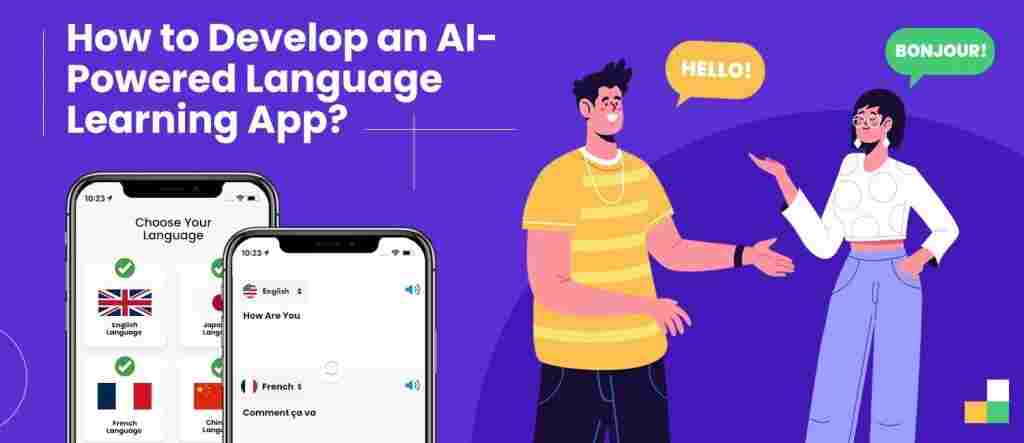
Building an AI-powered language learning mobile app requires combining educational psychology, advanced machine learning, and user-friendly app design. Such an app doesn’t just provide vocabulary lists or grammar rules; it actively adapts to the user’s learning style, tracks progress, and delivers meaningful feedback in real time. To design and develop such an app, developers must focus on multiple layers–from user interface to AI algorithms–that collectively create an immersive and effective language-learning environment.
Understanding the Need for AI in Language Learning
Traditional apps often follow a one-size-fits-all approach, where every learner receives the same lessons in the same order. The problem is that language acquisition is highly personal. Some learners excel in vocabulary memorization, while others may focus better on grammar rules or conversational practice. AI bridges this gap by analyzing user behavior, mistakes, and learning pace to tailor lessons accordingly.
For instance, if a learner struggles with verb conjugation but easily remembers nouns, the AI can design future lessons with more verb-focused exercises, while maintaining reinforcement for mastered concepts. Similarly, natural language processing (NLP) allows AI to evaluate spoken input, correct pronunciation, and provide conversational practice with chatbots that simulate real dialogue. This ensures that learners receive a holistic language-learning experience without needing a tutor by their side.
Key Features of an AI-Powered Language Learning App
When building such an app, the inclusion of AI should not just be a buzzword. Instead, it must power features that genuinely improve learning outcomes. Some of the essential features include:
1. Personalized Learning Path
AI can assess a user’s proficiency through initial tests or interactions. Based on results, the app can generate a custom learning path that focuses on weak areas while not wasting time on already mastered topics. This adaptive system keeps users motivated by balancing difficulty with achievement.
2. Speech Recognition and Pronunciation Feedback
One of the hardest parts of language learning is speaking correctly. AI-powered speech recognition tools can analyze a learner’s pronunciation, detect errors, and provide instant corrective feedback. This not only builds confidence but also mimics real-world conversation practice.
3. Conversational Chatbots
NLP-driven chatbots allow learners to engage in interactive dialogues, making practice sessions more realistic. These bots can be programmed to cover different contexts–such as ordering food in a restaurant, making small talk, or attending a business meeting. Over time, the chatbot adapts to the learner’s progress and introduces more complex scenarios.
4. Smart Vocabulary Builder
AI can track which words a learner frequently forgets and ensure they appear more often in future exercises. It can also suggest synonyms, antonyms, and contextual usage to deepen understanding. By embedding spaced repetition algorithms, vocabulary retention improves significantly.
5. Progress Tracking and Analytics
Data analytics powered by AI helps learners see their improvement over time. Graphs, streak counters, and milestone badges provide motivation while giving a clear view of strengths and weaknesses.
6. Gamification with AI Insights
Games such as quizzes, puzzles, and timed challenges can be tailored by AI to match the learner’s level. For example, if a user has mastered beginner vocabulary, the AI can automatically introduce intermediate-level challenges to avoid stagnation.
Designing the App Architecture
An AI-powered language learning app requires a robust architecture that can handle heavy computation while remaining accessible on mobile devices.
1. Frontend Design (User Interface):
The app should be visually appealing, simple, and intuitive. Users must be able to access lessons, exercises, and progress reports without difficulty. Interactive animations, minimalistic icons, and easy navigation are essential.
2. Backend (Data Processing and AI Models):
The backend must handle user data securely while running AI algorithms. Models like NLP, speech recognition, and adaptive learning engines must be integrated into the system. Cloud computing can ensure scalability for a growing user base.
3. Database Management:
A strong database is required to store vocabulary lists, grammar modules, user progress, and AI-generated feedback. Proper encryption and data privacy protocols are vital for maintaining user trust.
4. API Integration:
APIs can help integrate external resources such as translation engines, speech recognition software, or dictionaries. This reduces development time and allows access to high-quality features.
Technology Stack for Development
To create such a sophisticated application, developers must use a blend of modern technologies:
Programming Languages: Flutter (for cross-platform development), Python (for AI model development).
AI and Machine Learning Frameworks: TensorFlow, PyTorch, Scikit-learn.
NLP Tools: SpaCy, Hugging Face Transformers, Google Dialogflow.
Speech Recognition APIs: Google Speech-to-Text, Azure Cognitive Services.
Databases: Firebase, MongoDB, or PostgreSQL for user data and lesson storage.
Cloud Services: AWS, Google Cloud, or Microsoft Azure for AI model deployment and scalability.
Challenges in Development
Building an AI-powered language learning app isn’t without obstacles. Developers must overcome technical, ethical, and educational challenges.
1. Accuracy of Speech Recognition:
Different accents, speech patterns, and background noise can make it difficult for AI to assess pronunciation correctly. Ensuring high accuracy is critical for a good learning experience.
2. Data Privacy:
Since the app collects sensitive data like voice recordings and user progress, strict privacy protocols must be in place. Compliance with data protection laws such as GDPR is essential.
3. Content Quality:
AI can assist in structuring lessons, but the content itself must be accurate and culturally relevant. Poor-quality lessons could lead to ineffective learning.
4. Technical Accessibility:
The app must function smoothly on devices with varying processing power and internet connectivity. Offline features can be a valuable addition.
Benefits for Learners
An AI-powered language learning app offers several benefits:
Flexibility: Learn anytime, anywhere, without needing a tutor.
Personalization: Lessons adapt to individual needs, making learning more efficient.
Confidence Building: Real-time feedback improves speaking and writing skills faster than static lessons.
Engagement: Gamified learning keeps users motivated.
Scalability: Learners across the world can access the same quality education.
The Future of AI in Language Learning
As AI technology advances, language learning apps will become even more immersive. Augmented Reality (AR) could allow learners to practice in simulated environments, such as walking through a virtual French café. Virtual Reality (VR) could make international immersion possible without leaving one’s home. Furthermore, as generative AI improves, chatbots will become indistinguishable from human conversation partners, providing endless practice opportunities.
AI-powered translation tools may also integrate seamlessly into learning apps, allowing users to switch between their native language and the target language effortlessly. This will blur the line between learning and real-world communication, accelerating fluency like never before.
Final Thoughts
In today’s fast-paced and ever-changing world, education has become more than just textbooks and classrooms–it is about adaptability, innovation, and accessibility. This is where Uncodemy truly makes a mark. It isn’t just another learning platform; it is a bridge that connects learners to opportunity, professionals to growth, and dreamers to the tools they need to build a meaningful career. What makes Uncodemy stand out is not just the range of courses it offers, but also the way it prioritizes real-world application over rote theory. The focus on practical, job-ready skills ensures that students don’t just learn concepts but actually gain the confidence to implement them in professional scenarios.
Equally important is how Uncodemy fosters inclusivity. Whether someone is a fresher stepping into the competitive world of jobs or a working professional looking to upskill, the platform provides flexibility and mentorship that adapts to their journey. With industry experts guiding the way, learners are never left on their own–they are mentored, supported, and encouraged at every stage. This guidance builds not only technical expertise but also confidence and resilience, qualities that are essential in today’s workplace, especially for those enrolled in an Artificial Intelligence course.
Another remarkable feature of Uncodemy is its alignment with industry demands. In an era where technologies and business models evolve quickly, there is often a gap between what academic institutions teach and what employers seek. Uncodemy helps close that gap by constantly updating its content and curating programs designed to match current market needs. This relevance is what makes its learners stand out in job interviews and workplace settings.
What also deserves appreciation is the community it builds. Education is not just about knowledge transfer; it is about collaboration and growth. Through peer interactions, group discussions, and networking opportunities, Uncodemy creates a supportive environment where learners can thrive collectively. This sense of belonging helps individuals not only achieve academic or professional goals but also grow personally.
Ultimately, Uncodemy represents the future of learning–flexible, industry-focused, and deeply supportive. It shows that education can be both empowering and enjoyable, practical yet aspirational. For anyone aiming to step confidently into the next phase of their career or life, Uncodemy serves as both a guide and a partner. It equips individuals not just with skills but with the courage and mindset to embrace opportunities.