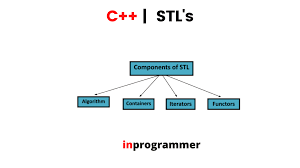
STL components of C++
STL roughly falls under four major constituent parts: containers, algorithms, iterators and objects functions. These elements are meant to be efficient, flexible, and ready to be reused thus they play an essential role in current C++ programming.
Containers
Data structures with such containers store sets of items or data. They are used as class templates, and they are adaptable in variations of elements which they contain. Containers take care of storage space of the elements within them and provide member functions to access those elements commonly using iterators.
There are four broad types of containers namely:
Sequence Containers: These containers are able to store data linearly and in-order of the elements they are inserted.
Array: A non-resizable array of compile-time length that has methods to perform common operations that are typical of arrays. The std:: array is a written array wrapper.
Vector: An array which can grow and shrink itself to accommodate newly added or deleted elements. The type of sequence container that one would normally choose is vectors by virtue of their flexibility and random access.
Deque (Double-Ended Queue): This is a sequence container that can be "grown" and "contracted" efficiently using both ends, so elements can be inserted, or removed, at the back or the front.
List: Stores information in non-contiguous memory (which is the opposite to vectors) and offers access to the information sequentially over the elements. It adopts the doubly linked list.
Forward List: These are like lists except that they use singly linked lists, and the store only where the next element is. It requires less memory to use and slightly more efficient insert and delete than a doubly-linked list, but it only permits forward iteration.
Container Adaptors These modify current container classes in order to meet specialized needs or demands and offer a limited interface in order to streamline purpose and clarity.
• Stack: The concept of this follows the Last In First Out (LIFO) where only one end is utilized.
• Queue: It obeys the FIFO principle where the first things added go out first. It is defaulted on a deque container.
• Priority Queue: Does not use FIFO or LIFO; an element will be removed according to its priority, and by default this will be the element with the highest priority. It can make use of a vector as an underlying container by default.
° A- Associative Containers: The elements can be stored in a key-based sorted order as opposed to insertion order.
- Multiple Sets: the unique data, each with an associated value and is generally stored in a default order of increasing order.
- Map: The stores in the form of the key-value pairs, however, with only this requirement: the keys ought to be unique. The user of it will keep the container disordered by default by the value of the keys.
- Multiset: The similar set with the ability to have repeated values.
- Multimap: Like a map, but permits multiple entries to be keyed according to the same keys.
-
° Unordered associative containers: The data is stored in no specific order, and allows high-performance insertion, deletion and search, commonly by means of hash tables.
° Unordered Set: Keys are stored in an hash table and are unique; offers fast and randomized insert and delete, search.
° Unordered Multiset: It is similar to the set but supports multiple instances of an identical key.
° Unordered Map: An unordered Map stores key value pairs using a hash table whereby the key used to locate the storage position is hashed.
° Unordered Multimap: This works similarly to an unordered map except that it is possible to have many values associated with a single key.
Algorithms
The STL algorithms are functions that can be used to perform basic actions on data which are mainly containers. The functions are very effective and they are applied in tasks such as sorting, searching, modifying and manipulating data in containers. Every STL algorithm is specified in <algorithm> and <numeric> header files. They work on sequences of elements and such are usually characterized by two iterators. The structure of the container i.e. its size, storage allocation etc., is usually not altered by the algorithm.Algorithms can be classified into some classes of operations
Manipulative (Modifying) Algorithms: These are algorithms which operate upon the elements of a specified container or shuffle them around in some way.
Non-Manipulative (Non-Modifying) Algorithms: Such algorithms are run on an element range and these leave their values and their order unchanged.
Sorting Algorithms: They are algorithms whose main purpose is to sort the elements effectively. The sort() method sorts the specified range in a specified manner and it operates data structures that offer random accessibility to their elements such as vectors and arrays.
Numeric Algorithms: These are named in the <numeric> header and operate on numerical data, e.g. accumulate.
Iterators
Iterators are analogies of the pointers to allow the user to refer to memory addresses of the STL containers and proceed over their contents. They form a basic element between linking STL algorithms and containers so that containers are indifferent to algorithms. The iterators are declared in the <iterator> header file.
Function Objects (Functors)
Function objects like functors are things which can be called such as functions since they overload the function-call operator (). They are normally applied with STL algorithms. Functors permit the action of a related function to be parametrized and may carry per-functor state data. Their declarations are given in the <functional> header.
Functors may be differentiated by the kind of an operation they impress:
Arithmetic Functors: Calculates addition such as plus, minus, multiplies, divides, modulus and negate.
Relational Functors: Carry out relational predicates, like equal_to and not_equal_to, greater, greater_equal, less and less_equal.
Logical Functors: Logical operations such as logical_and, logical_or, logical_not.
Bitwise Functors: Do bitwise operations but like bit_and, bit_or and bit_xor.
Advantages of the C++ stl
The first advantage of STL is that it allows generating generic, reusable and well-tested code that can operate over various kinds of data. This implies that an algorithm can be implemented once and subsequently applied to different sets of data with no need to write specific codes about each one.
Its other merits are:
Flexibility: Obtained with the help of customizable templates and functors, Lambdas.
Problem-Solving Focus: Tools are already in place so that the developers can be able to focus on problem-solving and not the lower-level coding.
Memory Management: STL also manages the memory, this prevents many of the memory bugs such as memory leak.
C++ STL limitation
Although the advantages of C++ STL are essential, there are certain drawbacks to it:
Performance Overheads: Seemingly, very efficient when dealing with general problems, its generic behavior has a tendency of being inefficient with memory consumption and execution speed compared to ones developed specifically.
Complexity of debugging: Debugging of a code that includes STL is complex.
Weak control over the memory: It has a weak control over the memory, when compared to manual memory management.
Poor Support of Concurrent Programming: There is poor support of concurrent programming in STL.
Mixing in with Custom Data Structures: Sometimes integration of custom data structures may not be very flexible.
Iterator Validity: Iterators may become incorrect in case the element that it points to is removed which is often a source of an incorrectness.
In spite of these shortcomings, the STL is an indispensable C++ programming asset that offers an extensive set of high-power and pliable tools.
Relevant Uncodemy Courses to C++ STL
Uncodemy has a number of courses that may interest those passionate about C++ and its Standard Template Library, even though no such course is explicitly called C++ STL and shown in the search results.
But they may teach the basics of C++ and possibly even STL components in their curriculum in general.
Uncodemy or some other relevant C++ training course details and courses include:
C With Data Structure Certification Training: Uncodemy offers a quality Data Structure With C bootcamp course in Noida. The course is conducted by people with vast experience in the industry and is designed to ensure that students realize success in their career. They do provide working students or the ones at far location with live sessions or the mode of classes.
Master Data Science Course with Python, Machine Learning and AI Uncodemy also has a Master Data Science course with Python, Machine Learning and AI that has industry led training and placement. Although it is not exactly C++ STL, studying data structures and algorithms, which form the central part of STL, is essential in data science.
General C++ Courses: Most C++ courses include a course in the Standard Template Library (STL) in the course. For instance:
Udemy: Beginning C++ Programming- From Beginner to Beyond: This course is a well rounded course that additionally provides an introduction to the STL of C++. It presents a good combination of theory and practice to real life code walkthrough.
Simplilearn: Introduction to C++: This course is aimed at entry-level and basic users of C++. The course introduces the basics of C++ as well as the key concepts of this programming language, such as its C++ Standard Template Library (STL).
Uncodemy focuses more on reality training and placement assistance, including connections with fortune 500 Companies and placements in other organizations. Once students want to begin their career period as soon as possible, they provide special batches.