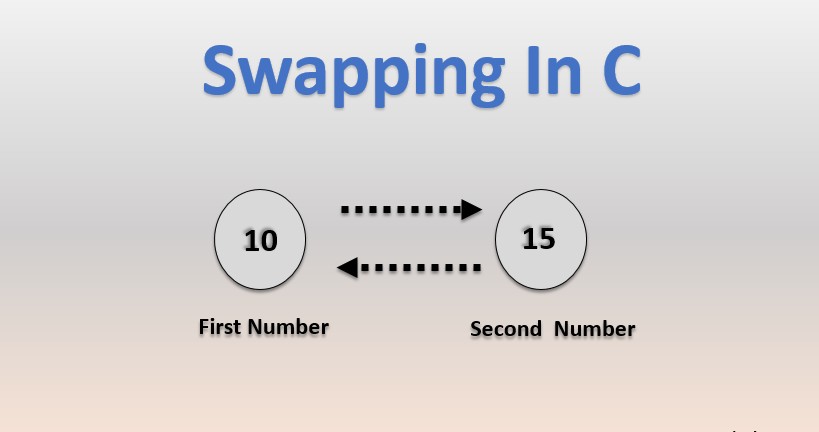
C Program to Swap Two Numbers Using Temp and Without Temp
In the journey of learning C programming, one of the most basic yet essential programs beginners come
across is swapping two numbers. While it may sound simple, this small exercise helps in understanding
core concepts like variables, data types, memory storage, and arithmetic operations. Whether you're just
starting out or enrolled in a C Programming Course in Noida, mastering this concept will lay a solid
foundation for your coding career.
C Program to Swap Two Numbers Using Temp and Without Temp
Sonal Rana / 5
days ago
9
8 min read
In this article, we'll walk you through how to write a C program to swap two
numbers using a temporary variable and without using a temporary variable. Along the way, we’ll
also explain how these approaches work and in what scenarios each method is useful.
1. What Does Swapping Mean?
Swapping simply means exchanging the values of two variables. For example, if you
have:
a = 5;
b = 10;
After swapping:
a = 10;
b = 5;
This seems straightforward, but it's a great way to understand variable
manipulation, memory, and the flow of logic in C.
2. How Swapping Helps Build Logical Thinking
Learning to swap two numbers isn't just about syntax, it lays the groundwork for
thinking like a programmer:
Logic Building
Understanding order of execution.
Recognizing the role of memory usage.
Getting familiar with variable states and transitions.
Foundation for Bigger Programs
Sorting Algorithms like Bubble Sort use swap logic extensively.
Swapping helps in array manipulations, data structure operations, and optimization
algorithms.
Debugging and Tracing Practice
Tracing swap steps improves your debugging skills, which are critical in real-world
projects.
3. Method 1: Swapping Using a Temporary Variable
Swapping values between two variables is a fundamental concept in programming
that helps understand how variables store and manipulate data. One of the most straightforward
ways to swap two numbers is by using a temporary variable to hold one of the values temporarily.
How the Temporary Variable Helps
When you want to swap two numbers, directly assigning one to the other causes
loss of data because the original value gets overwritten. A temporary variable acts as a safe
placeholder:
First, store the value of the first variable in the temporary variable.
Then, assign the second variable's value to the first variable.
Finally, assign the value stored in the temporary variable to the second
variable.
This way, no data is lost during the swapping process.
Code:
#include

int main() {
    int a, b, temp;

    printf("Enter two numbers: ");
    scanf("%d %d", &a, &b);

    printf("Before swapping: a = %d, b = %d\n", a, b);

    temp = a;
    a = b;
    b = temp;

    printf("After swapping: a = %d, b = %d\n", a, b);

    return 0;
}
Explanation:
This C program swaps the values of two numbers entered by the user using a
temporary variable. First, it takes input for two integers a and b. It then stores the value of
a in a temporary variable temp, assigns the value of b to a, and finally assigns the value
stored in temp to b. This effectively swaps the values of a and b. The program prints the values
before and after swapping to show the change. Using a temporary variable ensures no data is lost
during the swap.
4. Method 2: Swapping Without Using a Temporary Variable
Swapping two numbers without a temporary variable is a clever technique that
avoids the need for extra memory space. Instead, it uses arithmetic operations or bitwise XOR to
interchange the values directly.
This method is useful in situations where memory optimization is crucial or when
you want to write concise code.
Advantages of Swapping Without Temp Variable
No extra memory needed: Saves space, especially useful in low-memory
environments.
Demonstrates deep understanding: Shows proficiency in using operators
creatively.
Useful in embedded systems: Where memory is limited and efficiency is
key.
Caution When Using This Method
Using arithmetic operations can cause overflow if the numbers are too
large.
Bitwise XOR swap only works correctly for integer types.
Sometimes, this method is less readable for beginners compared to using a
temporary variable.
Modern compilers often optimize code well, so manual micro-optimizations
like this may be unnecessary in many real-world projects.
Approach 1: Using Arithmetic Operations
#include

int main() {
    int a, b;

    printf("Enter two numbers:may be unnecessary in many real-world projects.
Modern compilers often optimize code well, so manual micro-optimizations like
this may be unnecessary in many real-world projects.
How It Works:
This C program swaps two numbers entered by the user without using a temporary
variable. It uses arithmetic operations to exchange the values of a and b.
First, it takes input of two integers a and b.
Then, it adds a and b and stores the result in a.
Next, it subtracts the new value of a by b and assigns it to b. This
effectively assigns the original value of a to b.
After that, it subtracts the new value of a by the new value of b and
assigns it to a. This assigns the original value of b to a.
The values of a and b are now swapped without using any extra memory for a
temporary variable.
Approach 2: Using Bitwise XOR
#include

int main() {
    int a, b;

    printf("Enter two numbers: ");
    scanf("%d %d", &a, &b);

    printf("Before swapping: a = %d, b = %d\n", a, b);

    a = a ^ b;
    b = a ^ b;
    a = a ^ b;

    printf("After swapping: a = %d, b = %d\n", a, b);

    return 0;
}
How It Works:
This program swaps two numbers without using a temporary variable by using the
bitwise XOR (^) operator. It performs three XOR operations:
a = a ^ b;
b = a ^ b;
a = a ^ b;
These steps cleverly exchange the values of a and b by manipulating their bits.
After these operations, the original value of a is stored in b and vice versa. This method saves
memory by not needing an extra variable, but can be harder to read for beginners.
5. Why Is This Important?
You might wonder why so much emphasis is placed on something as basic as swapping
two numbers. The answer is that it teaches you multiple programming concepts:
Memory Management: Understanding how variables store data.
Operator Usage: Learning how arithmetic and bitwise operators work.
Algorithmic Thinking: Exploring multiple ways to solve the same problem.
Code Optimization: Comparing speed, readability, and efficiency.
If you're enrolled in a C Programming Course in Noida, expect this to be one of
the first concepts your instructor will ask you to implement.
6. Use Cases of Swapping
Swapping is a basic operation used in many algorithms and real-world
applications. Here are a few:
Sorting Algorithms: Most sorting techniques like bubble sort, selection
sort, and quicksort heavily rely on swapping.
Data Structure Manipulation: Used in linked lists, trees, and graph
traversal.
Game Development: Used in matrix manipulation or character swapping.
Use a temp variable for clarity, especially for beginners or in
collaborative environments.
Avoid arithmetic methods if integer overflow is a concern.
Bitwise operations should only be used when performance matters and
you're confident in your logic.
8. Common Mistakes to Avoid
Not initializing variables before use.
Misunderstanding arithmetic swapping, especially the order of operations.
Using the wrong data type, especially if you're working with float or
double.
9. FAQs on C Program to Swap Two Numbers
Q1. Why is swapping two numbers important in programming?
Swapping is used in many algorithms like sorting and is a fundamental operation in
data manipulation.
Q2. Which method is better: with or without a temporary variable?
Using a temporary variable is safer and more readable; the other methods are used
when memory is limited.
Q3. Can we swap float or double variables using these methods?
Yes, but bitwise XOR doesn't work with float/double—use temp or arithmetic methods
instead.
Q4. What is the disadvantage of using arithmetic swapping?
There is a risk of integer overflow, especially with large values.
Q5. Is XOR swapping faster?
It's theoretically faster and uses less memory, but it's less readable and rarely
used in production code.
Q6. Is this program often asked in interviews?
Yes, especially for entry-level or C programming-focused interviews to test
understanding of variables and logic.
10. Conclusion
Swapping two numbers might be a small task, but it carries a big lesson. From
using a temporary variable to smart tricks with arithmetic or bitwise operations, the c program
to swap two numbers opens up a world of learning. It improves your understanding of how
variables work, how operations are executed, and how memory behaves during a program’s
execution.
Swapping two numbers without a temporary variable is a neat trick that leverages
arithmetic or bitwise operations. While the temporary variable method is straightforward and
clearer, knowing alternative methods strengthens your grasp of programming fundamentals and
prepares you for coding interviews or system-level programming.
So if you're just starting your journey with a C Programming Course in Noida,
don’t rush past these basics. Master them well—they’ll support you throughout your career in
coding.