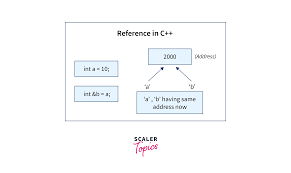
So What is C++ Reference?
The C++ reference is an alias to another variable, and this allows the programmer to work directly over data. In contrast to pointers, references are not objects (or once could say are objects of simple type of reference data), instead it is a reference data type, which is regarded to be safer, but less powerful, than C-derived pointers. The syntax of establishing a reference entails application of the ampersand (&) sign. As an example, int& ref = x; makes ref an integer reference variable referring to x such that when ref is altered it will alter the value of x because they both hold the same address.
Main features of sources
C++ references have different properties and are differentiated with other data types and pointers:
- Initialization Requirement: On creation, a reference has to be initialized. It makes the reference point to a legitimate object and never be null.
- Impermissible Reassignment: After the declaration and initialize a reference to a variable, it can not be released to another variable. This unchangeability once created is one of the major distinctions to pointers which can be re-assigned to reference another object.
- Direct Usage: References do not need dereferencing operators (such as the pointer ) in order to retrieve the value to which they pointThey may be utilized directly as ordinary variables, so the code is usually easy to read and to use.
- Not an Object Reference Pointers are not objects either and references do not always have a storage space in the memory. Although, in practice, the implementation of references is provided by compilers using the pointers in the background, the C++ Standard does not provide the specific implementation to be used with references.
- No Null References: Reference does not allow null thus not like in pointers. They should never be linked with a bogus item of storage.
References types
C++ has various kinds of references with their behavior and useful particular scenarios:
° Lvalue References: These are the reference types that are traditional and are declared using ordinary ampersand ( & ) and usually points to named variables which can be altered. Lvalue references may only be initialized by lvalues (expressions to which we can take an address) and are usually used to pass arguments by reference to functions.
° Rvalue References: Rvalue references are introduced in C++11 and they are declared using the two ampersand (&&) signs and are mostly used with temporary objects or rvalues. Their primary goal is allowing the implementation of the so-called move semantics, where resources of the temporary objects can be stolen or moved (instead of copying) and thereby cause an important efficiency gain. An rvalue reference has to be initialized with an rvalue, but not with an lvalue.
° Forwarding References (Universal References): A special case of rvalue reference that can be bound to both lvalues and rvalues in contexts where other sorts of rvalue references cannot do the same, e.g. when used as parameter types in template functions. They play an important role in so-called perfect forwarding which enables passing of arguments to another function retaining their value category (lvalue or rvalue).
By Reference Passing of Arguments
reference is commonly and conveniently used in the arguments of functions. Under passing by reference, no duplicate of the initial variable is attained and this is especially effective in huge data structures. This will enable the function to alter the original variable.
Example:
Copy Code
include <iostream>

std:: using namespace;

void change (int& x) {

    // Makes changes in the original variable

    x =20;

}

int main(){

    int a = 1 0;

    Pass by reference

    modify Value(a);

    cout << a; //Output: 20

    return 0;

}
Here, modifyValue() changes the value of a due to the fact that x refers to a. This eliminates the overhead that is incurred when copying a while making sure to edit the original variable.
Function getting back References
It is also possible to have references being returned by functions, which is useful in case one has large variables or in case one wants to append or change a variable locally within a function. Nevertheless, the key thing is to ensure that a reference is never returned to a local variable because once a function returns a local variable is destroyed and this amounts to a dangling reference.
Example:
Copy Code
include <iostream>

std:: using namespace;

int & getMax (int &a,int &b) {

    // Return bigger between the two numbers

    return ( a > b ) ? a : b;

}

int main( ) {

    int x=10, y = 20;

    int maxVal = getMax (x, y);

    // Adjust the integer of the greater amount

    maxVal=30;

    cout << "x = , "x, y = "; // Output: x = 10, y = 30

    return 0;

}
In this case, getMax() will give the address of the greater integer and maxVal will be able to manipulate y.
Changing data within range-based Loops
References are convenient to code inside the range-based for loop when the goal is to edit an element through an iterable collection.
Example:
Copy Code
include <iostream>

include <vector>

with the namespaces std;

int main( ) {

    vector

    We are able to change elements in case reference is used //

    if (int& x : vect) {

        x= x + 5;

    }

    // Elements of printing // The printing elements

    {for(int x c vect) {

        cout << x <<" "; // Output: 15 25 35 45

    }

    return 0;

}
With the right hand side definition: int& x : vect, the resulting address of reference x will refer to all the elements, which allows in-place editing.
Rvalue references and Move Semantics
Rvalue references added in C++11 exist to improve performance via the introduction of so-called move semantics. This makes it possible to transfer resources (such as dynamically allocated memory) of temporary objects without incurring costly copying. As an example, the std::string objects can be moved simply by handing over the internal buffer pointers rather than the need to construct new buffers.
The std::move() operation is applied on casting an lvalue to an rvalue reference, which will indicate that the resources contained in the object are shareable or can be stolen. It does not come at runtime performance cost because it is a compile time operation. Nonetheless std::move() does not implicitly make the move, it only makes it possible that a move-constructor or move-assignment operator is assigned when a suitable one is present.
Example
Copy Code
include <iostream>

include <vector>

#include <string> // The header that was added to realize string example

int main( ) {

    std::vector a={3, 1, 4, 1, 5, 9};

    std::cout << "a original size: " << a.size() << std::endl; // Output: 6

    c = std::vector

    std::cout << "Vector a size after move: " << a.size() << std::endl; // Output: 0 (usually such resources are moved)

    std::cout << "After move, the size of the vector c: " << c.size() << std::endl; // Output: 6

    return 0;
Here, a is made into an rvalue using std::move(a), so c can be made up of the resources of a by a move, leaving a in an undefined but valid condition (typically empty).
Perfect Forwarding and Forwarding references
Forwarding references (the type is also called universal reference) are critical to template programming to effect perfect forwarding. They enable a template function to be called with any type of value (lvalue or rvalue) as argument and pass it to a function that is created in another module without losing the original value type.
This is done with std::forward() that conditionally casts an lvalue into an rvalue in case the original parameter was an rvalue.
Copy Code
include <iostream>

as well as

template<typename T>

void process (T&& arg) {};

    This is a function which takes either lvalues or rvalues

    std::cout << endsfЦ|Red and black are burned out, and I rub a little bit of it on the tip of the frontal lobe, processing: << arg << std::endl;

}

template<typename Arg>

void wrapper(Arg arg ) {

    // std::forward does not imply altering the category of original value

    process(std::forward<Arg>(arg));

}

int main( ) {

    int (value) = 10;

    wrapper(value) ;          // Processes an lvalue

    wrapper(20);             //Calls process by using rvalue (temporary)

    return 0;

}
In this case wrapper takes forwarding reference (Arg&&) and std::forward to transfer value and 20 to be processed but keeps their lvalue/rvalue characteristics
Best Practices on C++
References
Whereas references can be a very strong point, it is hard to use them properly without following some best practices.
Choose references to parameters
° Avoiding Copies: It is always a good idea to take or make parameters of functions const lvalue references (const T&) when you do not want to make the copy of big objects and you want to be sure that the function parameter does not change the original object. It provides efficiency without the possibility of making unnecessary adjustments.
° The Arguments: When a function is supposed to make a change in a direct argument, modify it with non-const lvalue references (T&).
° Output Parameters: The inventor of C++ Bjarne Stroustrup advises to employ output parameters pointers of the type (T) as opposed to non-const references of the type (T&)
The reason is that the & (address-of) operator comes along with explicit warning that the argument may be altered, thus enhancing the readability of the code and making possible changes to be identified with ease.
Should not be references as data member
As a rule do not use references as data members in classes. It is due to the reason that:
No Reassignment: Reference data members cannot be rebound later (i.e., after construction) and this may block implicitly defined assignment-like operator functions, as well as the correct copying or assignment of objects of a class.
Ambiguity: There will be an ambiguity of whether a reference data member and the class itself, or an external object. The pointer notation (t->f()) leaves no doubt that the member of an object points at something different (t->f()).
and std ::, std for ::, forward Use Well
° std::move Use std::move () when you explicitly want to take ownership or resources away, or say that it should be possible to move out of its contents. But, you should not use std::move() in a return statement of a local variable because in most cases Return Value Optimization (RVO) will do this more efficiently, eliding copies. RVO can be in fact bypassed by using std::move() in it.
° std::forward: All templates require perfect forwarding and std::forward() is fundamental to this process because it makes sure that the value category of an argument (i.e. lvalue or rvalue) is not changed when the argument is forwarded to a third-party function.
The Pros and Cons of Pointers as opposed to References
Though references and pointers can both be used to access a data indirectly, they occur in different situations:
Nullability and reassignment considerations: These concepts as well as considerations can be made by using pointers whenever there is a possibility of the variable not pointing to an object (i.e. the variable can become null) or during circumstances when the pointer needs to be reassigned like during the life of a program to refer to other things. Dynamic memory facilities also require pointers.
References to Aliasing and Non-Null Guarantees: Use references when you wish to create an alias to an existing object and when you wish to make sure it always points to a valid object (i.e. it can never be null). They lighten the issues of syntax by eliminating the necessity of dereferencing.
How to Include Uncodemy Courses in Your C++ journey
In the instance where a person wants to enhance his knowledge in the concepts of C++ references and other advanced concepts, there are a series of courses offered by Uncodemy in IT training exercises, which aim at making people get smarter faster. Although specialized courses directly called C++ References might not exist, Uncodemy course catalog includes broad programs in such areas as Full Stack Development, Data Science, and Software Testing in which C++ has been used as the fundamental or supporting language.
To learn C++ successfully, it is important to have a great understanding of such fundamental concepts as references, pointing, classes and memory management. Based on how Uncodemy teaches their skills, they would teach these key aspects of C++, probably in the context of such suites as:
Full Stack Development: The backend services or high-performance components may require C++ and knowledge about the references to handle the data efficiently and generate optimum performances.
Data Science: Python enjoys a substantial lead but C++ has a strong presence in data processing and machine-learning libraries and functions that require high-performance. It would help to know about references that can help in optimizing these components.
Software Testing: To know more about the inner workings of the C++ language and any programming language that involves the use of the reference mechanism, it is important to know how to test C++ applications efficiently and find memory access and data manipulation related errors.
Uncodemy focuses on the area of practice and is in the business of teaching real industry-ready skills with their 90-Day Developer Training Course and other courses. Through taking up apposite Uncodemy courses, learners have the capability to:
Get Hands-On Experience: Use the theoretical knowledge of C++ references in matters relating to real-life projects and coding.
Solidify core concepts: This will enhance their knowledge on the core concepts of C++ which are the key to understanding higher concepts such as object-oriented programming, data structures and algorithms.
Become More Employable: Build a strong foundation in C++ that has demand in a wide array of technology-related jobs, as well as systems programming, game development, and high-frequency trading.
Uncodemy is a premium resource that any individual seeking to acquire or advance his or her skills in any given technology area that is in demand should take advantage of due to the detailed training services they offer. With a mixture of readings and practical work, one can learn how to work with C++ references and what their best advantage can offer to doing it better and stronger.