Machine Learning (ML) has changed the way we use technology. From predicting tomorrow’s weather to recognizing faces in photos and recommending what to watch next on Netflix—ML is behind it all. But when you start learning ML, one of the first confusions you’ll face is understanding the difference between classification and regression.
These two are the most common types of supervised learning tasks. Though they sound technical, don’t worry! In this blog, we’ll explain everything about classification vs regression in simple terms, using real-life examples
This post is written to sound like a person, not a robot—so it’s easy to understand.
We’ll also guide you to the right learning resources, like Uncodemy’s top-rated Machine Learning Course in Noida that can help you master these concepts practically.
📌 What is Supervised Learning?
Before jumping into classification and regression, let’s take a quick pitstop at “supervised learning.” It's a method in ML where the model is trained using labeled data. That means, for every input, the answer (label) is already known.
Example: You want to teach a model to identify whether a fruit is an apple or banana. You give it a lot of examples with labels like:
Apple → red, round
Banana → yellow, long
Your model will learn from these labeled examples.
Supervised learning has two main types:
Classification
Regression
🤖 What is Classification?
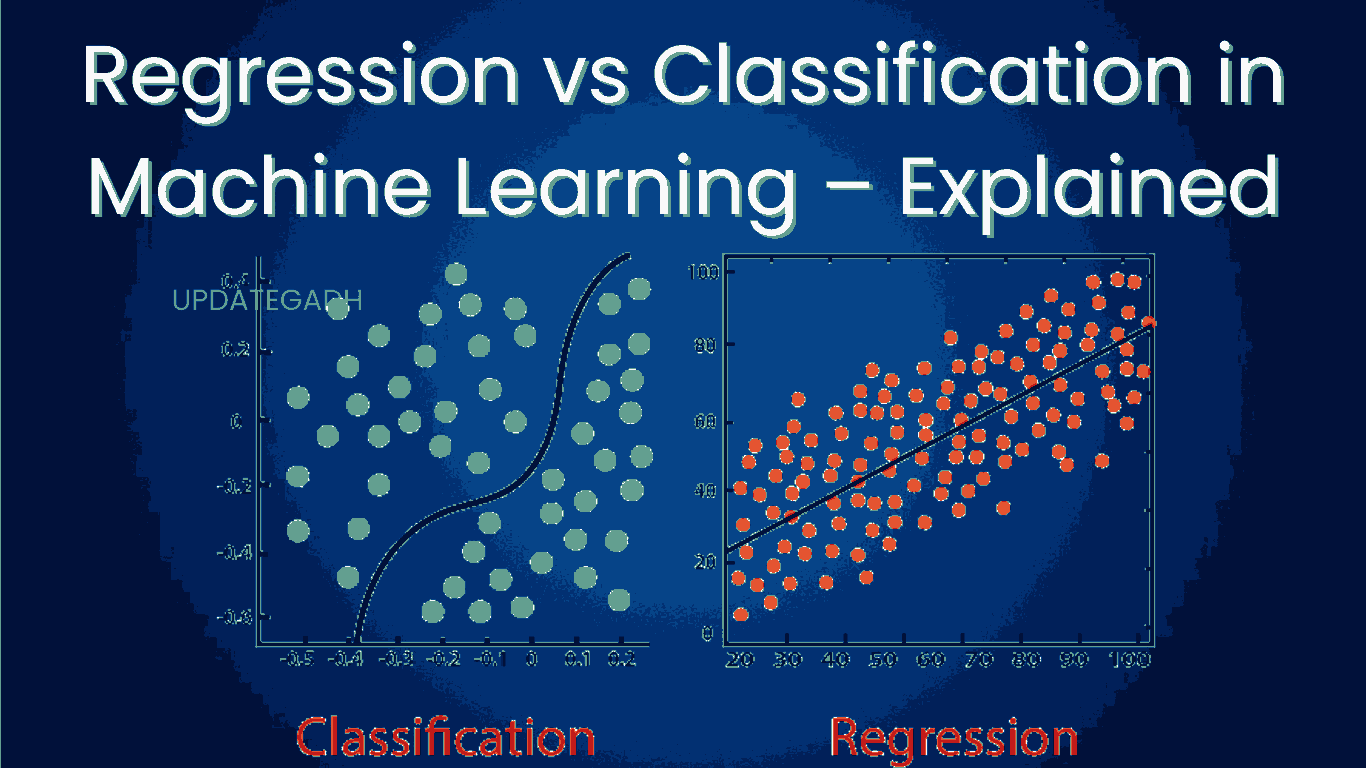
Definition: Classification is a type of ML task where the output is a category or class.
In simple terms: The machine answers the question: “Which group does this item belong to?”
🔍 Real-Life Examples of Classification:
Email: Is it Spam or Not Spam?
Medical Diagnosis: Does the person have Disease A, Disease B, or No disease?
Image Recognition: Is this a picture of a Cat, Dog, or Horse?
Loan Approval: Will the applicant Default or Repay?
So, the output is a label or category, not a number.
✅ Types of Classification:
Binary Classification – Only 2 classes Example: Male or Female, Yes or No
Multi-Class Classification – More than 2 classes Example: Classifying animals into cat, dog, lion, tiger, etc.
Multi-Label Classification – Multiple labels for one input Example: A movie can be both “comedy” and “romance.”
📈 What is Regression?
Definition: Regression is a type of ML task where the output is a continuous value (number).
In simple terms: The machine answers the question: “How much?” or “What is the value?”
🔍 Real-Life Examples of Regression:
Predicting house prices based on location and size
Forecasting temperature for tomorrow
Estimating car mileage based on engine size
Predicting sales revenue next month
So, regression outputs a real number, not a class.
✅ Types of Regression:
Linear Regression – Predicting a value using a straight line
Polynomial Regression – Prediction with curves
Ridge, Lasso, ElasticNet – Advanced techniques to handle complex relationships
🧠 Key Differences: Classification vs Regression
Feature
Classification
Regression
Output
Category or Class (e.g., Dog, Cat)
Continuous value (e.g., ₹1,000, 25.5°C)
Data Type
Categorical
Numerical
Examples
Email spam detection, disease diagnosis
House price prediction, weather forecast
Evaluation Metrics
Accuracy, Precision, Recall, F1-Score
Mean Absolute Error (MAE), Mean Squared Error (MSE), R² Score
Algorithms Used
Logistic Regression, Decision Trees, SVM, KNN
Linear Regression, SVR, Decision Trees, Random Forest
Output Nature
Discrete
Continuous
🎯 How to Choose Between Classification and Regression?
Choosing between the two depends on what you're trying to predict:
If your target variable is a label or category, use classification.
If your target variable is a numeric value, use regression.
🔄 Example Comparison:
Problem
ML Type
Will this person buy the product? (Yes/No)
Classification
How much will this person spend on the product?
Regression
Which color is this shirt – Red, Blue, or Green?
Classification
What is the size of the shirt in cm?
Regression
🛠 Popular ML Algorithms for Each Task
Classification Algorithms:
Logistic Regression – Despite its name, it’s used for classification!
K-Nearest Neighbors (KNN)
Support Vector Machine (SVM)
Naive Bayes
Random Forest Classifier
Neural Networks
Regression Algorithms:
Linear Regression
Support Vector Regression (SVR)
Decision Tree Regressor
Random Forest Regressor
Gradient Boosting Regressor
Neural Networks (for continuous outputs)
🧪 Performance Metrics
For Classification:
Accuracy – Percentage of correct predictions
Precision – Out of predicted positives, how many are actually positive
Recall – Out of actual positives, how many were identified
F1 Score – Balance between Precision and Recall
For Regression:
Mean Absolute Error (MAE) – Average of absolute differences
Mean Squared Error (MSE) – Average of squared differences
R² Score – How well the predictions match the actual values
🧑🏫 Still Confused? Let’s Take a Simple Analogy
Imagine you're teaching a robot:
If you tell it to recognize fruits as Apple or Orange, it’s Classification.
If you tell it to guess the weight of each fruit, it’s Regression.
Same input (fruit), but different outputs: one is a label, the other is a number.
💡 Why Is This Important?
Understanding the difference between classification and regression helps you:
Choose the right algorithm for your problem
Understand how to prepare your dataset
Know which metrics to use to evaluate your model
Avoid applying the wrong model and wasting time
📚 Want to Learn This Practically?
If you're someone who's just starting out or want to master ML from scratch, check out Uncodemy’s Machine Learning Course in Noida. You’ll get:
Hands-on projects in both classification and regression
Practical ML algorithms in Python
Real industry use-cases
Certification and placement support
🙋♀️ FAQs on Classification vs Regression
Q1. Is classification always better than regression?
Answer: No. It depends on the problem. If your output is a category, use classification. If it's a number, use regression.
Q2. Can we convert regression to classification?
Answer: Yes, but with limitations. For example, if you're predicting age (a regression task), you could group them into age ranges (e.g., 0–20, 21–40), turning it into a classification task. But some precision is lost.
Q3. What tools are commonly used?
Answer: Python is the most popular language. Libraries include:
Scikit-learn
TensorFlow
Keras
PyTorch
Q4. Is logistic regression a regression or classification algorithm?
Answer: Despite the name, logistic regression is used for classification tasks.
Q5. What should I learn first—classification or regression?
Answer: Both are fundamental. Start with linear regression (easy to understand), then move to logistic regression.
✨ Final Thoughts
In the journey of machine learning, understanding the difference between classification and regression is like learning the difference between night and day. They are the foundation of almost every ML model you'll ever build.
Classification answers the question: What kind is it?
Regression answers the question: How much is it?
Each has its use, and both are equally powerful in their own domain. By grasping the basics clearly, you’re one step closer to becoming a Machine Learning expert.
And don’t forget—if you want to learn this hands-on, the Machine Learning Course in Noida by Uncodemy is a great place to begin.
Happy Learning! 🚀 Written in a simple tone so that even if you're not from a tech background, you can understand and start your ML journey with confidence.