Introduction of Temperature Scales
There are two popular temperature scales Celsius and Fahrenheit. The Celsius scale is one of the units that make up the International system of units (SI), which places the freezing point of water at 0 C and boiling point at 100 C. The scale employed in such countries as USA is Fahrenheit which assigns the freezing and boiling points of the water to 32 F and 212 F, respectively. It is worthy to mention that when the temperature reads -40 Celsius it is also the equivalent temperature in Fahrenheit.
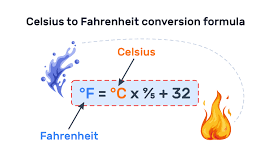
Formula of Celsius to Fahrenheit Conversion
The basic C to F conversion formula to change temperature between Celsius (or degree Celsius) (C) to its Fahrenheit (or degree Fahrenheit) counterpart (F) is not at all complicated:
\\
Alternatively, since
9/5=1.8, the formula may also be written as:
\\
In this formula the multiplication by
The difference in the scale intervals between two temperature systems (namely 2, the ratio between the scale interval of 1 o C and 1.8 the scale interval of 1 o F is corrected by 9/5 or 1.8. By adding 32 the freezing temperature of water is brought to the same number on both scales, since 0 C is equivalent to 32 F.
As an example to give Fahrenheit equivalent of 26 o C, you would compute:
(26×9/5)+32=46.8+32=78.8°F.
Examples of Programming in Temperature Transformation
The concept of conversion Celsius to Fahrenheit is carried out in many programming languages; this is one of the basic exercises that can reinforce specific concepts of basic programming, functions, I/O management, mathematics, etc.
C programming code.
In C implementation of the conversion is feasible in using standard input/output functions. The algorithm to use will simply be inputting the value in Celsius, processing the formula and finally printing it in Fahrenheit.
The scanf() extracts the celsius value and the output by using printf() which displays an equivalent Fahrenheit figure rounded to two decimal places.
The sample code in Python program
Python has a more terse syntax to carry out the temperature conversion, and many times one uses float data types to represent the correct decimal representation.
This python script will ask the user to enter Celsius, convert it into a number in a floating point, run the formula in a function and finally print it.
JavaScript Example Programming
To manage conversion of temperatures, JavaScript may be adopted in case it is a web based application or requested interactive script.
This JavaScript snippet engages prompt() to get the user to input Celsius and afterward executes the process before the result is printed in the console.
Speedy estimation techniques
In simple estimation conversions where exact accuracy would not normally apply, there are easier methods of estimation. The easiest way of converting Celsius to Fahrenheit is through doubling and adding 30. In such an example, the doubling of 25oC would result in 50 and then combining 30 results in 80oF, which is already near the actual actual value (77oF). This estimation is usually true at temperatures that occur on earth.
The other instant estimation is through the doubling of Celsius temperature then 10 percent having to be subtracted with that doubled number and lastly 32 is added. As an example, to change 20 o C:
Take 20, and multiply it by 2 = 40.
Take 0.1 off 40 (4) =36.
The conversion of 20 degrees C (68 degrees F) results by adding 32 = 68 degrees F.
Construction of Temperature Converter Website
The development of a temperature converter site can be an expedient initiative of a future web developer. This activity includes specifying the purpose, selecting the technology stack, designing the user interface, writing JavaScript to do the conversions, doing real-time conversion and error processing. The most important ones would be a choice of Celsius-Fahrenheit-Kelvin conversions, a clean interface where the user can type the desired value and press a button to make the conversion, immediate conversion, and error messages.HTML and CSS would be utilized to structure and style the application, whereas JavaScript would perform the function.
Optimise your Programming Skills with Uncodemy
Educational sites such as Uncodemy provide courses that can help any person to expand their knowledge in programming and prepare to work. Uncodemy trains in many IT skills such as unpottery programming languages such as Python, Java and C. In spite of the fact that there are no marked Uncodemy classes labeled explicitly as the temperature conversion per se, their courses that could be termed as extending to the basic, namely Python Full Stack, Java Full Stack, and C with Data Structure and Algorithms, would provide the students with the required knowledge of how to program temperature conversion software and many others.
Important concepts such as input/output manipulations, mathematical operations, and functions that are vital in creating useful programs such as temperature converters are covered in the Uncodemy curriculum. As an example, their course on Data Analytics using Python would be of use there since temperature conversion is one of the essential features of data processing and analysis. They have also designed PG Programs in Data Science and Data Analytics which focus on industry-specific skills and live projects coaching their learners to become qualified in software development. Uncodemy specializes in being more hands-on, real-life case studies which is prescribed by providing mentorship of experienced professionals, placement of jobs and a prosperous alumni community. The programs assist the students in establishing a fine background of more challenging programming activities and nurture advancement within the realm of software development.