The Concept of CRUD on Full Stack Web Development
CRUD is an abbreviation of Create, Read, Update and Delete. Through these four basic operations, interaction between the users and the databases in web applications are supported. CRUD operations, in full stack web development, make it possible to manipulate and manage data, just as applications are able to add new records, retrieve information, update any available information and delete information that are no longer necessary.
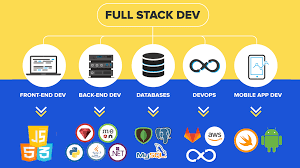
The concept of full stack development entails both frontend as well as backend of a Web application. Frontend takes the job of user interface and user interactions whereas the backend takes the job of server-side logic, database communications as well as the API endpoints. CRUD operations fall in both the ends as the frontend takes input and presents data and the backend fulfills CRUD requests, talks to the database and serves responses.
Form of CRUD Operations Bus errors
Create: When this operation is applied, it enables a user to input new data to a database. An example of an insert operation is filling a form to create a new user account; posting a new blog article.
Read: The most popular one is reading or retrieving data. It concerns retrieving a piece of stored data to be displayed in a web page like retrieving profile pages of a user or enumerating a list of blog posts.
Update: Update operations change pre-existing data. The information on a database will alter whenever a user posts it or edits it.
Delete: Such an action makes the data go away, like deleting comments or accounts of users.
Each of these operations relate to particular approaches in RESTful APIs namely POST (create), GET (read), PUT/PATCH (update), and DELETE (delete) methods communication protocols that the back end employs to connect and communicate to the front end.
Full Stack CRUD implementation
The use of CRUD engages the client-side and server-side. The frontend is powered by frameworks such as React, Vue, or Angular, so it handles interactive UI views and form submission and state management. The backend technologies include Node.js, Express, Django, or FastAPI that deal with logic, validations and queries to databases.
In the case of databases, MongoDB, MySQL, and PostgreSQL are trendy. A popular NoSQL database used in full stack development is MongoDB; the flexibility of this database and the reliance on a JSON-like storage schema makes it very popular. MySQL and PostgreSQL are database systems that administer data; they have well-organized data with strong querying capabilities.
Example: MERN-stack CRUD-App
The most commonly used stack in the creation process of a CRUD application is the MERN stack, made up of MongoDB, Express, React, and Node. In such arrangement:
- React controls the user interface, input and output.
- Express powering on Node.js builds API routes and API requests.
- The application data is kept in collections with MongoDB.
In Express, API endpoints are developed by developers to deal with every CRUD behavior, including adding new data with a POST route, retrieving data with GET routes, updating with PUT/PATCH, and deleting with DELETE. State and hooks in React will react to changes to these APIs on the backend to update the front end.
significance of Authorization to CRUD
Uncontrolled CRUD operation may cause unauthorized access and data modification. Hence, it is vital to add layers of authorization and authentication to make CRUD endpoints secure. Only authenticated individuals ought to be in a position to create, edit or destroy data pertaining to their use or owning. Such strategies as JSON Web Tokens (JWT) or OAuth are often used in full stack applications to secure these operations.
Use Cases and Case Studies
CRUD has real-life examples of how its application can be used to handle data and the interaction of the user efficiently. For example:
A blogging platform in which users may create, edit, delete and read blog entries, and user authentication to grant or deny access.
Employee management systems designed to take CRUD operations on employee records using friendly user portals and improving the efficiency in administration.
When using MEAN/MERN stacks in real-life applications, the patterns of CRUD operations optimized with MongoDB are presented with the performance and growth guarantee.
Uncodemy Courses to Mastering Full Stack CRUD development
Individuals who want to learn about full stack web and to acquire the skills to implement CRUD within their working framework will find extensive training programs in Uncodemy to fulfill their desire.
Full Stack Development: These courses are available in the cities such as Pune, Bangalore, Delhi, Noida and Hyderabad and include front end technologies and back-end technologies, database management and elaborate handling of CRUD operations through MongoDB and other tools and applications. The curriculum also involves installation of databases, schema design, document modeling, and implementation practice exercises which implement the CRUD functionalities in an effective way.
MongoDB CRUD Operation Learnings: Uncodemy has specific courses on CRUD operation in MongoDB, its installation, connection, schemas, models, and query complexities to work on databases effectively.
Backend Development: Other courses offer backend development on Node.js, Express and PHP, all of which have tutorial sections on how to build CRUD applications, APIs and safe data storage.
The training of Uncodemy involves some hands-on seminars and projects concentrating on the JavaScript and object-oriented programmable thinking concepts and Spring Framework to create CRUD applications of enterprise level. The courses offer employment services, and so they can be applied by those who have the aspiration to have a full stack growth career.
Conclusion
The practice of full stack web development relies on CRUD operations to create, read, update, and delete data using applications. These are implemented in both the frontend interfaces as well as at the backend servers at the interface of the APIs and the databases. Security layers are very important in secure and effective operations. Developers-in-making can take advantage of special curriculum, e.g. Uncodemy complete courses, to learn CRUD and create elegant full stack apps. By using practical projects and case studies, developers can acquire the skills and knowledge on how to play a role in the field of contemporary web development.
By learning in depth and performing skillfully throughout the stack the developers enable these dynamics, scaling and user friendly web applications to fit the requirements of the business and the user effectively.