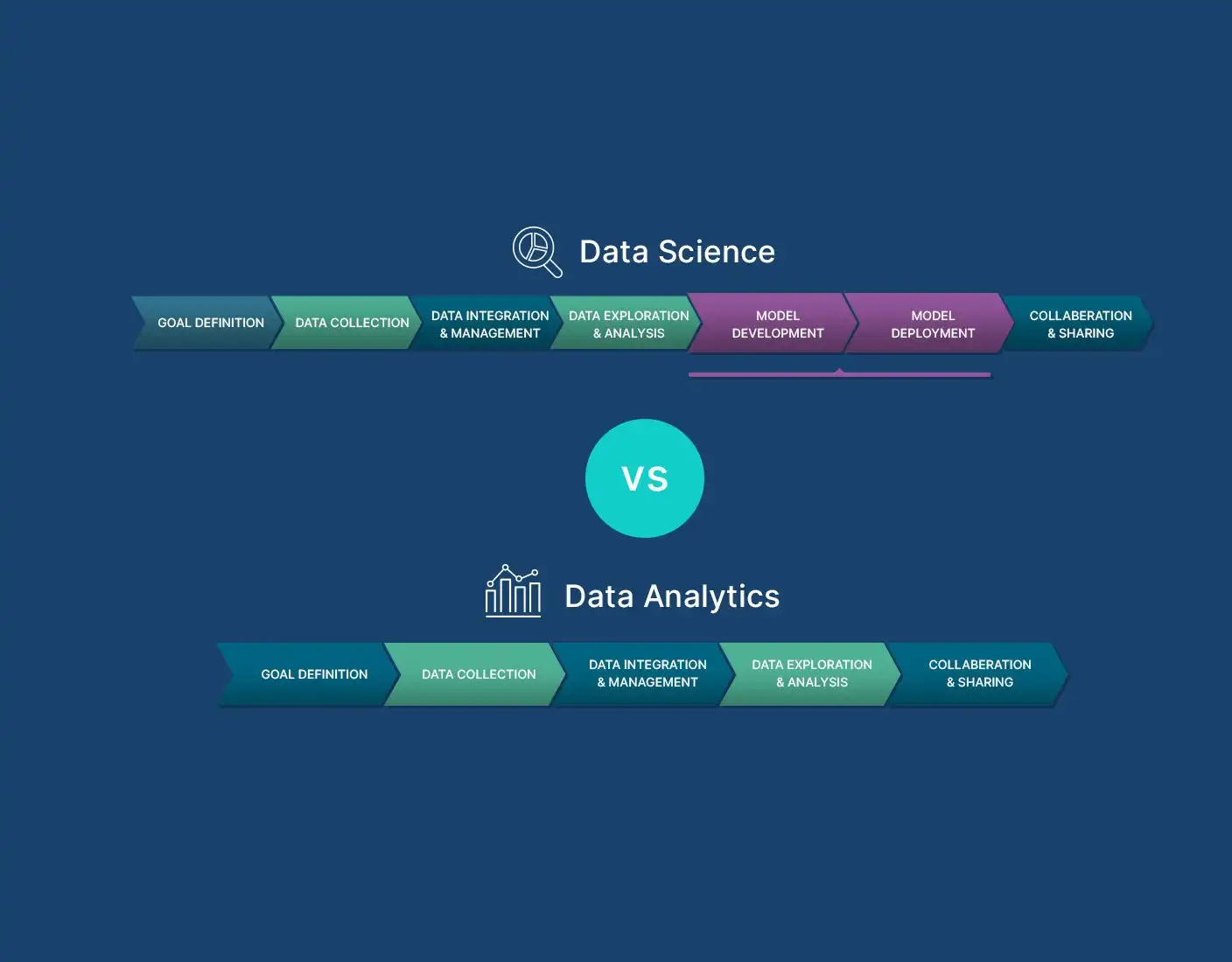
Data science is commonly discussed as the large picture. It is about mining the deep, large and complex groups of data, examining trends, creating predictive models and deriving hidden gems that can inform strategic decisions. A data scientist is a kind of a detective who applies mathematical tools, algorithms and programming to find answers to large questions like how the future will look, what opportunities are there or how systems are to be optimized. Conversely, data analytics revolves more around the analysis of the already available data and determining its patterns, findings, and actionable analysis that can be used by decision makers. Imagine it as spotlight around the data to make organizations see what already occurred and the way they can react to it promptly.
Among the main differences is the scope of their work. Data analysts deal with tabular data, like sales reports, customer surveys, or financial data. Their work is to search meaningful patterns and display them in elementary terms using reports, dashboards, or visualizations. A company that wants to know what products are selling most or what customer behaviour has shifted because ofa change in seasons would be dependent on data analysts. Conversely, data scientists look beyond structural data. They deal with dirty, disorganized, and massive data sets that are frequently to be cleaned and processed. They employ powerful means such as machine learning, artificial intelligence, and statistical modeling to predict what would likely occur in the future or to model alternative scenarios. As an example, a data scientist can create a predictive model that predicts the number of customers that can leave the company in the next quarter or the impact of a price change on the total revenue.
Another factor that differentiates them is the skills needed in each job. Statistical knowledge of tools such as Excel, SQL, Tableau, and basic statistics is very important in data analytics. It is rather about the way of interpretation of data and to display it in a manner which is easy to follow. Effective communication is also essential, as analysts must clarify the results they find to managers and investors who might not be well versed in technical terms. Data science, however, requires even a broader scope of technical skills. It deals with writing code using a language like Python or R, designing algorithms, working with large data structures like Hadoop or Spark, and using sophisticated math. Data scientists are explained to be half mathematicians, half computer scientist, and half business strategists.
The other significant distinction is the issue that each field attempts to solve. Data analytics is centred primarily on the what and the how. It informs you about what happened in the past and how it is possible to explain it. An example: why did sales decline last month? Which campaign was more effective? Data science, on the other hand, addresses the why and what next. It aims at finding out why an event occurred and more significantly, what is going to happen in the future. It is an answer to some questions, such as what sales will be in six months'? Which new markets should a company develop? Such futuristic quality makes data science especially valuable in the contemporary business landscape, where forecasting next steps can confer a competitive advantage on organisations.
In terms of benefits in the career realm, both majors are very fulfilling. Data analysts tend to work in industries such as financial services, marketing, healthcare and retail industries, where the use of data in their decision-making is common. Their services are imperative to the daily operation of business activity, and the necessity of competent analysts is continually increasing as organizations create data to the extent which has never been seen. However, the data scientist can end up in even more specific positions that demand higher levels of complex problem solving. Their fields of operation include artificial intelligence, machine learning, research, and product innovation. Due to the complexity of what they do, data scientists tend to earn the highest wages in the technological sector. That said, becoming a data scientist can be a more difficult journey and demand a greater investment of some kind (education, training, and learning).
Interest and your background are important when choosing between the two. However, in case you are a person interested in working with data and want it in simple tools and clear results, data analytics is what might be the correct option. It is usually said to be a wonderful way of getting to the data world as you get to develop good foundations working on real life problems that organizations grapple with daily. Conversely, when you are intrigued with algorithms, you like programming and love puzzles that have no right-or-wrong answers per se, then data science might be a better fit. It is more investigational and makes you think outside the box. Nevertheless it requires patience as the course to master is long and technical.
The difference can also be viewed in the context of the impact and timelines. The reporting of data analytics is faster-paced. Organisations are required to make instant decisions and analysts give insights to enable them to act fast. As another example, weeks or even days can be used to analyse customer feedback to enhance a product, or to assess sales data to change a marketing campaign. Data science projects, in turn, tend to be longer-term in nature. The process of developing a recommendation system on an e-commerce platform or an AI model on healthcare prediction might require months of research, development, and testing before it can be made available to be used. The payoff, in many cases, however, can be far greater because these models have the potential to revolutionise the way a company operates and generate long-term value.
The two disciplines do not compete but instead complement each other. Indeed, both data analysts and data scientists are utilized by many companies, and data analysts and data scientists are not interchangeable. Analysts offer clarity in present and historical performance, whereas scientists move the boundaries to predict and innovate. Collectively, they constitute the spine of data-driven organisations. Considering a company to be a ship, data analysts are the ones who read the maps, take care that the ship is on the right track, and data scientists are the ones who design the new journeys and decide how to reach the destinations in the most efficient way.
It should also be noted that the boundaries between the two are gradually becoming blurred. As new tools and technologies proliferate, standards are being changed to where analysts need to learn basic machine learning techniques and scientists need to be able to present data in a clear, readable way. Most professionals enter as analysts before becoming data scientists with a few years of experience and further expertise. This logical sequence demonstrates the strong interdependence of the two disciplines, and why having knowledge about both can make you a more multifaceted specialist.
Ultimately, the question of data analytics vs. data science is one that depends on your career ambitions and preferred work. Do you love crunching numbers, finding patterns, and assisting firms in making better real-time decisions? Data analytics may offer you a rewarding career with sustainable demand. Data science will be closer to your aspirations, should you be go-getting, like to dive deep into complicated issues, seeking solutions through algorithms, and drive innovation by using predictive modeling. Both career paths provide stability, development, and attractive prospects to be at the center of the ongoing data revolution. The point is to consider your strengths, your inquisitiveness, and the nature of the problems you want to solve.
As the world becomes more data-driven, both data analytics and data science will continue to expand, creating endless opportunities. Choosing one does not close the door to the other; instead, it places you on a journey of constant learning where skills from one area can enhance the other. The most successful professionals are those who remain curious, flexible, and open to growth. So, whether you choose analytics or science, the future is bright, and the world of data is ready to welcome you with endless possibilities.