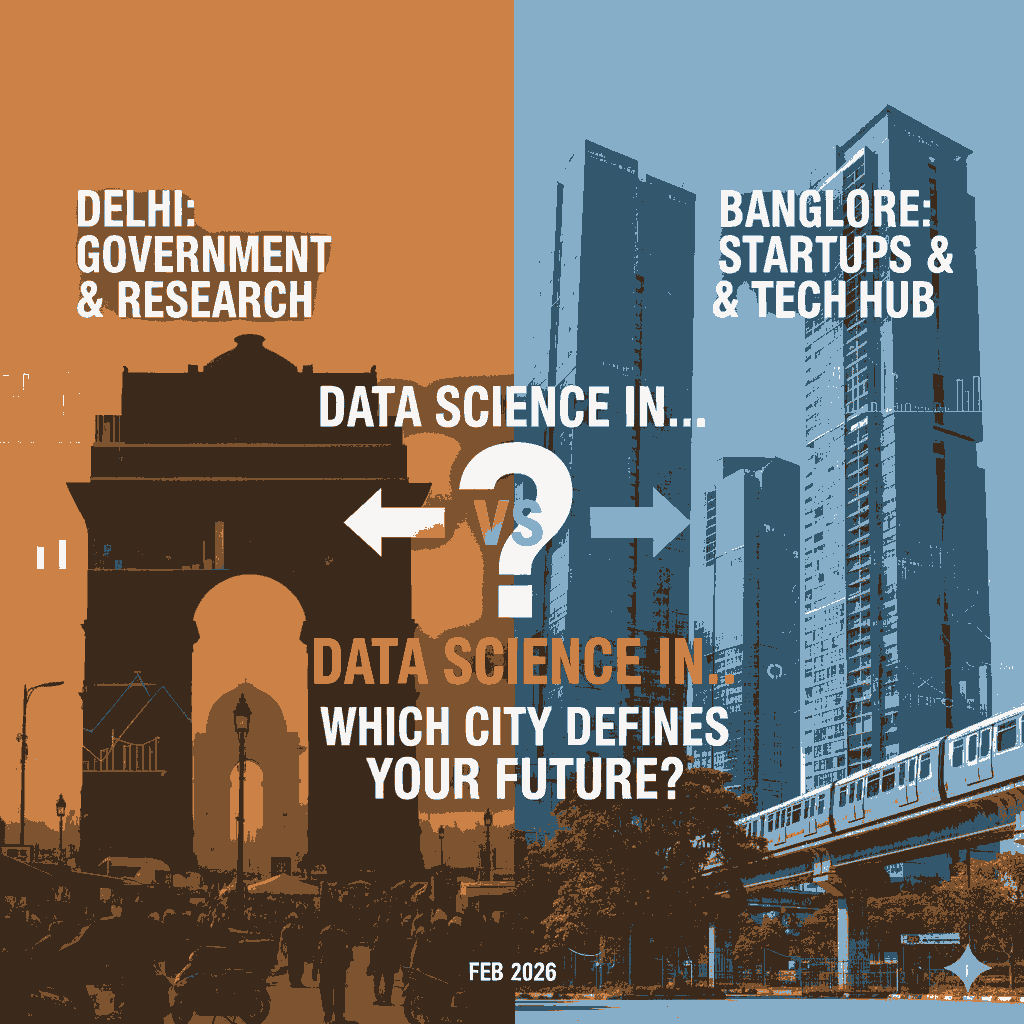
When deciding, it should be more than just a number of job opportunities; be sure to consider potential educational or employability opportunities, industry connections, community & culture, and lifestyle factors. Ultimately, both cities have similarities and trade-offs that will shape your career development in certain ways. This blog-style article will present you with a thorough comparison to help you discern which may best lay the groundwork for building your career in Data Science.
Academic Environment and Learning Ecosystem
Delhi has long enjoyed a reputation for deep academia and mature learning environments. There are several respected institutions in Delhi, including IIT Delhi, IIIT Delhi, and Delhi University, that offer strong courses in data science, machine learning, and artificial intelligence. These courses generally balance theoretical rigour with structured assessments. This generally allows learners to create a solid foundation in mathematics, statistics and computing. A significant percentage of the courses are based on research and exploration; hence, learners are often working with academic projects that are open-ended, promoting analytical thinking and algorithm and model development in the long-term.
Bangalore, meanwhile, has a wholly different learning flavour. While Delhi may be deemed too safe in its focus on academic structure, Bangalore thrives under agile, industry focused learning. There are a multitude of tech institutes, bootcamps and startup led academies that create an environment, where practical application rules the day. At times, the experience can be very much: 'me with a bunch of other students solving real-world experiences with live data sets, hackathons and tech tie-ups with mentors in the industry'. The training style is consistent with the energy in the city: fast, hands on and forever involving multiple incarnations of the latest and emerging technologies.
The Job Market and Corporate Environment
Delhi's corporate world is diverse. As the capital of India, it is home to the corporate offices of many government ministries, multinational consulting firms, health care corporations, and finance organizations. Data Science professionals in Delhi may find themselves in a number of roles connected to public policy, analytics for governance, and data-driven finance. There will be a steady and consistent need for professionals able to navigate data into structured environments in finance, consulting, research, and health care. For many learners, Delhi provides an environment of stability, reputation, and expertise in specific domains.
Bangalore is the Silicon Valley of India for a reason. Global giants in technology such as Google, Amazon, and Microsoft call Bangalore home as do home-grown companies such as Infosys, Wipro, and Flipkart. Additionally, whatever may be the established firms, Bangalore has dozens of startups in fintech, health tech, edtech, and e-commerce all reliant on data science and data scientists. Not only is the demand for data science here significant, but it is amplifying and multifaceted. There are many roles available, from machine learning engineer to data product manager. Professionals in Bangalore also have much faster career progression than many other markets or job resources, as the hiring market puts pressure to accelerate away from changing technologies and work organisations.
Networking and Professional Community
Delhi’s networking culture showcases its diverse academic and corporate background. Its conferences, symposiums, and university-organized events provide an established context for its Data Science community. Institutions have much more to provide in terms of learned sessions, leading policy discussions, and professionally-organized forums where the public and private sectors liaise. It has a tone of formality and is reflective, perfect for individuals who enjoy the discourse around material with the opportunity to connect with academic talent or leading lights within a corporate entity.
Bangalore is rooted in informal vibrant professional interactions. The amount of hackathons, networking events around innovation camps, and start-up pitch nights means that Data Scientists at different levels together experience what Bangalore can provide all inspiring opportunities to meet industry pioneers, entrepreneurs, and a peer-based learning environment. Networking is happening less and less in the structure of events in cafes, coworking venues, and pure innovation spaces. This "letting it all hang out" work culture is a powerful collaboration and experiential externalisation that is distinctly Bangalore. For someone keen on exploring a fundamentally refreshing culture of innovation, Bangalore's professional community is an embrace for learners.
Official "Cost of Living” and infrastructure
In terms of pricing, you will find that Delhi is often less expensive or "cheaper." The metro and other public transport systems in Delhi facilitate travel and accommodation options appear to be more diverse and affordable compared to Bangalore. You can often have a balance of education and living costs in Delhi, less of a burden for students or early career professionals. The affordability in Delhi allows learners to think more critically about how they spend their money on certifications, projects or additional learning mechanisms.
Bangalore tends to be more expensive in comparison. The cost of housing in the big tech town is usually through the roof and commuting becomes an even bigger issue with traffic patterns. The city itself makes it easier for tech professionals with its own technical innovation infrastructure. With coworking options or startup incubators, Bangalore is designed for innovation. While you may spend more on living expenses, the professional opportunities can often help balance this out, especially for those that find solid placements or roles with a steep learning curve.
Opportunities for Placement and Professional Growth
Placement in Delhi is a somewhat structured process. Corporations work with universities, students join recruitment processes formally known as recruitment drives, and they participate in assessments that include aptitude assessments, interviews, and domain-based assessments. The focus is primarily on-entry level jobs with an emphasis on analytics, business intelligence, or domain-centric data use cases. There is steady growth, and there are great opportunities for graduates to move into higher-level positions in an established corporate structure.
Bangalore, is on the other side of the spectrum in which placement is less structured, but dynamic. Places for recruitment can be found in meetups, networking events and project showcases. Many learners land jobs because they create stellar portfolios and utilize relational ties made within their community also referred to as a network, rather than a placement cell. It is a startup driven city that allows young professionals to directly join as an entry-level candidate and jump to high-impact roles under multi-week timelines. While the culture is intense, there are ample opportunities for fast upward mobility as a professional.
Work-Life Balance and Lifestyle Considerations
The decision between cities extends beyond academia and employment; there are lifestyle considerations in choosing Delhi and Bangalore. Delhi has its own cultural experiences and the cultural richness of Delhi offers museums, historical monuments, art galleries, and intellectual activities. For learners, the cultural richness of the city allows for a balanced lifestyle because learners travel between both academic and cultural experiences. With a relatively slow and structured pace, and the cost of living reasonably affordable, learners may engage in a comfortable lifestyle while building a career.
In contrast, Bangalore thrives on being a cosmopolitan city. While culture has to do with cafes, tech meet ups, startup hangouts, and a youthful buzz around innovation. The lifestyle itself is dynamic; however, it may require some stamina, at times, to deal with traffic, high costs of living, and driven workplaces. For many, being part of a fast-moving, energetic, and large community that represents all that is new, and unique, is worth all the sacrifices. Bangalore indeed provides a supportive stage for that.
Long-Term Career Thoughts
Moving forward, Delhi is indeed a stable and specialized location. Professionals have a tendency to become domain experts, where your data application end of the work is relatively specific to finance, governance, or healthcare. In Delhi, you will get a relatively predictable career trajectory with predictable promotions, job stability, and recognition within industries.
On the other hand, Bangalore long-term career prospects are related to constant reinvention. Most data scientists in the city continually move across firms from startups and tech firms to entrepreneurial opportunities, exposing them to various applications of AI and machine learning. The city supports both creativity and nurtures individual versatility and leadership for those who can navigate fast-paced and uncertain environments. For those who would want to continue to stay ahead of the curve in their professional development, Bangalore is a long-term bet.
Finishing the Ticket
The decision about the right city will mostly depend on your overall priority. If your key priorities are affordability, structure to academic depth, and cross-sectoral diversity, the right fit for you may be Delhi. Alternatively, if you envision goals that are all tied to fast-paced innovation, exposure to startups, and an emerging tech culture that operates globally, then Bangalore may be your choice. Both cities are incubators of talent in their own respect but there is a distinct difference about how they nurture that talent. You should make a decision that best suits the lifestyle and career path you visualize.
FAQs
- Can I study in Delhi and work in Bangalore later?
Yes, many students complete their academic training in Delhi and then move onto career opportunities in Bangalore. The skills are transferable, and the strong foundation we prepare for in Delhi usually sets you up to excel in Bangalore's fast-paced job market.
- Does Bangalore consistently pay more than Delhi?
Generally speaking, yes, Bangalore usually consistently pays more especially at startup and multinational companies. That said, the cost of living is higher which tempers some of that and costs of Delhi are relatively less in the beginning with that being said most instances balance out with pay preventing any large net gain or loss.
- Is Delhi better for jobs related to the Government and data?
Yes, not only is Delhi perfect for data jobs associated with or tied to a government agency, but its strong proximity to ministries, research bodies and policy organizations gives it a tailored edge in gaining potential hiring access to government-related data jobs. If you are a learner, considering being involved with public policy, governance analytics or social research then Delhi naturally offers opportunities over Bangalore.
- Which city for long-term growth in AI and ML?
In terms of long-term growth for AI and ML, Bangalore has a functional edge. With Bangalore's ecosystem as a startup capital, the range and exposure to global entrepreneurs and brands, testing, and experimentation will ensure that professionals will be firmly rooted in technology at the forefront of advancement.
Conclusion
Both Delhi and Bangalore offer a different journey for anyone chasing careers in Data Science. Delhi offers affordability, academic strength and consistency, whilst Bangalore provides dynamism, innovation and rapidity of growth. Which city you pursue will ultimately be driven by your career aspirations, financial comfort, and lifestyles. No matter where you start, either city can provide value and add to a productive journey in Data Science.