Data Science vs Machine Learning: Key Points Explained
In today’s data-driven world, two of the most frequently discussed fields in technology are Data Science and Machine Learning. While they are often used interchangeably, they are distinct domains with overlapping concepts and applications. For beginners or even working professionals looking to switch careers, it’s essential to understand the differences, similarities, and individual scopes of these fields.
In this comprehensive blog, we'll break down what data science and machine learning mean, compare their key aspects, explore the skills required, career options, real-world applications, and help you determine which path might be right for you.
What Is Data Science?
Data Science is a multidisciplinary field that focuses on extracting insights and knowledge from structured and unstructured data. It involves various techniques from statistics, computer science, data engineering, visualization, and domain-specific knowledge.
Core Components of Data Science:
Data Collection: Using tools like APIs, web scraping, or databases.
Data Cleaning and Preparation: Removing inconsistencies, null values, and formatting data.
Exploratory Data Analysis (EDA): Finding patterns, trends, and anomalies in data.
Data Visualization: Using charts, graphs (via libraries like Matplotlib, Seaborn, Tableau).
Machine Learning (optional): For predictive modeling.
Data Science Tools:
Python, R
Jupyter Notebooks
Pandas, NumPy
SQL
Tableau, Power BI
Excel
What Is Machine Learning?
Machine Learning (ML) is a subset of Artificial Intelligence (AI) focused on building models that learn from data and make predictions or decisions without being explicitly programmed.
It’s a technical core used in many data science workflows, but it is also its own distinct field.
Core Components of Machine Learning:
Algorithms: Linear regression, decision trees, support vector machines, neural networks.
Model Training: Feeding labeled or unlabeled data to algorithms.
Validation and Testing: Ensuring model generalizes well.
Model Deployment: Putting models into production for real-world use.
Data Science vs Machine Learning: The Key Differences
Feature
Data Science
Machine Learning
Definition
Broad field focused on data extraction
Subset focused on pattern recognition
Goal
Insights and decision-making
Predictions and automation
Scope
Includes data analysis, visualization
Focuses on training models
Skills Required
Statistics, SQL, Python, visualization
Algorithms, programming, math
Tools
Excel, Tableau, Pandas
Scikit-learn, TensorFlow, PyTorch
End Output
Reports, dashboards, insights
Predictive models, classification
Use of AI
Optional
Core focus
How Data Science Uses Machine Learning
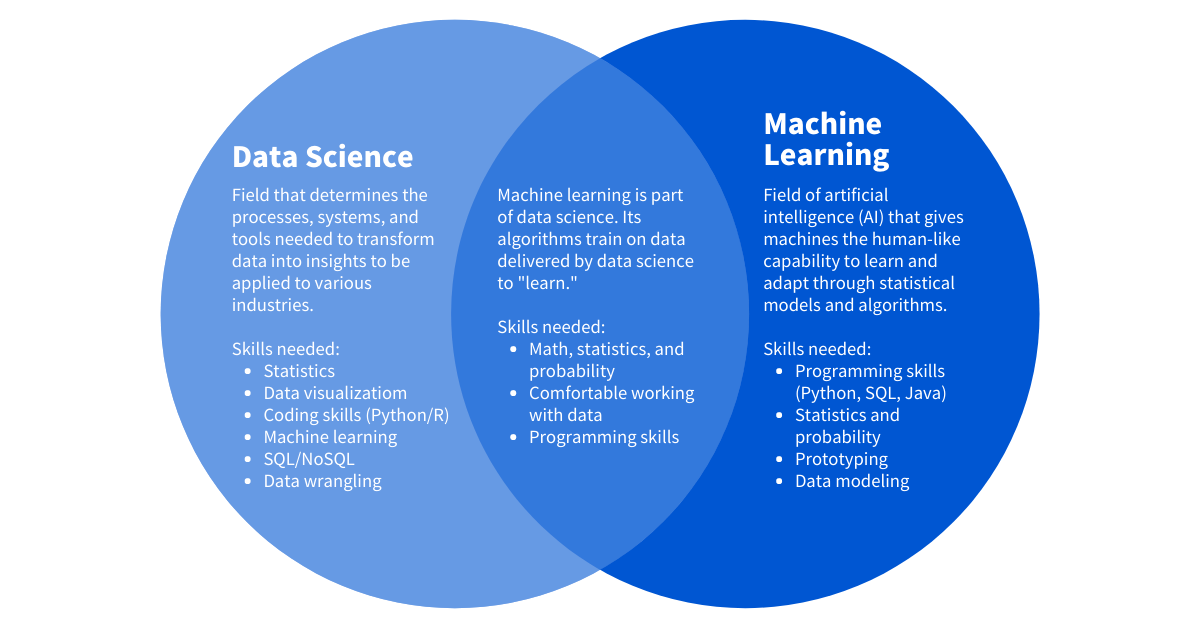
Though different, machine learning is often a part of the data science pipeline. For example, a data scientist may use EDA to understand customer data and then use an ML algorithm to build a predictive model to forecast churn.
Data scientists don’t always use ML, but machine learning engineers almost always focus only on modeling and performance.
Similarities Between Data Science and Machine Learning
Both involve data manipulation using Python or R.
Both require mathematics and statistics.
Both aim to provide value through data.
Both are used heavily in industries like finance, healthcare, e-commerce, etc.
Both involve cleaning, preprocessing, and working with large datasets.
Roles and Responsibilities: A Comparison
Data Scientist Responsibilities
Identifying business problems and how data can solve them.
Collecting and cleaning large datasets.
Performing statistical analysis and A/B testing.
Visualizing trends and sharing insights with stakeholders.
Image and Speech Recognition: Face ID, Google Voice.
Self-driving Cars: Vision-based object detection.
Natural Language Processing: Chatbots, translators.
Educational Path: What Should You Learn?
To Become a Data Scientist:
Programming in Python or R
Statistics and Probability
SQL for data querying
Data cleaning with Pandas
Data visualization libraries
Optional: basic ML knowledge
To Become a Machine Learning Engineer:
Strong Python programming
Linear Algebra, Calculus, and Probability
Algorithms and data structures
Machine learning algorithms in depth
Neural networks and deep learning
Model deployment and APIs
Career Opportunities
Both fields offer high-paying, in-demand careers, but the job titles and focus areas differ.
Job Role
Data Science
Machine Learning
Job Titles
Data Analyst, Data Scientist, BI Analyst
ML Engineer, AI Engineer, Data Scientist
Entry-Level Salaries
₹5–10 LPA (India) / $80–120K (USA)
₹7–15 LPA (India) / $100–140K (USA)
Growth Opportunities
Can lead to data science manager roles
Can lead to AI architect or research roles
Which Is Right for You?
It depends on your interests, strengths, and career goals.
Choose Data Science if:
You love analyzing data to tell stories.
You enjoy working with business teams and insights.
You are not as interested in deep algorithms.
Choose Machine Learning if:
You love coding and math.
You're fascinated by intelligent systems.
You want to work on automation and predictive models.
How to Start Learning Each Field
For Data Science Beginners:
Learn Python basics
Master Pandas, NumPy
Practice with real datasets on Kaggle
Learn data visualization
Take an end-to-end data science project
For Machine Learning Beginners:
Strengthen math and statistics
Learn ML algorithms (supervised, unsupervised)
Work on projects like classification, clustering
Use Scikit-learn and move to TensorFlow
Learn deployment basics (Flask, FastAPI)
Recommended Resources
Top Platforms to Learn Data Science:
Uncodemy’s Data Science Course
Coursera (IBM Data Science Professional Certificate)
Kaggle (for datasets and competitions)
Analytics Vidhya (for tutorials)
Top Platforms to Learn Machine Learning:
Uncodemy’s AI and ML Course
Andrew Ng’s ML Course (Coursera)
Fast.ai
Google’s ML Crash Course
Conclusion
While Data Science and Machine Learning are closely connected, they serve different purposes. Data Science is broader and focuses on data analysis and insights, while Machine Learning is a subset that focuses on predictions and automation using data.
Understanding the difference helps you make a smart decision about your career direction and choose the right skills to invest in.
Whether you're building dashboards with visual insights or training deep learning models, there's no wrong choice — just different paths based on your interest and goals.
Kickstart Your Journey with Uncodemy
Want to become a Data Scientist or Machine Learning Engineer?
✅ Learn from industry experts ✅ Get hands-on project experience ✅ Access placement support
👉 Enroll today at Uncodemy and turn your ambition into a career.