Types de Données Numériques
The two major choices of branches that Python deals with numbers include floats and integers. Int type covers whole numbers up to integers but without the decimal point like numbers of years or counts or age etc. It can take negative values. Flat type is applied to the decimal numbers which are such as the weight, height and the average. Complex numbers are also supported within Python, and these are expressions of numbers with a real component and a complex imaginary component and have the form a + bj with a and b real numbers and j is the imaginary unit.
Integers (int)
It is possible to create integer literal directly, and it may be positive, negative, or zero. Python imposes no set restriction as to how large a numerical value can be: the only constraint is the memory subsystem of a system. An example would be, it is still possible to add 1 to a very long integer. But integer to string conversion of a very long integer may raise a ValueError otherwise the default limit of 4300-digits int conversion to string which can be modified through sys.set_int_max_str_digits(). Underscore characters can be used as thousands separators in large integer readability. We can also have different bases such as binary (pre-changed to 0b or 0B), octal (pre-changed to 0o or 0O) and hexadecimal (pre-changed to 0x or 0X) to represent integers.
Numbers (float) The Fly
Float is a number that can be float in point (we can imagine 1.0, 2,75.) Python has class floats to denote the same. The floating-point literals can be constructed by using the dot character, and otherwise, the integer or decimal part will have a default value of 0. Composites are the floats that are made with a minus sign preceding it. Like integers, it is possible to use underscores in floating-point numbers to enhance readability of very long numbers. Floating-point numbers can also be interpreted through scientific expression by the means of e or E followed by a power of 10, as in other languages.Python has a propensity to store values of floats as a 64-bit (double precision) value, aligned with the IEEE 754 standard. It means a floating point number has a maximum number as about 1.8×10 - 308
Where the larger values are to be represented by inf The nearest a non zero quantity can come to being zero, is.. 5.0×10−324
Being less than or near to zero, things are at par with zero.
Complex Numbers(complex)
In Python, complex numbers are represented by a built-in type, which is a complex number, consisting of real and imaginary parts in the form a + bi where i is j in Python. By example, 2+ j3 is a complex number and it is of type complex. Complex numbers may be defined with the help of literals when a is the real part and bj is the imaginary part. In order to avoid NameError, the number has to be written before the j (e.g. 1j).The only method of the complex type is the .conjugate() method, changing the sign of the imaginary part to produce the conjugate complex. The complex numbers can be also created by use of the in-built complex() function that takes the real part and the imaginary part of the number as arguments. It gives 0j unless arguments are passed to it. Any single argument will be taken as the real part and the imaginary part will be taken as 0j. The arguments that the function can take are integers and floats. It is also capable of converting strings into complex numbers as long as the string entails the proper a + bj format but with no spaces, or an exception will be produced in the form of ValueError. A non-iterable passed as a string will raise TypeError.
String Data ( str )
Python strings are collections of character-like data which are used to represent and store a piece of information that is textual in nature. The str type is referred to as str. String literals can be constructed using the single (''') or double (""") quotes but both the open and closure quotes have to be the same. It is a good habit of not mixing quotes usage in the code. The maximum number of characters that may be contained by the python strings is constrained only by the computer memory. Blank strings one can use quotes without characters in between thus having a length of 0 when it is checked using len().
Triple-quoted string literals (three single or three double quotes) are used in particular to write multiline strings, most typically to write docstrings in Python code, but they can also be used to write single-line literals.To include a quote character within a string, one must use the other type of quote character to delimit it, e.g. single quotes within double-quoted strings.
The Data Type called bool (Boolean)
One of two values namely True or False is represented by the Boolean data type. The Python representation of these values is in the form of keywords True and False. The Booleans come in handy when it is necessary to monitor the state of conditions or make comparisons. In case of comparisons between two values, the value of the comparison is always a Boolean. Conditions on the code execution may also rely on Booleans, e.g. on an if statement. Also, and, or and not are boolean functions which take two Boolean values and produce a third Boolean result at the basis of their logical operation.
NoneType
The Python keyword None is an object to an object which is of type NoneType and this NoneType object is utilized, in showing that there is no value. It is two things as opposed to zero or not so, it signifies nothing whatsoever. An example is when a parameter of a given function lacks a return definition, it is then set to None. On the same note, when a variable is then bound with the output of a function that returns nothing, the said variable will have None. Whereas None cannot be used as the value of a variable, it is not possible to create new objects of the NoneType type because any attempt to do so will raise NameError.
Collection Data Types
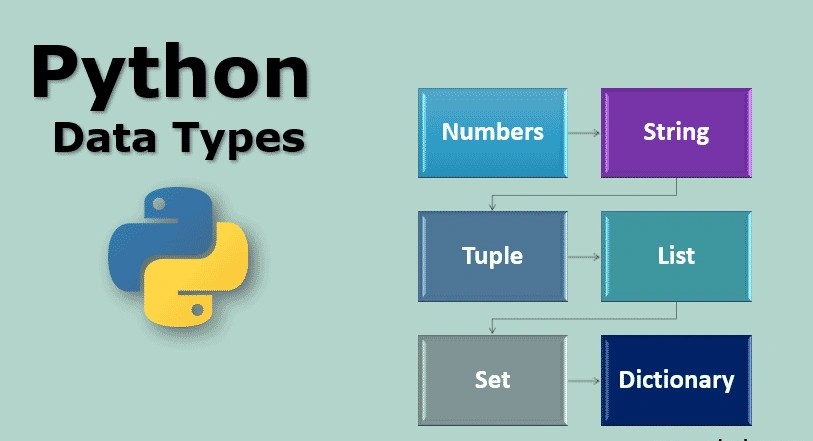
Python offers a number of built-in collection data structures that can hold sets of items and that share some standard behaviors of handling items as a unit, but differ in other ways (in particular, their ordering, mutability, and indexing). Such are lists, tuples, dictionaries and sets.
Lists (list)
Lists are immutable, ordered data structures that contain data; they are analogous to the concept of an array in other programming languages, but more adaptable in that they can contain any combination of types, including lists themselves. The single list may include integers, floats, strings, Booleans and it may even include another list. Lists may be pre-filled or can be blank lists which get filled. The append() method is widely used to add items in a list.It is able to access elements in a list using the brackets followed by the index (which is 0 based). With slicing, it is possible to access sequences of more than one element, through the following syntax my_list. There is also a list, by slicing Other practical functions of the lists include the pop() which eliminates an item using its index, remove to get rid of a particular element, clear to clear everything and sort to list the items in alphabetical order.
Tuples (tuple)
Tuples are similar to lists because they can be considered as read-only. This immutability predisposes them to store data that are not intended to change like coordinates or dimensions of an object. The construction of the nest is made through the insertion of parentheses between the values. Tuples are comparable to lists since they may also store any type of information. Because they are immutable, tuples have fewer methods and the most common ones are count() which can be used to count the number of occurrences of a value or index() which can be used to find an element by its index. The lists in turn can include tuples and the tuples can include lists and they fit in with the python type lists.
Dictionaries (dict)
Python dictionaries are data structures that are used in key-value format whereby each item in the dictionary has a specific key which is used to get its value. A dictionary satisfies the mutation property, i.e., it may be updated with new entries and hashes, deleted, or edited. They are most often used when structured data needs to be stored, e.g. when storing personal data (name, age, address, phone number). It is easier to alter the value of a particular variable in a dictionary than in a list and key-value in a dictionary is easily added. Dictionaries also have in-built capabilities such as keys() to give all keys and values() to give all the values.
Python Data Types Uncodemy Courses
Uncodemy is a training institution in Delhi, Noida, and specialises in training in different technologies whereby python programming, data science, and machine learning among others are trained. In their courses, they are focused on raising qualified specialists in these areas. In particular, the course module of Python Programming language in Uncodemy contains Python Standard Data Types, that is, int, float, complex, and bool.Uncodemy also runs a highly acclaimed Data Science and Machine Learning using Python certification course in Noida.