DCGAN Applications: How It Changed Generative Modeling
Artificial Intelligence has redefined how we create, visualize, and even imagine data. One of the major breakthroughs in the field of deep learning and computer vision came with Generative Adversarial Networks (GANs) a revolutionary concept introduced by Ian Goodfellow in 2014.
But as the technology evolved, a more stable, efficient, and visually powerful version of GANs emerged the Deep Convolutional Generative Adversarial Network (DCGAN).
DCGANs didn’t just improve image generation; they completely changed the landscape of generative modeling. From producing realistic human faces to enabling AI-driven art and deepfake detection, DCGANs have played a crucial role in shaping modern AI creativity.
In this article, we’ll explore what DCGANs are, how they work, key applications, and their impact on generative modeling.
What Is a DCGAN?
A DCGAN (Deep Convolutional Generative Adversarial Network) is a type of GAN that uses Convolutional Neural Networks (CNNs) to improve the stability and quality of generated data particularly images.
While a traditional GAN consists of two networks — a generator and a discriminator — DCGAN replaces the simple feed-forward structure with deep convolutional layers that help the model learn visual features more effectively.
How DCGAN Works
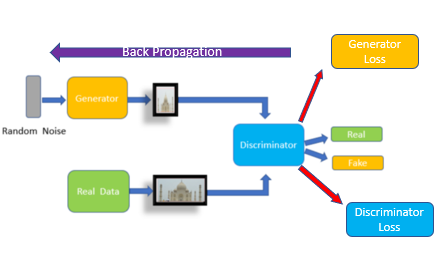
Just like a standard GAN, DCGAN works as a two-player game between:
1. Generator (G):
Takes random noise as input.
Uses transposed convolutions (also called deconvolutions) to produce realistic images.
2. Discriminator (D):
Takes both real and generated images.
Uses convolutional layers to determine whether the image is real or fake.
Both networks train simultaneously —
The generator tries to fool the discriminator,
While the discriminator tries to identify fakes correctly.
Over time, both networks improve, leading to highly realistic and visually convincing image generations.
Architecture of DCGAN
The original DCGAN paper introduced several architectural guidelines that made training GANs more stable and powerful.
Component
Function
Convolutional Layers
Used instead of fully connected layers for feature extraction.
Batch Normalization
Helps stabilize training by normalizing layer inputs.
ReLU Activation (Generator)
Ensures non-linearity and faster learning.
LeakyReLU (Discriminator)
Prevents neurons from dying during training.
No Pooling Layers
Strided convolutions are used instead of pooling for better learning.
Generator Architecture Example
# Simplified PyTorch-like structure
Generator(
Input: Random Noise (z)
→ Transposed Conv2D (512 → 256)
→ BatchNorm + ReLU
→ Transposed Conv2D (256 → 128)
→ BatchNorm + ReLU
→ Transposed Conv2D (128 → 3)
→ Tanh Activation (Output Image)
)
The generator gradually upsamples noise into a realistic image.
Discriminator Architecture Example
Discriminator(
Input: Image (64x64x3)
→ Conv2D (3 → 128) + LeakyReLU
→ Conv2D (128 → 256) + BatchNorm + LeakyReLU
→ Conv2D (256 → 512) + BatchNorm + LeakyReLU
→ Flatten + Sigmoid (Output: Real/Fake)
)
The discriminator downsamples the input image to learn discriminative visual features.
Why DCGAN Was a Game-Changer
Before DCGANs, GANs struggled with training instability and low-quality image generation. DCGAN introduced deep convolutional layers, which enabled:
Better feature learning from spatial data (images).
Improved visual coherence in generated results.
Stable and faster training through batch normalization.
Meaningful latent space representation, allowing image manipulation.
Essentially, DCGAN made generative models truly usable in practice — setting the foundation for many modern AI applications.
DCGAN Applications That Changed Generative Modeling
Let’s dive into the real-world applications that highlight how DCGANs revolutionized AI-driven creativity and modeling.
1. Image Synthesis
DCGANs are widely used to generate high-quality synthetic images from random noise. These images often look realistic enough to fool human observers.
Example:
Generating human faces using datasets like CelebA.
Creating synthetic datasets for training computer vision models.
This approach helps companies reduce data collection costs while maintaining variety in datasets.
2. Data Augmentation for Deep Learning
Training deep learning models often requires massive datasets. But collecting and labeling large amounts of data is time-consuming and expensive.
DCGANs solve this problem by generating new, synthetic images that resemble real ones, thereby expanding the training dataset.
Use Case: In medical imaging, DCGANs generate realistic MRI or X-ray scans to augment datasets improving diagnostic accuracy in deep learning models.
3. Art and Design Generation
AI-driven art has become one of the most fascinating applications of DCGANs. Artists use them to generate unique, abstract, and surreal visuals.
Example:
Projects like DeepArt and AI Art Gallery rely on GAN variants to create new artwork styles.
Designers use DCGAN-generated visuals for creative inspiration and mood boards.
This fusion of AI and creativity is shaping the future of generative design.
4. Super-Resolution and Image Enhancement
DCGANs serve as the foundation for Super-Resolution GANs (SRGANs) models that enhance image quality and resolution.
They can reconstruct low-resolution or blurred images into detailed, high-resolution ones.
Applications include:
Enhancing old photos or CCTV footage.
Improving satellite imagery.
Upscaling game textures for better graphics.
5. Face Generation and Deepfake Technology
One of the most discussed DCGAN applications is realistic face generation. Models like StyleGAN (an evolution of DCGAN) can produce images of non-existent people that look completely real.
Positive Use Cases:
Generating avatars for virtual environments.
Testing facial recognition systems without privacy concerns.
Ethical Concerns:
Misuse in deepfake content and misinformation. Thus, research into ethical AI and deepfake detection is an essential complement to DCGAN innovation.
6. Image-to-Image Translation
DCGANs paved the way for more advanced generative tasks like image-to-image translation, where one image style is converted into another.
Examples:
Converting sketches into photos.
Turning day images into night scenes.
Translating satellite maps into street maps.
Frameworks like Pix2Pix and CycleGAN extended DCGAN principles to make these transformations smooth and realistic.
7. 3D Object Generation
With minor modifications, DCGANs can also generate 3D object representations by learning spatial relationships from 2D data.
Applications:
3D modeling for virtual reality and gaming.
Simulating architectural structures or product prototypes.
This is transforming industries like automotive design, real estate visualization, and metaverse content creation.
8. Fashion and Style Generation
In fashion tech, DCGANs are used to generate:
New clothing designs.
Virtual try-on models.
Style-based product variations.
E-commerce brands leverage these AI-generated visuals for personalization and trend prediction, making DCGANs a vital tool for AI-driven fashion innovation.
Impact of DCGANs on Generative Modeling
DCGANs were not just another neural network innovation they redefined how we perceive AI creativity.
Here’s how DCGANs impacted the broader AI and deep learning ecosystem:
1. Simplified Generative Learning
DCGANs demonstrated that with proper architecture, complex generative tasks could be trained stably using deep learning paving the way for models like StyleGAN, BigGAN, and Diffusion Models.
2. Foundation for Modern Generative AI
Most generative systems today — whether text-to-image or video synthesis trace their architecture lineage back to DCGAN principles.
3. Improved Representation Learning
DCGANs showed that unsupervised learning can extract meaningful features from data, helping models understand complex patterns without explicit labels.
4. Accelerated Creative AI Research
By bridging art and deep learning, DCGANs inspired a new generation of research exploring AI creativity, style transfer, and multimodal learning.
Challenges and Limitations
While DCGANs brought remarkable improvements, they also have challenges:
Training Instability: Even small hyperparameter changes can cause mode collapse.
Limited Resolution: Standard DCGANs struggle with generating very high-resolution images.
Data Dependence: Requires large, diverse datasets to perform well.
Ethical Risks: Generating fake or misleading content raises serious concerns.
Newer architectures like StyleGAN, VQGAN, and Diffusion Models have addressed many of these issues but the foundation laid by DCGAN remains crucial.
Future of DCGANs
Even though advanced models now dominate the field, DCGANs still hold educational and experimental value.
They’re used in research prototypes, academic projects, and AI art experiments.
Serve as a stepping stone to understanding modern generative architectures.
Inspire hybrid models combining GANs and diffusion techniques for more controlled image generation.
In short, DCGANs continue to influence how we build and understand generative AI systems.
FAQs
1. What makes DCGAN different from a traditional GAN?
DCGAN replaces simple dense layers with convolutional layers, enabling better spatial understanding and image generation.
2. Can DCGAN generate videos or 3D content?
Yes, with modifications. By extending convolutional operations to 3D, DCGANs can generate video frames or 3D object structures.
3. Are DCGANs still used today?
Absolutely. They’re widely used for research, learning, and in creative industries as foundational models for more advanced GAN variants.
4. What datasets are used to train DCGANs?
Common datasets include MNIST, CIFAR-10, and CelebA — depending on the task (digits, objects, or faces).
5. How do DCGANs impact creative industries?
They enable AI-generated art, design, and virtual experiences — allowing creative professionals to collaborate with AI in new ways.
Conclusion
DCGANs marked a turning point in the history of generative modeling. By combining convolutional networks with adversarial learning, they transformed how machines generate realistic images and understand visual data.
Their influence extends far beyond academic research reaching art, fashion, entertainment, healthcare, and synthetic data generation.
Even as newer models like diffusion-based architectures emerge, the principles introduced by DCGAN continue to shape the backbone of modern generative AI.