DDPM in AI: Understanding Denoising Diffusion Models
Artificial Intelligence has transformed the way machines generate creative and realistic content. From lifelike faces to surreal digital art — behind the scenes lies a fascinating concept known as Denoising Diffusion Probabilistic Models (DDPMs). These models have become the backbone of modern generative AI tools, such as Stable Diffusion, Imagen, and DALL·E 2.
In this blog, we’ll explore what DDPMs are, how they work, their advantages over traditional models, and where you can learn to build such systems yourself with Uncodemy’s AI and Machine Learning courses.
What is a Denoising Diffusion Probabilistic Model (DDPM)?
At its core, a DDPM is a generative model — a type of AI that learns to produce new data resembling its training examples (like images, audio, or text). Unlike GANs (Generative Adversarial Networks), which rely on a generator–discriminator competition, DDPMs work through a diffusion process — gradually turning noise into structured data.
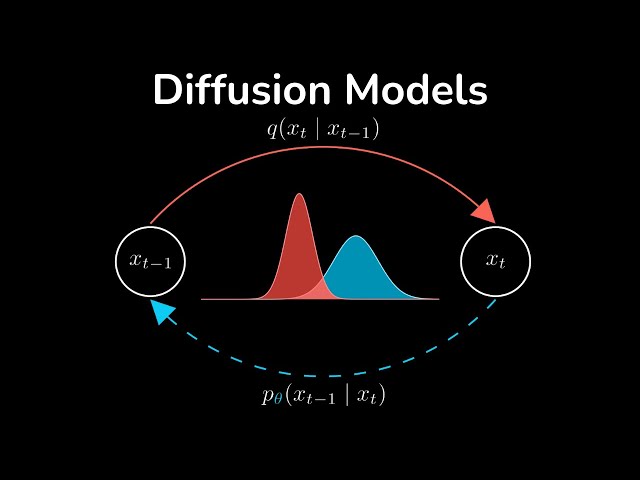
You can imagine this as teaching a model to reverse the process of adding noise. First, you destroy the data by adding random noise step-by-step until it becomes pure noise. Then, you train the model to reverse that destruction — bringing the data back to its original, clean form.
How DDPMs Work: Step-by-Step Explanation
Let’s break it down into two phases — Forward Process and Reverse Process.
1. Forward Diffusion (Adding Noise)
The model starts with a clean image and gradually adds noise over several steps. By the end of this process, the image becomes completely unrecognizable — just random pixels. This step helps the model understand how real data degrades.
Mathematically, it’s represented as:
xt=αt−−√xt−1+1−αt−−−−−√ϵtxt=𝛼txt−1+1−𝛼t𝜖t
Where:
xtxt
= noisy image at step t
αt𝛼t
= noise schedule factor
ϵt𝜖t
= Gaussian noise
2. Reverse Diffusion (Removing Noise)
Now the magic begins. The model learns how to reverse the noise process — taking a random noisy image and predicting what the clean image could have been.
Over thousands of training steps, the model becomes skilled at turning random noise into realistic images.
DDPM vs GANs: A Smarter Generation Approach
Generative Adversarial Networks (GANs) have been dominant for years, but DDPMs bring several advantages that make them the new favorite in AI research.
Feature
DDPM
GAN
Training Stability
Highly stable, no adversarial training
Often unstable, needs fine-tuning
Output Quality
Extremely realistic with fine details
May produce artifacts
Diversity
Generates diverse samples
Sometimes limited diversity (mode collapse)
Training Time
Longer due to multi-step process
Faster but less stable
In short, DDPMs trade off speed for superior quality and consistency, making them ideal for applications requiring ultra-realistic visuals.
Key Components of DDPM
1. Noise Scheduler: Controls how much noise is added at each step.
2. Neural Network (often a U-Net): Learns to predict and remove noise.
3. Sampling Process: Reverses the noise in multiple iterations to generate the final image.
4. Loss Function: Guides the model to predict the correct denoising path.
Together, these components allow DDPMs to learn the underlying probability distribution of data essentially, how pixels interact to form meaningful visuals.
Applications of Denoising Diffusion Models
DDPMs are not just for artistic images — their applications span across industries:
1. Image Generation
Used in tools like Stable Diffusion and Midjourney, DDPMs generate photorealistic or creative visuals from text prompts.
2. Image Restoration
They can denoise, deblur, and inpaint (fill missing areas) in damaged photos.
3. Medical Imaging
In healthcare, DDPMs help generate synthetic scans for training AI systems without exposing real patient data.
4. Text-to-Image Conversion
DDPMs power large models like OpenAI’s DALL·E 2, connecting language understanding with visual creativity.
5. Super-Resolution
They upscale low-quality images into high-resolution outputs — useful in surveillance, film restoration, and more.
Advantages of DDPMs
1. High-Quality Output: Generates images with incredible realism and detail.
2. Stable Training: No adversarial competition like GANs.
3. Versatile: Can be applied to audio, video, or 3D data too.
4. Diverse Results: Each random seed produces a unique variation.
5. Mathematically Grounded: Rooted in probabilistic and thermodynamic theory, making it more interpretable.
Challenges of DDPMs
While DDPMs are revolutionary, they aren’t perfect.
1. Slow Sampling: Generating an image requires hundreds or thousands of steps.
2. High Computational Cost: Needs significant GPU power and training time.
3. Complexity: Understanding the math behind diffusion and noise schedules can be tricky for beginners.
Researchers are addressing these issues with optimized variants like DDIM (Denoising Diffusion Implicit Models) and Latent Diffusion Models (LDM) — which power tools like Stable Diffusion.
How to Learn DDPMs and Generative AI (with Uncodemy)
If you’re inspired to dive deeper into DDPMs and generative AI, Uncodemy offers professional, hands-on training courses to help you build these systems from scratch.
These courses combine theoretical depth with project-based learning — perfect for students, AI aspirants, and professionals looking to upskill.
Explore these courses on Uncodemy and start building your own diffusion models today.
Future of Diffusion Models
The future of AI creativity is bright — and DDPMs are leading that revolution. We’re moving toward multimodal diffusion, where models will seamlessly mix text, image, sound, and video generation.
Imagine creating entire virtual worlds from a single idea — that’s where diffusion models are taking us.
Conclusion
Denoising Diffusion Probabilistic Models (DDPMs) have redefined what’s possible in generative AI. Their unique ability to generate high-quality, diverse, and realistic outputs has made them the backbone of modern AI creativity.
While they demand more resources and training time, the results are worth it — paving the way for a future where machines can create as beautifully as humans imagine.
If you’re ready to explore this fascinating field, start with AI and Deep Learning programs in Delhi — and learn how to build the next generation of intelligent systems.
FAQs
Q1. What does DDPM stand for in AI? DDPM stands for Denoising Diffusion Probabilistic Model, a type of generative model that learns to generate data by reversing a noise process.
Q2. How is DDPM different from GANs? While GANs rely on adversarial training between two networks, DDPMs use a noise-based diffusion process, making them more stable and producing higher-quality outputs.
Q3. Which AI models use DDPMs? Popular AI systems like Stable Diffusion, Imagen, and DALL·E 2 are based on DDPM architectures.
Q4. Can I learn DDPMs as a beginner? Yes! With the right foundation in Python and deep learning (through platforms like Uncodemy), you can start building diffusion-based models.
Q5. What are some real-world applications of DDPMs? They are used in image generation, restoration, medical imaging, super-resolution, and creative AI art generation.