Deadlock Avoidance in Operating Systems: Techniques and Examples
-
Irshad Khan / 2
Weeks ago
- 28
- 15 min read
What is a Deadlock?
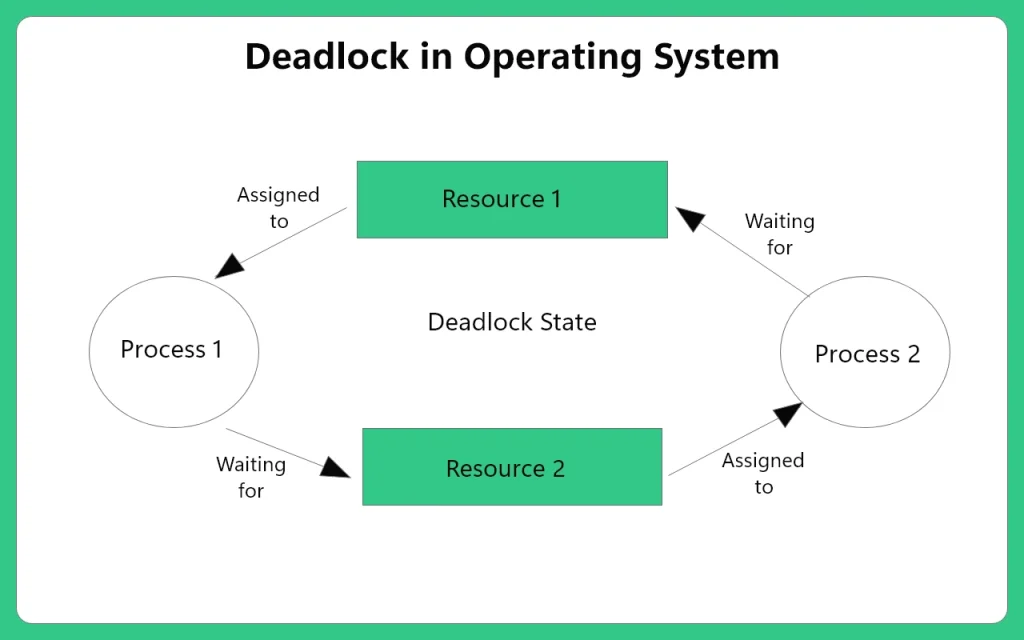
A deadlock is a situation in computing where a set of processes are blocked
because each process is holding a resource and waiting for another resource that is acquired by
some other process. This leads to a circular wait and no process can proceed further, leading to
system freeze or degraded performance.
Four Necessary Conditions for Deadlock
- Mutual Exclusion: Only one process can use a resource at a time.
- Hold and Wait: A process holding at least one resource is waiting to
acquire additional resources.
- No Preemption: A resource cannot be forcibly taken from a process.
- Circular Wait: A closed chain of processes exists where each process
holds at least one resource needed by the next process in the chain.
Understanding these conditions is fundamental in deadlock avoidance in OS, as
breaking any one of these can prevent deadlock from occurring.
Importance of Deadlock Avoidance in a Software Testing Course
In a Software Testing Course, learners are taught not only to find bugs but also
to understand system behavior under various circumstances. Deadlocks can severely impact user
experience, system uptime, and reliability. Hence, knowing how deadlocks occur and how to avoid
them is a critical competency for software testers, especially those involved in testing
concurrent or multi-threaded applications.
By learning deadlock avoidance in OS, testers can:
- Identify scenarios in which deadlocks may occur
- Write test cases to simulate deadlock situations
- Validate system behavior under resource constraints
- Ensure systems are designed for maximum uptime and efficiency
Difference Between Deadlock Prevention and Deadlock Avoidance
- Deadlock Prevention: It tries to ensure that at least one of the
necessary conditions for deadlock cannot hold. It is more conservative and may lead to
resource under-utilization.
- Deadlock Avoidance: It allows the conditions to hold but makes scheduling
decisions based on the possibility of deadlock. It uses additional information to avoid
unsafe states.
This distinction is crucial in both academic understanding and practical testing
scenarios, often covered deeply in operating systems modules of software testing curricula.
Deadlock Avoidance Techniques
Let’s dive into the common techniques used for deadlock avoidance in OS.
1. Banker’s Algorithm
Developed by Edsger Dijkstra, the Banker’s algorithm simulates resource
allocation for processes and ensures the system remains in a safe state. It operates similarly
to a bank loan system where resources are only allocated if they don’t lead to a future
deadlock.
- Define maximum resource needs for each process
- Allocate resources only if the system remains in a safe state
post-allocation
- Example: If Process A needs a total of 5 units but
already has 3 and only 1 is available, the system won’t allocate more to A unless it’s
guaranteed the remaining resources will be available to fulfill A’s complete request later.
Pros:
- Highly effective in resource-controlled environments
Cons:
- Requires prior knowledge of maximum resource needs
2. Safe State Algorithm
This algorithm ensures that the system never enters an unsafe state. An unsafe
state doesn’t mean a deadlock is certain but implies the risk of one.
- A system is in a safe state if it can allocate resources to all processes
in some order and still avoid deadlock
Application:
- Common in embedded systems and applications where resource allocation can
be predicted and controlled.
3. Wait-Die and Wound-Wait Schemes
These are timestamp-based approaches:
- Wait-Die: Older processes wait; younger ones are aborted and restarted.
- Wound-Wait: Older process wounds (preempts) younger process; younger ones
wait.
Use Case:
- Database management systems and real-time applications.
Real-World Examples of Deadlock Avoidance
1. Database Management Systems
Databases often use locking mechanisms to manage access to data. If not properly
managed, it can lead to deadlocks. Systems like Oracle or SQL Server use deadlock detection and
avoidance techniques like transaction timeouts and priority-based preemption.
2. Traffic Control Systems
Imagine an intersection where cars must yield to one another. If all cars wait
indefinitely for the next to move, no one goes anywhere — a deadlock. Modern traffic control
algorithms use sensor-based timing and priority rules to avoid such scenarios.
3. Operating Systems
Windows and Linux both implement deadlock avoidance and detection in their
kernel-level resource management systems.
How Software Testers Simulate and Test for Deadlocks
In a Software Testing Course, you may learn:
- How to simulate resource allocation scenarios
- Tools to detect thread locking and resource contention
- Creating unit and integration tests to handle concurrent processing
Testing Tools:
- Thread Sanitizer: Detects race conditions and deadlocks
- JProfiler: Analyzes thread states and locks
- Deadlock Detector plugins in IDEs like Eclipse or IntelliJ
Best Practices to Avoid Deadlocks
- Avoid Nested Locks: Always acquire locks in a consistent global order.
- Use Timed Locks: Avoid indefinite waiting.
- Resource Hierarchies: Enforce an ordering for acquiring resources.
- Lock Timeout: Implement timeout for locking attempts.
- Minimize Lock Scope: Reduce the duration for which a lock is held.
Role of Deadlock Avoidance in Software Quality Assurance
From the perspective of a Software Testing Course, deadlock avoidance ensures the
following:
- System Reliability: Prevents app crashes and hangs
- Performance Optimization: Avoids unnecessary process blocking
- Scalability: Ensures systems handle growing concurrent load effectively
- Security: Avoids denial-of-service scenarios due to resource hogging
Integrating Deadlock Avoidance into Software Development Life Cycle (SDLC)
In modern software engineering practices, especially in Agile and DevOps
environments, early detection and prevention of concurrency issues like deadlocks are integrated
throughout the Software Development Life Cycle (SDLC). This proactive approach minimizes
late-stage failures and helps deliver high-quality, fault-tolerant software systems.
- Requirement Analysis: Identify components that require concurrent
processing and shared resources early in the process.
- Design Phase: Incorporate deadlock prevention strategies such as resource
hierarchy and lock ordering in architecture.
- Development: Follow coding best practices like acquiring locks in the
same order and using concurrency-safe libraries.
- Testing: Simulate concurrent environments using thread testing frameworks
to expose potential deadlocks.
- Deployment: Monitor live systems for resource contention using logging
and monitoring tools.
- Maintenance: Continuously patch and refactor multi-threaded code to
handle evolving resource demands.
Deadlock Avoidance in Cloud and Distributed Systems
In cloud-based and distributed architectures (e.g., microservices, Kubernetes),
deadlocks can arise from inter-service dependencies, shared state, and improper coordination of
API calls. Here’s how deadlock avoidance applies in such contexts:
- Service Timeouts: Set maximum wait times on API responses to prevent
infinite blocking.
- Circuit Breakers: Used in microservices to break the cycle when a service
is not responding, avoiding deadlock across dependent services.
- Distributed Locks: Tools like Redis-based RedLock are used for acquiring
locks across distributed environments, with timeout and failover support.
- Message Queuing: Ensures asynchronous communication, reducing the chance
of deadlock due to direct synchronous calls.
In these complex systems, testers often use distributed tracing tools (e.g.,
Jaeger, Zipkin) to monitor inter-service communication and detect potential deadlocks or latency
bottlenecks.
Advanced Tools and Frameworks for Deadlock Detection
To strengthen deadlock testing in real-world scenarios, software testers utilize
a combination of tools and frameworks:
- VisualVM: Java-based monitoring tool to track thread behavior and lock
contention.
- Apache JMeter: Stress testing tool capable of simulating heavy concurrent
loads to reveal deadlock risks.
- Intel Inspector: Dynamic memory and thread debugger for C/C++
applications that identifies deadlock issues.
- Race Catcher: Analyzes multi-threaded Java and C++ applications for race
conditions and deadlocks.
- Python’s threading and asyncio Modules: Can be used to create test
scripts that simulate deadlock scenarios in Python-based systems.
Industry Trends and Future of Deadlock Management
With the rise of multi-core processors, machine learning systems, and edge
computing, concurrent and parallel processing has become standard practice. As a result,
deadlock management is evolving with trends like:
- AI-based Deadlock Detection: Machine learning models trained on log data
to predict potential deadlocks before they happen.
- Runtime Monitoring Agents: Embedded monitors in production software that
track thread behavior and resource access in real-time.
- Formal Verification: Use of mathematical models to verify the absence of
deadlocks during design and development stages.
Deadlock avoidance techniques play a crucial role in ensuring efficient resource allocation and system stability in operating systems. Understanding such concepts helps developers build reliable and scalable applications. To strengthen practical software testing and automation skills, learners can explore the Playwright Training Course in Noida designed for modern development environments.
FAQs: Deadlock Avoidance in Operating Systems
- Q1. What is a deadlock in operating systems?
A
deadlock happens when processes wait forever for resources held by each other.
- Q2. What is deadlock avoidance?
It’s a technique to
prevent deadlocks by carefully allocating resources to keep the system safe.
- Q3. What is the Banker’s Algorithm?
A deadlock
avoidance method that checks if resource allocation keeps the system in a safe state.
- Q4. What does “safe state” mean?
A state where all
processes can finish without getting stuck waiting for resources.
- Q5. How does resource allocation prevent
deadlocks?
By granting resources only if it won’t lead to a deadlock
situation.
Conclusion
Deadlocks are one of the most challenging issues in concurrent programming and system design. Understanding deadlock avoidance in OS equips software testers and developers with the tools to build resilient, responsive, and reliable systems. A robust Uncodemy's Software Testing Course in Gurgaon ensures that learners are not only aware of what deadlocks are but also capable of predicting, preventing, and debugging them in real-world applications.
By mastering techniques like the Banker’s Algorithm, safe state modeling, and preemption strategies, you add a vital skill to your professional toolkit. And in today’s world of multi-threaded applications and real-time systems, that skill is more relevant than ever.