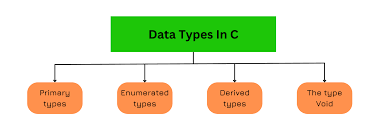
The meaning of Derived Data Types
Arrays
An array is a finite list of elements of the same data type, treated as a unit, of the same name and of the same order. C often uses arrays to do operations with homogeneous sets of values. They arise by gathering other basic forms of data such as int, float or char and saving them in consecutive memory locations.
An array is made up of the number of elements as well as the type of data; therefore, the size of an array will be dependent on them. Consider, e.g. char a[] = HEY, which also declares an array of four characters (the last one of which is a null character), making its total size 32 bits (4 bytes). Arrays are continuously assigned in memory and void ones are not allowed. They are normally one dimensional, although multi dimension ones may be formed e.g. by declaring an array of arrays. When the size of an array is not known, it is called an incomplete array declaration Since an incomplete array declaration does not have an explicit size it must be specified elsewhere in the program.
Major characteristics of arrays are Wild card size at compile time, elements with same type, contiguous memory, and random access to elements. Collections of both primitive and derived data types including user defined data types can be stored in arrays.
Functions
A C function is an independent block of one or several statements with a given name that can be used to accomplish a particular task. The point of program execution in C is usually the main-function. Functions may be declared with a return_type, a function_name and parameters. The return_type is the type of value the meant function can be expected to have at the end of its execution cycle; or void in case there is none. It is possible to define the unique identity of the function by the use of the name_function to enable the utility of the given function in different locations of a given program. The statements defining the actions of the function are contained in the function_body. Parameters simply refer to optional input values that are noted in the function.
A size of a function is calculated by adding the total size of local variables, global variables used, parameters and size of the returned value in case it is an address. An add operation would consume approximately 12 bytes on a 64-bit compiler.
Pointers
Pointers are special variables in the C language which contains addresses of other variables. The size that a pointer takes up in memory is usually predictable but the type is dependent on the type of data that the address of the element it points to is. As an example, as when a pointer holds an address of an integer then this pointer is an integer pointer. The pointers may have addresses of a float, integer, array, string, function, and structure address.
A pointer declaration has the data type, pointer name and the dereference operator. Any pointer can also be various types and can be several levels (e.g. pointer to pointer).
User defined data types
Besides the data types that are derived, C also offers user-defined types of data captured in terms of structures, unions and enumerations.
Structures
A C structure (or struct) is a user defined data type which defines a set of items of potentially different data types sharing a common name. Structures, in contrast, permit collection of heterogeneous information unlike the arrays which require only the collection of homogenous information. The members of a structure occupy adjacent memory locations and the first member begins at the beginning or start address of a structure.
The structure members should be any kind except incomplete such as functions or void. A structure may have pointers to structures of its own type, but not these structures themselves directly as members. Every structure component declared should have a name that is unique to the structure. The compilers allocate the structure members in a sequence in which they are declared. Structures can contain unused bits (padding) so that array members of these structures are well aligned. The size of a structure is the sum of necessary storage size of all members in the structure along with any alignment padding that is needed.
Unions
Another derived form of data type in C happens to be a union which is comparable to a structure, but has one major difference which is that of memory allocation. Every value in a union has the same memory location so at any given time multiple values cannot be stored in multiple members. A union does not allocate any specific memory to its members; instead the memory which a union consumes is that of the largest member of a union. The occupation of other members of the same union will replace the old object that occupies the common storage area.
Unions are not empty and cannot contain an exemplar of itself. Members of unions cannot be functions, or of void or incomplete type, however unions themselves may be pointers to unions of the same type. Unions can be convenient when the size and the type of objects may vary throughout the execution of a program without restricting to constructions machine dependent. The expression to specify unions is the same as structures, and union members should be given distinct names inside the union, but may be identical in other unions or namespaces (using or not using nesting). To say the least, a union of a float, a 5-character array, and a 5-integer array would consume 20 bytes in a 64-bit compiler.
Enumerations (Enums)
A user-defined data type, enumeration or enum in C includes a set of named, integer constants. Enums are the source of flexibility as user names can be substituted by integer constants. These constants have default values which are 0 and are increased by 1. e.g. in enum color{red,blue,green}, in this case, the values are red which is 0, blue which is 1 and green which is 2. One may also explicitly assign values, e.g.: `enum fruit {mango = 10, apple, grapes}`, then `apple` would be equal to 11 and `grapes` to 12.
The main reason for enums is convenience and it only exists so that the programmer can easily represent named choices and give sensible names to integer values.
TOP 7 Best Practices of Writing a C Programming Blog Post (1300 words)
A witty yet informative blog of about 1300 words that captures the audience using the best practices is something that should be planned and followed accordingly particularly in matters concerning technical aspects, such as C programming and derived data types.
Length and structure of content There is plenty of content left.
In the case of a blog with 1000-1500 words, it will be a medium-form content, and it will work to create social media shares. In regard to search engine optimization (SEO), lengthier and highly researched posts consisting of 2450 words or more do better in ranking in Google. Blog posts of 1300 to 1700 words usually work well when it comes to writing articles of the whaT is type of responding to a particular question type. According to research by industry we find that words longer than 1000 words tend to work better, and this works because a greater number of people share it in social media and it ranks better in a search result. HubSpot discovered that blog posts about 2100 to 2400 words provided the highest amount of organic traffic and number of leads.
In a 1300 word blog post, an introduction can take between 100 and 200 words and a conclusion can take the same, and the body has to absorb the remaining number of words which is around 1100 words. The body should be preferably partitioned into 4-5 parts. One should have one main idea in each section with detailed analysis whereas a sub-heading must be used to discuss many topics.
Writing Process
In preparation, make a list of headings, before writing, consider usual questions and the searchable terms. The title will be made beforehand. The main sections should first be established before writing the introduction and conclusion paragraphs.
You should not edit the document at the same time you are writing; doing this may kill the flow and you will even waste more time. The initial phase should be writing the text fast and then revising. Large paragraphs, especially those that contain more than four lines, should be split into bullet points in order to improve the readability of the text by those reading it online. Change the length of sentences and paragraphs and be short. Be direct through the use of an active voice and the use of the word you.
To make a technical blog post it is important to address difficult and obscure topics, provide working code, clarify concepts, detail tradeoffs and disadvantages. Confirm that the information is useful and can be applied in the solution of the problems in the minds of the readers. Introduce drawings and illustrations to shake up the routine and make it more interesting. People can be lured into reading contents by sharing it up by 80 percent using images with a twofold increase.
To back up the facts, attach a single reference or maybe twice concerning authoritative sources. Once a draft is done, revise the whole post in terms of typos and formatting. Regular publication also has a major influence in search performance and optimal results. The best traffic and conversion rates are achieved by those companies that post 2 to 4 blog posts every week.
Uncodemy courses integration
In order to feature the Uncodemy courses, find the courses related to the topic of the C programming e.g. C With Data Structure training. Uncodemy is a coaching service with high quality bootcamps. They also offer professional courses that are job-based in addition to other aspects of placement such as writing resumes and conducting mock-interviews. The students have an option of both face-to-face and virtual training. Uncodemy also has specialized batches to cover students who want to embark in their careers soon. Their mentors are industrial giants and well-known startups. Uncodemy also collaborates with the fortune 500 companies to offer the grooming.
An example of how to apply this idea to an Uncodemy course might look as follows: "To anyone, who wants to know more about C programming and data structure, Uncodemy provides extensive training. In Noida, their C with Data Structure certificate course (after going through training by well-practiced industry practitioners) offers job person placement assistance. Most of the past students have been successful in life as they work in top firms. Uncodemy offers individually tailored growth classes, as well as the choice between an on-site or online instruction, and is therefore convenient both to students with jobs or a long commute in. Besides, they provide special sets of courses to those students who are keen on beginning their career as soon as possible." This incorporation points out the advantages & relevance of the course to the topic of the blog post.