Whether you are a beginner trying to choose your first programming language or someone looking to understand which language best suits a specific project, this detailed comparison will give you clarity.
If you wish to gain hands-on knowledge and real industry skills, check out the programming courses offered by Uncodemy, where expert trainers guide you through both C and Java with practical implementation and project-based learning.
Introduction to C Language
C is often referred to as the "mother of all programming languages." Developed by Dennis Ritchie in the early 1970s at Bell Labs, C played a crucial role in the development of operating systems, most notably UNIX. It is a procedural programming language known for its efficiency and control over hardware. Many modern languages, including C++, C#, and even Java, have their roots in C.
Introduction to Java Language
Java was developed by James Gosling at Sun Microsystems in 1995. Unlike C, Java is an object oriented language that is platform independent. The phrase “write once, run anywhere” perfectly captures Java’s philosophy. Java code is compiled into bytecode which runs on the Java Virtual Machine, making it a favorite for cross platform applications, Android development, and enterprise-level systems.
Key Differences Between C and Java
Let us now examine the difference between C and Java based on various parameters.
1. Programming Paradigm
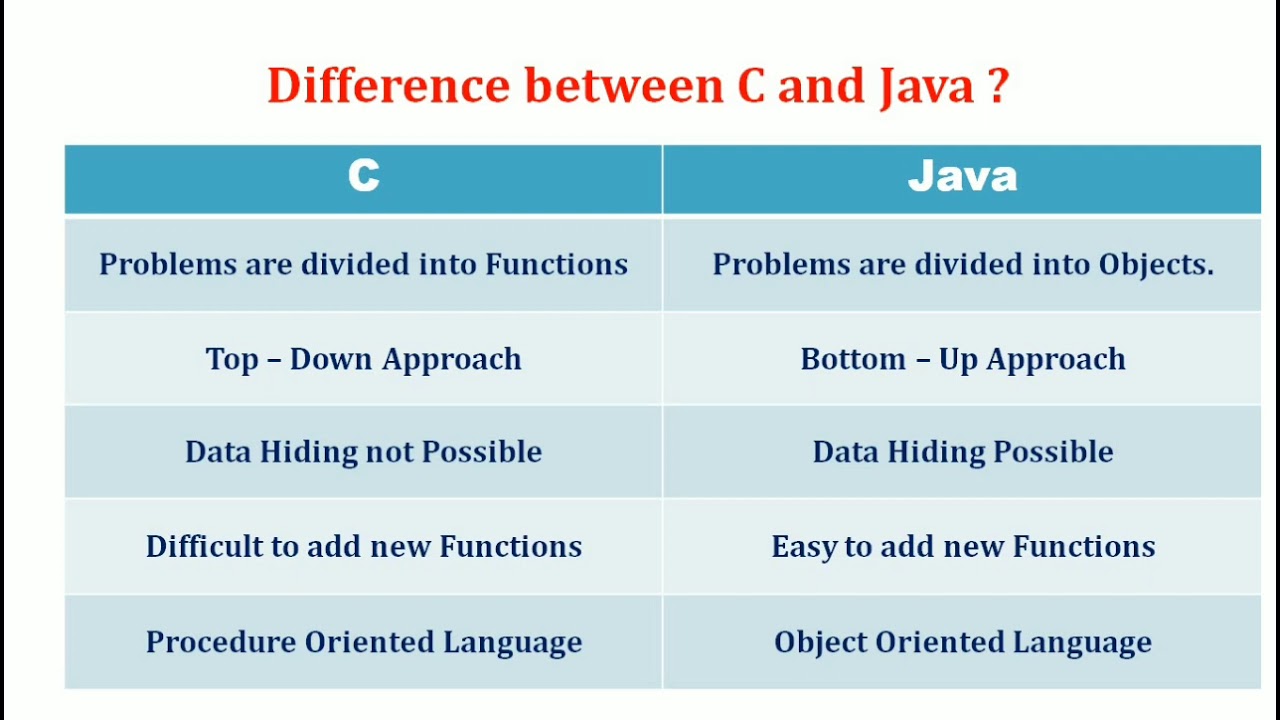
C follows a procedural or structured programming paradigm. It focuses on functions, sequences of tasks, and flow control. Programs are designed step by step, and data is usually processed using a top-down approach.
Java adopts the object oriented programming paradigm. It emphasizes the use of objects and classes. This approach makes Java more modular and reusable. Concepts like inheritance, polymorphism, abstraction, and encapsulation are central to Java.
2. Platform Dependency
C is a platform dependent language. Programs written in C need to be compiled separately for different operating systems. This limits its portability.
Java is platform independent thanks to the Java Virtual Machine. Once compiled, Java programs can run on any system that has the JVM installed. This makes it ideal for applications that require cross platform compatibility.
3. Compilation and Execution
C programs are compiled directly into machine code using a compiler. This makes C programs faster in execution but less flexible when moving between systems.
Java programs are first compiled into bytecode, which is then interpreted and executed by the JVM. While this makes Java a bit slower than C in raw performance, it increases portability and security.
4. Memory Management
C requires manual memory management. Programmers use functions like malloc, calloc, and free to allocate and deallocate memory. This gives precise control but increases the risk of memory leaks and errors.
Java uses automatic memory management through its garbage collector. The Java runtime environment takes care of memory allocation and cleanup, reducing programmer effort and improving safety.
5. Pointers
C supports pointers, which are variables that store the address of another variable. Pointers offer direct memory access, allowing for efficient programming but also introducing complexity and potential security risks.
Java does not support pointers explicitly. Although references are used in Java, they are not as low level or exposed as C pointers. This decision improves program safety and reduces vulnerabilities.
6. Syntax and Complexity
C has a simpler syntax but requires more lines of code to implement complex operations. It is less abstract and demands a deeper understanding of system-level operations.
Java has a more structured and readable syntax, especially for large applications. Its object oriented nature simplifies complex tasks using built in libraries and APIs, reducing the overall code length.
7. Security
C is less secure due to its support for pointers and direct memory manipulation. Buffer overflows, segmentation faults, and memory leaks are common issues in C programming.
Java was designed with security in mind. The JVM acts as a security layer, and Java provides features like exception handling, access modifiers, and strong memory management to create safer applications.
8. Speed and Performance
C generally outperforms Java in terms of speed and execution time. Since C is compiled into native code, it can run faster especially for resource intensive tasks.
Java, while slightly slower, provides reasonable performance for most applications. The tradeoff between performance and portability is usually worth it for modern enterprise and mobile applications.
9. Libraries and Support
C has a limited standard library. While powerful, it lacks built in support for modern features like networking, database connections, and user interfaces.
Java comes with a rich standard library and extensive APIs that support everything from GUI development to network programming and database connectivity.
10. Application Domains
C is widely used in system programming, embedded systems, operating systems, and hardware driver development. Its performance and low-level access make it ideal for environments where resources are limited.
Java is commonly used in web applications, mobile apps (especially Android), enterprise software, and cloud-based systems. Its platform independence and extensive libraries make it suitable for high-level applications.
Syntax Comparison Example
To understand the difference between C and Java, let us look at a simple example of a “Hello World” program in both languages.
C Program:
Copy Code
c

CopyEdit

#include <stdio.h>

int main() {

    printf("Hello, World!");

    return 0;

}
Java Program:
Copy Code
java

CopyEdit

public class HelloWorld {

    public static void main(String[] args) {

        System.out.println("Hello, World!");

    }

}
While both programs achieve the same output, Java uses a class based structure, whereas C uses a procedural structure with functions.
Pros and Cons of C
Pros:
- High performance
- Low level hardware access
- Great for system-level programming
- Simple syntax
Cons:
- No built in memory management
- Difficult error handling
- Platform dependent
- Limited support for modern applications
Pros and Cons of Java
Pros:
- Platform independent
- Object oriented and modular
- Rich set of libraries and APIs
- Automatic memory management
- Strong security features
Cons:
- Slower than C in raw execution
- More memory consumption
- Requires JVM to run
Which One Should You Learn First?
If you are just starting out, your choice between C and Java depends on your goals.
Choose C if:
- You want to understand the fundamentals of programming and memory management
- You are interested in system programming or embedded systems
- You prefer a language that gives direct control over hardware
Choose Java if:
- You want to build web or mobile applications
- You are interested in object oriented design
- You want a language that balances simplicity and functionality
A strong recommendation is to learn both. Starting with C helps build a strong foundation, while Java opens doors to enterprise level development and a broad range of job opportunities.
To learn both languages from scratch and apply them in real world projects, explore the comprehensive courses at Uncodemy. Whether you are a beginner or aiming to upskill, Uncodemy’s expert guidance and structured curriculum will give you the edge you need in today’s competitive job market.
Conclusion
Understanding the difference between C and Java is essential for choosing the right tool for your programming journey. While C gives you a deeper understanding of how computers work, Java prepares you for developing applications across platforms with ease and security. Each language has its strengths and use cases. The real skill lies in knowing which one to use and when.
As technology continues to evolve, mastering foundational languages like C and Java ensures you stay relevant, adaptable, and in demand. Whether you are building an operating system or a mobile app, the knowledge of these two powerful languages will serve as a strong asset in your development toolkit.
So, dive in, practice coding, and make the most of your learning journey with the right guidance and resources. Start today with Uncodemy and code your way to success.