If you're eager to dive deeper into Dijkstra’s Algorithm and related topics, consider checking out the Data Structures and Algorithms Course in Noida offered by Uncodemy. This course is packed with real-world applications, hands-on coding experiences, and a thorough analysis of the time complexity of different algorithms.
What Is Dijkstra’s Algorithm
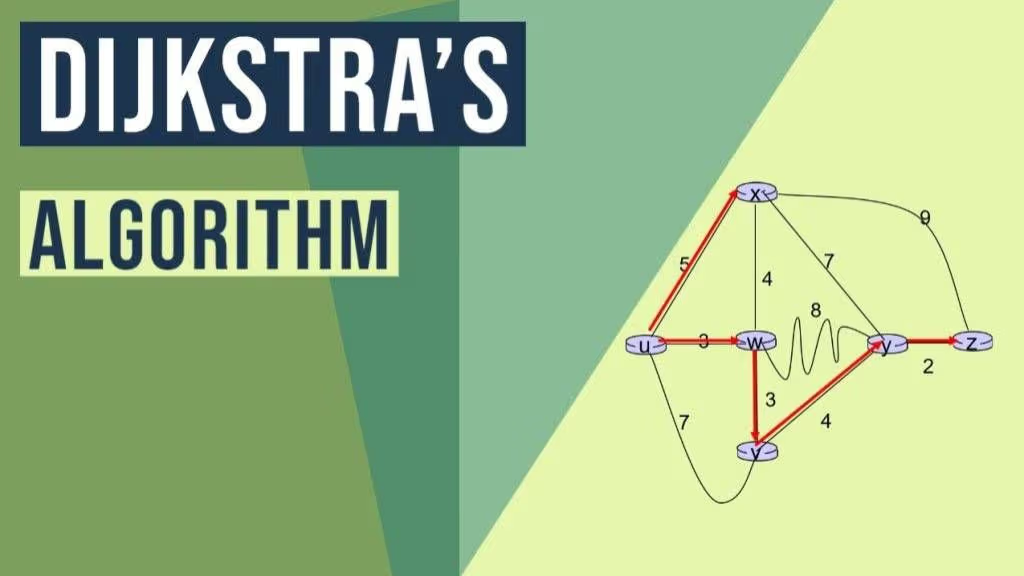
Dijkstra’s Algorithm is all about finding the shortest path from a starting vertex to all other vertices in a graph that has non-negative edge weights. The algorithm constructs a shortest path tree by consistently picking the unvisited node that has the smallest known distance and then updating the distances to its neighboring nodes.
This greedy strategy ensures that the shortest path is discovered in a methodical and efficient manner. However, the speed of this process largely hinges on the data structures employed for selecting the next node and updating distances.
Why Time Complexity Analysis Matters
Time complexity is a vital consideration for algorithms, especially in real-world scenarios where performance and scalability are key. Understanding the time complexity of Dijkstra’s Algorithm is essential for:
- Selecting the most suitable implementation based on the graph's size and structure
- Predicting performance for both worst-case and average-case scenarios
- Enhancing systems like navigation tools, routers, and logistics software
- Making educated choices between various path-finding algorithms
Time Complexity Using Different Data Structures
Using Simple Arrays
At its core, an array serves to keep track of distances. Each time the algorithm runs, it goes through the entire array to find the vertex with the smallest tentative distance.
- Picking the next vertex takes linear time based on the number of vertices.
- Each of the V vertices is selected just once.
- In a dense graph, edge relaxation can happen V squared times.
So, the time complexity here is O(V²). While this method is straightforward to implement, it doesn't hold up well for larger graphs.
Using Binary Heaps and Adjacency Lists
In a more refined approach, we use a binary heap as a priority queue, and the graph is represented with adjacency lists.
- Extracting the vertex with the smallest distance takes logarithmic time.
- Each edge is relaxed once, and updating the distance in the priority queue also takes logarithmic time.
- This results in a total time complexity of O(E log V).
This technique is significantly quicker, especially for sparse graphs where the number of edges is nearly equal to the number of vertices.
Using Fibonacci Heaps
Fibonacci heaps take it a step further by allowing constant time decrease-key operations and logarithmic time extract-min operations.
- The overall time complexity becomes O(E + V log V).
Although this is the most efficient method in theory, Fibonacci heaps can be quite complex to implement and are often not favoured in real-world applications.
Best Case, Worst Case, and Average Case Scenarios
- In the best-case scenario, the graph is sparse and efficiently managed with a binary heap, leading to a time complexity of about O(E log V).
- On the flip side, in the worst-case scenario, if we use an array-based implementation on a dense graph, the complexity jumps to O(V squared).
- Typically, the average case falls somewhere in between these two extremes, depending on how the graph is structured and the implementation chosen.
Space Complexity of Dijkstra’s Algorithm
When it comes to Dijkstra’s Algorithm, memory usage includes:
- The graph itself, which is usually represented with adjacency lists
- A distance array that keeps track of the shortest path to each vertex
- A priority queue for picking the next vertex
- Overall, the space complexity is O(V + E), which is generally acceptable for most real-world applications.
import time
The Role of Priority Queues
The efficiency of Dijkstra’s Algorithm is significantly affected by the type of data structure used for the priority queue.
- Binary heaps strike a nice balance between ease of use and performance
- Fibonacci heaps provide the best theoretical performance, but they can be quite complex
- Simple arrays are easy to understand but can be inefficient for larger graphs
Choosing the right structure is essential for achieving a good balance between code maintainability and performance.
When to Use Dijkstra’s Algorithm
- You should think about using Dijkstra’s Algorithm when:
- All the edge weights in your graph are non-negative
- You need to find the shortest path from a single source to all other nodes
- The graph is either sparse or you can utilize an efficient data structure like a heap
On the flip side, steer clear of Dijkstra’s Algorithm if your graph has negative edge weights. In those situations, the Bellman-Ford algorithm is a better choice.
Optimizations and Advanced Considerations
- You can apply early stopping if you know your target node, allowing the algorithm to halt once that node’s shortest path is determined
- For multiple queries in static graphs, preprocessing with Dijkstra from all sources or using A* search might be more efficient
- Bidirectional Dijkstra can be employed to search from both the source and target, which helps to minimize the search space
These optimizations can significantly enhance performance in real-time systems or environments with high-frequency queries.
Related Course
If you want to build a solid foundation in graph theory, path-finding algorithms, and complexity analysis, check out the Data Structures and Algorithms Course in Noida offered by Uncodemy. This course is perfect for students, job seekers, and professionals looking to boost their problem-solving skills and ace coding interviews.
Conclusion
Dijkstra’s Algorithm is a powerful and crucial tool for tackling shortest path problems. However, its efficiency largely hinges on the data structures you choose. The time complexity can vary from O(V²) to O(E + V log V), depending on how you implement it. Grasping these nuances will help you write efficient programs and optimize for real-world applications.
Whether you’re developing a route planner, a logistics tool, or a communication network, knowing when and how to apply Dijkstra’s Algorithm can truly make a difference.
If you’re eager to master this algorithm along with other advanced techniques, consider enrolling in the Data Structures and Algorithms Course in Noida by Uncodemy to elevate your skills to the next level.
Frequently Asked Questions (FAQs)
Q1: What’s the best time complexity for Dijkstra’s Algorithm?
The best time complexity you can achieve is O(E + V log V) when using a Fibonacci heap, but in practice, binary heaps are usually the go-to choice.
Q2: Can Dijkstra’s Algorithm work with negative weights?
No, it can’t. If there’s any edge with a negative weight, it won’t function correctly. You should use the Bellman-Ford algorithm instead.
Q3: Why do we see binary heaps used more often than Fibonacci heaps?
Binary heaps are simpler to implement and still perform well. While Fibonacci heaps have better theoretical performance, they’re more complicated and not commonly used in real-world applications.
Q4: What’s the space complexity of Dijkstra’s Algorithm?
The space complexity is O(V + E), which takes into account the graph, the distances, and the priority queue.
Q5: How does the density of a graph impact time complexity?
In sparse graphs, the time complexity is close to O(E log V). However, in dense graphs, it can get as high as O(V²), especially with basic implementations.
Q6: Can Dijkstra’s Algorithm be applied in parallel computing?
Absolutely! There are parallel versions of Dijkstra’s Algorithm that are utilized in high-performance computing, but they do require careful handling of shared data structures.
Q7: What if I use an array for the priority queue?
If you go that route, the time complexity jumps to O(V²), which isn’t efficient for larger graphs.
Q8: Is Dijkstra’s Algorithm used in real-time systems?
Yes, it’s commonly used in GPS systems, network routing, and game development. Various optimizations are made to ensure it meets real-time demands.
Q9: How does Dijkstra differ from the A* Algorithm?
A* uses heuristics to steer the search, making it quicker for certain problems where the goal node is known. Dijkstra treats all nodes equally in its search.
Q10: Where can I dive deeper into graph algorithms?
You can check out the Data Structures and Algorithms Course in Noida offered by Uncodemy for comprehensive training, complete with real-world examples and coding practice.