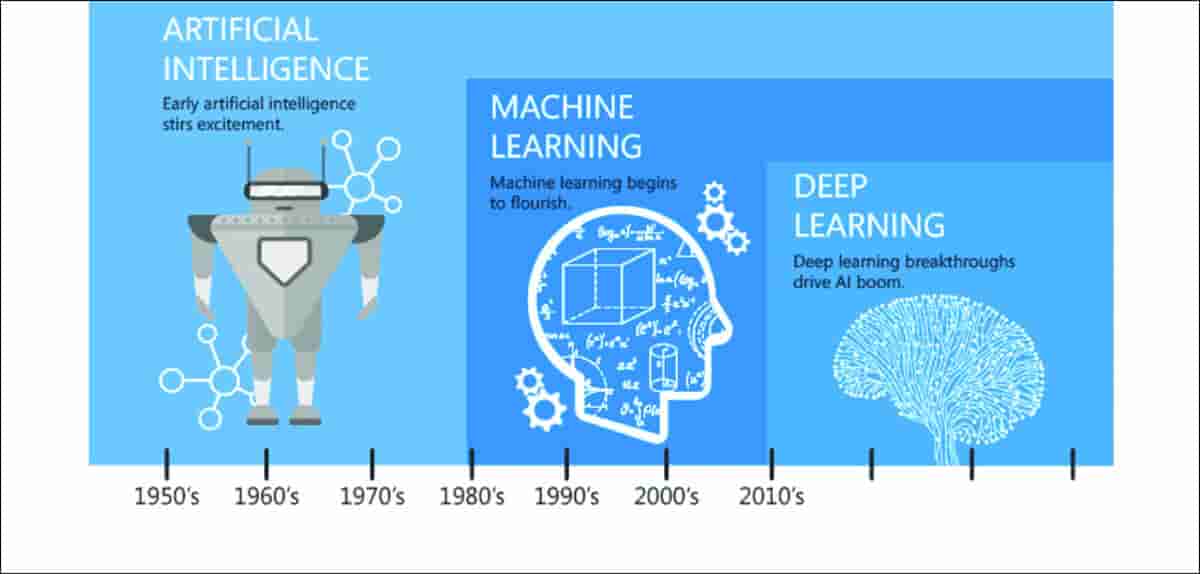
1. Artificial Intelligence (AI)
Artificial Intelligence (AI) is the broadest concept, representing the endeavour to create machines or systems that can simulate human intelligence. The goal of AI is to enable computers to perform tasks that typically require human cognition, such as reasoning, learning, problem-solving, understanding language, recognizing patterns, and making decisions.
- Goal: To create intelligent agents that perceive their environment and take actions that maximize their chance of achieving their goals. It aims to make machines "think" like humans or at least mimic human cognitive functions.
-
- Key Characteristics:
- Broad Scope: Encompasses various techniques, from simple rule-based systems to complex neural networks.
-
- Cognitive Simulation: Focuses on replicating human-like intelligence.
-
- Problem Solving: Aims to solve problems that traditionally require human intellect.
-
- Typical Applications:
- Robotics: Intelligent robots performing complex tasks.
-
- Expert Systems: Systems that mimic the decision-making ability of a human expert.
-
- Natural Language Processing (NLP): Chatbots, language translation, sentiment analysis.
-
- Computer Vision: Facial recognition, object detection in images/videos, self-driving cars.
-
- Game Playing: AI opponents in video games.
-
2. Machine Learning (ML)
Machine Learning (ML) is a subset of Artificial Intelligence. It's a specific approach to achieving AI that focuses on enabling systems to learn from data without being explicitly programmed. Instead of hard-coding rules, ML algorithms are "trained" on large datasets, allowing them to identify patterns, make predictions, or take decisions based on that data.
- Goal: To enable machines to learn from data and improve their performance over time without explicit programming. It's about building models that can make predictions or decisions based on patterns identified in data.
-
- Key Characteristics:
- Data-Driven: Relies heavily on data for learning and improvement.
-
- Algorithmic Focus: Uses various algorithms (e.g., linear regression, decision trees, support vector machines, clustering).
-
- Learning from Experience: Performance improves as more data is processed.
-
- Types of ML:
- Supervised Learning: Learning from labelled data (e.g., predicting house prices based on historical data with known prices).
-
- Unsupervised Learning: Finding patterns in unlabelled data (e.g., customer segmentation).
-
- Reinforcement Learning: Learning through trial and error, receiving rewards or penalties (e.g., AI playing games).
-
- Typical Applications:
- Recommendation Systems: Product recommendations on e-commerce sites (e.g., Amazon, Netflix).
-
- Spam Detection: Classifying emails as spam or not.
-
- Fraud Detection: Identifying unusual patterns in financial transactions.
-
- Predictive Analytics: Forecasting sales, predicting customer churn.
-
3. Deep Learning (DL)
Deep Learning (DL) is a specialized subset of Machine Learning. It uses Artificial Neural Networks (ANNs) with multiple layers (hence "deep") to learn complex patterns from vast amounts of data. These neural networks are inspired by the structure and function of the human brain. DL excels at processing unstructured data like images, audio, and raw text.
- Goal: To learn complex patterns and representations from large datasets using multi-layered neural networks, often for tasks that are difficult for traditional ML (e.g., image recognition, natural language understanding).
-
- Key Characteristics:
- Neural Networks: Utilizes deep Artificial Neural Networks.
-
- Hierarchical Feature Learning: Automatically learns features from raw data, eliminating the need for manual feature engineering.
-
- Big Data Dependent: Requires very large datasets for optimal performance.
-
- High Computational Power: Often requires GPUs or specialized hardware for training.
-
- Types of DL Architectures:
- Convolutional Neural Networks (CNNs): Primarily used for image and video analysis.
-
- Recurrent Neural Networks (RNNs) / Long Short-Term Memory (LSTMs): Used for sequential data like text and speech.
-
- Transformers: Revolutionized NLP and are now used in various domains, powering Large Language Models (LLMs).
-
- Typical Applications:
- Image Recognition: Identifying objects, faces, and scenes in images.
-
- Speech Recognition: Converting spoken language to text.
-
- Natural Language Understanding/Generation: Powering LLMs, chatbots, content generation.
-
- Autonomous Vehicles: Processing sensor data for navigation and decision-making.
-
4. Data Science
Data Science is an interdisciplinary field that combines scientific methods, processes, algorithms, and systems to extract knowledge and insights from structured and unstructured data. It integrates elements from statistics, computer science, mathematics, domain expertise, and increasingly, AI and ML. The goal of Data Science is to turn raw data into actionable intelligence that can guide decision-making and strategic planning for businesses and organizations.
- Goal: To extract meaningful insights and knowledge from data to solve real-world problems and drive informed decision-making. It's about the entire process of working with data, from collection to communication of insights.
-
- Key Characteristics:
- Multidisciplinary: Blends statistics, mathematics, computer science, and domain knowledge.
-
- Problem-Oriented: Focuses on solving specific business or scientific problems using data.
-
- End-to-End Process: Involves data collection, cleaning, analysis, modelling, visualization, and communication.
-
- Actionable Insights: Aims to provide practical recommendations.
-
- Typical Applications:
- Predictive Analytics: Forecasting future trends (e.g., stock prices, disease outbreaks).
-
- Customer Segmentation: Grouping customers for targeted marketing.
-
- Market Basket Analysis: Identifying product purchase patterns.
-
- Risk Assessment: Evaluating financial or operational risks.
-
- A/B Testing: Optimizing website features or marketing campaigns.
-
-
The Interrelationship: A Nested Hierarchy
The relationship between these four fields can be visualized as a set of concentric circles or a nested hierarchy:
- AI (Artificial Intelligence) is the outermost and broadest circle. Its ambition is to create intelligent machines.
-
- ML (Machine Learning) is a core subset of AI. It's one of the primary methods used to achieve AI, focusing on teaching machines to learn from data.
-
- DL (Deep Learning) is a specialized subset of ML. It's a particular technique within ML that uses deep neural networks to learn complex patterns.
-
- Data Science is an overarching field that uses AI, ML, and DL as tools and techniques to extract insights and solve problems from data. Data Scientists leverage these technologies, along with statistics and domain knowledge, to drive business value.
-
In essence:
- AI is the big idea of intelligence.
-
- ML is how we get computers to learn without being explicitly programmed.
-
- DL is a powerful technique for ML that uses neural networks.
-
- Data Science is the practice of using all these tools (and more) to derive insights and make decisions from data.
-
-
Uncodemy Courses for Mastering These Domains
Uncodemy offers comprehensive programs designed to equip you with the skills needed across these interconnected fields:
- Data Science Courses: This flagship program provides a holistic understanding of the entire Data Science lifecycle. You'll learn Python programming, statistics, data visualization, machine learning, deep learning, Natural Language Processing (NLP), and data wrangling. This course is ideal for becoming a well-rounded Data Scientist who can leverage AI, ML, and DL techniques.
-
- AI & Machine Learning Courses: These courses delve deeper into the theoretical and practical aspects of Artificial Intelligence and Machine Learning algorithms. You'll gain expertise in building, training, and deploying various AI models using frameworks like TensorFlow and PyTorch, which are the backbone of advanced ML and DL applications. This is perfect for those aiming for roles like ML Engineer or AI Engineer.
-
- Python Programming Course: Python is the lingua franca for Data Science, ML, and DL. Uncodemy's Python Programming course provides the indispensable coding skills needed to implement AI algorithms, manipulate large datasets, and build data pipelines.
-
- Prompt Engineering Course: As Large Language Models (LLMs) become more prevalent across AI applications, Prompt Engineering skills are increasingly valuable. This course teaches you how to effectively communicate with LLMs to leverage them efficiently for various tasks, a skill that benefits all four domains, especially in content generation, data summarization, and understanding complex AI models.
-
-
Conclusion
While the terms Artificial Intelligence, Machine Learning, Deep Learning, and Data Science are distinct, they form a powerful ecosystem that is driving innovation across industries. AI is the overarching vision of intelligent machines; ML is a method for achieving AI by learning from data; DL is an advanced technique within ML using neural networks; and Data Science is the practical discipline that leverages all these tools to extract actionable insights from data and solve real-world problems. By understanding these differences and investing in comprehensive training from institutions like Uncodemy, you can strategically position yourself for a successful career in this dynamic and transformative technological era.