Have you ever attempted to complete a large jigsaw puzzle? Most individuals do not knock the puzzle off the table and just randomly pick pieces to try and piece it back together. Typically, they would separate the edge pieces, group like colors together, and build smaller sections of the overall image before moving to combine those smaller sections together. This practical approach is a perfect model of the divide and conquer algorithm in programming, taking a pleasurable task and breaking it into smaller steps.
The divide and conquer algorithm is like having a super way-organized friend, without ever being overloaded, because they know the secret of breaking up big tasks into smaller, actionable items. You may be sorting thousands of numbers or looking through giant sets of data. This divide-and-conquer model will allow you to take something that seems impossible and use algorithms to achieve simple solutions.
Understanding the Divide and Conquer Algorithm
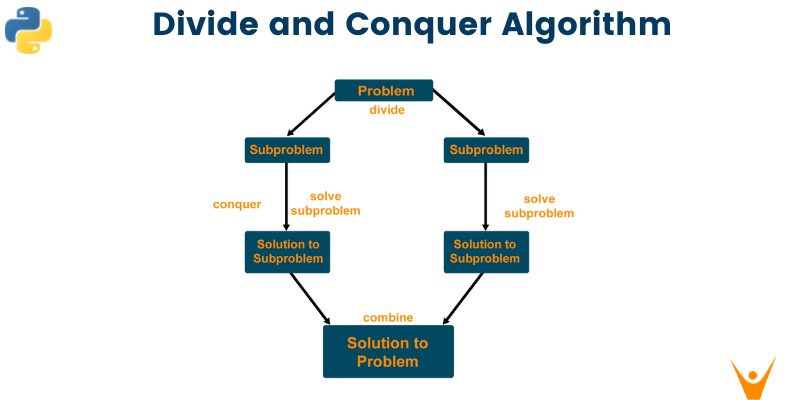
At its core, the divide and conquer algorithm is a simple three-step process that has been used to solve complex problems for many years now. It is called "divide, solve, and combine" to signify the process of transforming difficult problems into damages done about a mess.
The divide and conquer algorithm works by recursively breaking a problem into subproblems until subproblems are small enough that the algorithm can be solved outright. A good way to think about this particular algorithm is as if you were peeling an onion - just keep peeling layer by layer until you reach the simple part that is manageable.
These three processes compose the divide and conquer algorithm:
1. Divide means divide the original problem into a number of smaller subproblems of the same "type".
2. Conquer means solve the subproblems recursively (or simply if they are small enough).
3. Combine means combine the solutions from the subproblems to create a solution to the original problem.
What this process ensures is that the divide and conquer algorithm can provide a "for all" benefit to problems that would seem difficult without this systematic approach.
How the Divide and Conquer Algorithm Works in Practice
Let us look at a simple example of the divide and conquer algorithm in practice. Imagine you want to find the largest number in an array of 1000 elements.
Traditional method: check every element one by one, easy, but not very fun.
Divide and conquer method:
Divide the array in half.
Recursively find the maximum value in each half.
Compare the maximums to get the overall maximum.
While this seems excessively complicated for finding a maximum, the divide and conquer algorithm shines in more complex situations, such as performing sorting algorithms, multiplying matrices, or searching.
The key advantage of using the divide and conquer algorithm lies in its *recursive* approach to the solution. Each subproblem looks nearly identical to the original problem, just smaller. With this similarity, we can work through the same solution strategy again and again, making a very clean and efficient process.
Classic Examples of the Divide and Conquer Algorithm
Merge Sort: The Poster Child
Merge Sort is the most well-known example of the divide-and-conquer algorithm. It divides the array in half and determines the sorting for both halves recursively, eventually merging the two halves back together. The end product is a perfectly sorted array with O(n log n) time complexity.
Quick Sort: The Speed Demon
Quick Sort uses the divide-and-conquer algorithm by selecting a pivot element, partitioning the array around that pivot, and recursively sorting the resulting sub-arrays. When the Quick Sort is written well, it is often the fastest sorting algorithm in practice.
Binary Search: The Efficiency Expert
Binary Search is the iteration of the divide-and-conquer algorithm as it continually divides a sorted array in half, eliminating half of the possibilities with every comparison. It's similar to somebody asking you to guess a number between 1 and 100, and all you can do is ask questions, and every question has to be a guess. You will always guess the middle number first.
Implementing the Divide and Conquer Algorithm in C
Since many programmers start their journey with C, let's look at how to implement the divide and conquer algorithm using this fundamental language. Here's a classic merge sort implementation:
                    #include
                    #include

                    void merge(int arr[], int left, int mid, int right) {
                        int i, j, k;
                        int n1 = mid - left + 1;
                        int n2 = right - mid;

                        int L[n1], R[n2];

                        for (i = 0; i < n1; i++)
                            L[i] = arr[left + i];
                        for (j = 0; j < n2; j++)
                            R[j] = arr[mid + 1 + j];

                        i = 0; j = 0; k = left;

                        while (i < n1 && j < n2) {
                            if (L[i] <= r[j]) { arr[k]="L[i];" i++; } else j++; k++; while (i < n1) (j n2) void mergesort(int arr[], int left, right) if (left mid="left" + (right - left) 2; mergesort(arr, mid); 1, right); merge(arr, mid, pre>
This implementation showcases the divide and conquer algorithm perfectly – we divide the array, recursively sort the parts, then combine them back together.
Advantages of the Divide and Conquer Algorithm
Intelligent Efficiency
In general, the divide and conquer method can produce better time complexity compared to methods that rely on brute force by systematically breaking down problems to avoid doing the same work twice and by concentrating efforts where they are most useful.
Parallelization Capabilities
The independent nature of subproblems in divide and conquer algorithms means that it is often possible to solve the subproblems all at once using multiple cores on a multi-core processor, which provides additional value in modern computing.
Cleaner Code
The recursive nature of divide-and-conquer algorithms generally leads to code that is more digestible than a linear method. The logic reflects the mindset of how we naturally approach problems, so both we and other developers can understand the code more easily.
Approach to Problem Solving
Once you understand the divide and conquer mentality, you will begin to approach complicated problems by trying to dissect the problem into smaller parts.
Mastering C Programming with Uncodemy C Language Course in Noida
If you're serious about implementing algorithms like divide and conquer effectively, having a solid foundation in C programming is essential. The Uncodemy C language course in Noida provides comprehensive training that goes beyond syntax to teach algorithmic thinking and efficient implementation techniques.
The structured approach of Uncodemy C language course in Noida ensures you understand not just how to write code, but how to write efficient, maintainable code that implements complex algorithms like divide and conquer. With hands-on projects and experienced instructors, you'll gain the confidence to tackle real-world programming challenges.
When to Use the Divide and Conquer Algorithm
Perfect Scenarios:
Problems that can be broken into similar subproblems
When subproblems are independent of each other
Situations where combining solutions is straightforward
Problems where brute force approaches are too slow
Less Ideal Situations:
When the overhead of recursion outweighs the benefits
Problems with highly overlapping subproblems (dynamic programming might be better)
Very small datasets where simple algorithms are sufficient
The Future of Divide and Conquer
As computing continues to evolve to parallel and distributed models, the divide and conquer algorithm will only be more useful because it is easily parallelizable. In fact, divide and conquer has long been regarded as the foundation of most modern high-performance computing.
Learning the divide and conquer algorithm is not only to solve today's problems, but also to develop algorithmic thinking skills needed to more effectively tackle tomorrow's problems.
Regardless of which programming you are doing in your future, whether it is optimizing database queries utilizing relational techniques, processing and analyzing big data, or developing the next big application, develop your ability to think like this – divide and conquer – and be armed with those skills. There is an endless journey to understanding algorithms like divide and conquer, but every step you take only builds your specific problem-solving abilities, while on top of that, every step opens up new opportunities in the fields of software development, data science, and computer science research.
Frequently Asked Questions (FAQs)
Q: What's the main advantage of the divide and conquer algorithm over other approaches?
A: The divide and conquer algorithm often achieves better time complexity by breaking problems into smaller, manageable pieces, avoiding redundant work and enabling parallel processing.
Q: When should I avoid using the divide and conquer algorithm?
A: Avoid it when recursion overhead is too high, subproblems overlap significantly (use dynamic programming instead), or when dealing with very small datasets where simple algorithms suffice.
Q: What's the difference between divide and conquer algorithm and dynamic programming?
A: Divide and conquer solves independent subproblems, while dynamic programming handles overlapping subproblems by storing and reusing solutions to avoid redundant calculations.
Q: Can the divide and conquer algorithm always guarantee better performance?
A: No, it depends on the problem. While divide and conquer often improves time complexity, it may increase space complexity due to recursion and isn't always optimal for every scenario.
Q: How does Uncodemy C language course in Noida help with algorithm implementation?
A: Uncodemy C language course in Noida provides hands-on training in C programming fundamentals, algorithmic thinking, and efficient implementation techniques essential for mastering divide and conquer algorithms.
Q: What's the typical time complexity of divide and conquer algorithms?
A: Most divide and conquer algorithms achieve O(n log n) time complexity, though this varies based on how the problem divides and how solutions combine.