Factorial Program in C++: Iterative and Recursive Methods
The factorial of a number is a key concept in both mathematics and programming. You’ll often
find it popping up in areas like combinatorics, probability, number theory, and computer science. In this guide,
we’re going to take a closer look at how to implement a factorial program in C++, covering both iterative and
recursive methods, complete with clear examples and thorough explanations.
If you’re just starting out and want to enhance your logic-building skills in C++, or if
you’re gearing up for interviews, this tutorial is going to be incredibly helpful.
This blog is brought to you by Uncodemy – India’s top training institute.
Sign up for the C Programming Course in Noida (uncodemy.com) to learn programming from the
ground up.
What is a Factorial?
Mr. Snehank Singh
/ 11 days
13
22 min read
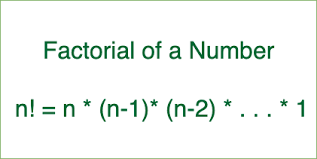
The factorial of a non-negative integer n is the product of all positive integers that are
less than or equal to n. It’s represented as n!.
Mathematically, it looks like this:
n! = n × (n-1) × (n-2) × ... × 2 × 1

For example:

5! = 5 × 4 × 3 × 2 × 1 = 120

And remember, 0! = 1 (that’s just how it’s defined).
Factorial Program Using Iteration in C++
The iterative method uses a loop (usually a for or while loop) to multiply the numbers from
1 up to n.
Code: Iterative Factorial Program
#include
using namespace std;

int main() {
	int n;
	long long factorial = 1;

	cout << "Enter a positive integer: ";
	cin >> n;

	if (n < 0)
    	cout << "Factorial is not defined for negative numbers.";
	else {
    	for (int i = 1; i <= n; ++i) { factorial *="i;" } cout << "factorial of " n p1-home">Enter a positive integer: 6
Factorial of 6 = 720
Factorial Program Using Recursion in C++
Recursion is a method where a function calls itself, and it works beautifully for solving mathematical problems like calculating factorials.
Code: Recursive Factorial Program
#include
using namespace std;

long long factorial(int n) {
	if (n == 0)
    	return 1;
	else
    	return n * factorial(n - 1);
}

int main() {
	int n;
	cout << "Enter a positive integer: ";
	cin >> n;

	if (n < 0)
    	cout << "Factorial is not defined for negative numbers.";
	else
    	cout << "Factorial of " << n << " = " << factorial(n);

	return 0;
}
Output
Enter a positive integer: 5 Factorial of 5 = 120
Iterative vs Recursive Approach
Feature>
Iterative
Recursive
Uses Loop
Yes
No
Function Calls
No
Yes
Memory Usage
Low
Higher due to stack usage
Readability
Moderate
High for small problems
Performance
Faster
Slower for large inputs
Common Mistakes to Avoid
- Forgetting the base case in recursion can lead to infinite loops and stack overflow,
which is definitely something you want to avoid.
- Using incorrect data types is another pitfall – make sure to use long long or unsigned
long when dealing with large factorials.
- Don’t forget that negative inputs are a no-go; factorials simply aren’t defined for
negative integers.
- And watch out for overflow! A C++ int can overflow after calculating 12!. It’s best to
stick with long long for those larger values.
Why Learn Factorial Logic?
Understanding how to write a factorial program goes beyond just crunching numbers. It lays
a strong groundwork in logic, loops, recursion, and function usage in programming.
Plus, factorial logic pops up in various areas like:
- Combinatorics: nCr, nPr
- Permutations and Combinations
- Probability Theory
- Dynamic Programming
- BigInteger challenges in competitive programming
Factorial for Large Numbers in C++
Standard int or long data types just can’t handle massive factorials like 100! or 200!. In
these cases:
Consider using arrays or strings to keep track of intermediate results.
You might also want to explore libraries like GMP or BigInteger in languages like Java or
Python for better handling of large numbers.
Factorial and Recursion Depth
Every time a recursive call is made, a new frame gets added to the call stack. When dealing
with large numbers, like n = 10000, this can lead to a stack overflow error. In these situations, using
iteration is a safer bet unless you’re leveraging tail recursion optimizations, which aren’t available in
standard C++.
Understanding Time and Space Complexity in Factorial Calculations
When diving into algorithms like factorials, it’s essential to take a closer look at their
time and space complexity. This analysis helps developers pick the most efficient method, especially when
dealing with large datasets or working in environments where resources are limited.
Iterative Method (Time Complexity: O(n), Space Complexity: O(1)):
The iterative approach relies on a straightforward loop to multiply numbers from 1 to n. It
operates in linear time—O(n)—because each multiplication is a single action performed once for every loop
iteration. The space requirement is minimal (constant space), as it only needs a handful of variables, no
matter how large n gets. This makes the iterative method a top choice for efficiency in both time and
memory.
Recursive Method (Time Complexity: O(n), Space Complexity: O(n)):
On the other hand, the recursive method, while elegant and more aligned with mathematical
definitions, comes with a higher space complexity due to the function call stack. Each time a function is
called, its state is added to the stack until the base case is hit. This means that for a given n, there are
n function calls stacked up in memory. While this is manageable for smaller n, it can lead to stack overflow
errors when n gets too large due to memory constraints.
Thus, developers need to weigh the balance between clarity and performance. In applications
where performance is critical, especially with large numbers, the iterative method is often the go-to
choice.
Tail Recursion and Its Relevance in Modern Programming
Tail recursion is a unique form of recursion where the recursive call is the very last
thing that happens in the function. In other words, once the recursive call is made, there’s nothing else
left to do. This characteristic allows tail-recursive functions to benefit from an optimization technique
known as tail call optimization (TCO).
With tail call optimization, the compiler can reuse the current function’s stack frame for
the next recursive call instead of creating a new one. This not only saves stack memory but also enables
recursive algorithms to handle much larger inputs.
However, it’s important to note that C++ doesn’t require tail call optimization, so whether
it happens or not really depends on the compiler and its settings. Still, writing your recursive logic in a
tail-recursive manner is a smart programming practice. It sets your code up nicely for languages that do
support TCO, like Scala, Scheme, or Haskell.
For instance, take a look at this tail-recursive version of the factorial function in C++.
int tailFactorial(int n, int accumulator = 1) {
	if (n == 0 || n == 1)
    	return accumulator;
	return tailFactorial(n - 1, n * accumulator);
}
In the function above, the result is passed along through the accumulator parameter.
Because the recursive call is the final statement, compilers that support Tail Call Optimization (TCO) can
make the stack usage more efficient. While this might not boost performance in standard C++, the overall
structure does enhance readability and maintainability.
Factorial in Real-World Applications
Factorials are crucial in a variety of fields:
- Data Science: They’re used in combinations and binomial coefficients.
- Cryptography: Factorial-based logic is applied in key generation.
- Gaming: They help determine combinations of characters or levels.
- Mathematics Research: Factorials show up in series expansions and
calculus.
Why Choose Uncodemy to Learn C Programming?
If you’re serious about mastering C or C++, take a look at the C Programming Course in
Noida (uncodemy.com). Uncodemy is a highly-rated institute that offers:
- Hands-on projects and live coding sessions
- Experienced mentors from top MNCs
- Support for your questions and job placement assistance
- Flexible schedules with both offline and online options
Whether you’re just starting out or gearing up for tech interviews, Uncodemy is the perfect
place to launch your career.
Conclusion
Grasping how to write a factorial program in C++ is an essential milestone for every
budding programmer. By diving into both iterative and recursive techniques, you not only sharpen your
problem-solving skills but also make your code clearer and more understandable.
But don’t just stop here—why not branch out and explore other concepts like calculating
permutations, combinations, or even implementing factorials using tail recursion or memoization?
Kickstart your programming adventure with the C Programming Course in Noida
(uncodemy.com) and learn practical coding skills from seasoned industry professionals.
FAQ: Factorial Program in C++
Q1. What is the factorial of 0?
The factorial of 0 is defined as 1.
Q2. What is the maximum value of n for which factorial can be calculated using int
in C++?
Typically, you can calculate up to 12! or 13! with a 32-bit int. For anything larger, it's
best to switch to long long.
Q3. What’s the difference between recursion and iteration in C++?
Recursion involves calling functions, while iteration relies on loops. Recursion can be
more intuitive, but it tends to use more memory.
Q4. Is recursion better than iteration for calculating factorials?
Not necessarily. While recursion is neat and clean, it can be slower and poses a risk of
stack overflow with larger inputs.
Q5. How can I calculate large factorials in C++?
For very large numbers beyond 20!, consider using arrays or external libraries like GMP.