Floyd’s Algorithm Explained with Real World Applications
In the vast landscape of computer science, algorithms serve as the guiding principles that help machines process information, solve problems, and optimize outcomes. Among these, Floyd’s algorithm (commonly referred to as the Floyd-Warshall algorithm) stands as a cornerstone in the study of graph theory, particularly when dealing with shortest path problems. For any student or professional enrolled in an Algorithms Course in Noida, understanding Floyd’s algorithm is crucial, as it opens the door to mastering efficient solutions to complex network problems that are frequently encountered in real-world applications.
This article explores Floyd’s algorithm in depth, explaining its principles, breaking down its working process, and showcasing its applications in everyday technologies. Through this exploration, students will gain a clearer understanding of why this algorithm remains an indispensable part of the algorithms curriculum.
Floyd’s Algorithm Explained with Real World Applications
Mr. Bambam Yadav / 1 days
0
4 min read
Introduction to Floyd’s Algorithm
Before delving into the specifics of Floyd’s algorithm, it is important to understand the context in which it operates. In computer science, graphs are used to model pairwise relationships between entities. For example, cities connected by roads, computers linked by networks, or people linked through social networks can all be represented as graphs. A common problem in graph theory is finding the shortest path between two nodes, which is essential for optimizing resource use, reducing costs, and improving performance.
Floyd’s algorithmis a dynamic programming approach designed to find the shortest paths between all pairs of vertices in a weighted graph. Unlike Dijkstra’s algorithm, which focuses on the shortest path from a single source node, Floyd’s algorithm solves the all-pairs shortest path problem. This distinction makes it a powerful and widely applicable tool, especially in systems where relationships between all entities need to be evaluated comprehensively.
In an Algorithms Course in Noida, students are introduced to a range of graph algorithms, but Floyd’s algorithm holds special importance because of its elegant approach and broad applicability in network design, optimization, and decision-making systems.
How Floyd’s Algorithm Works
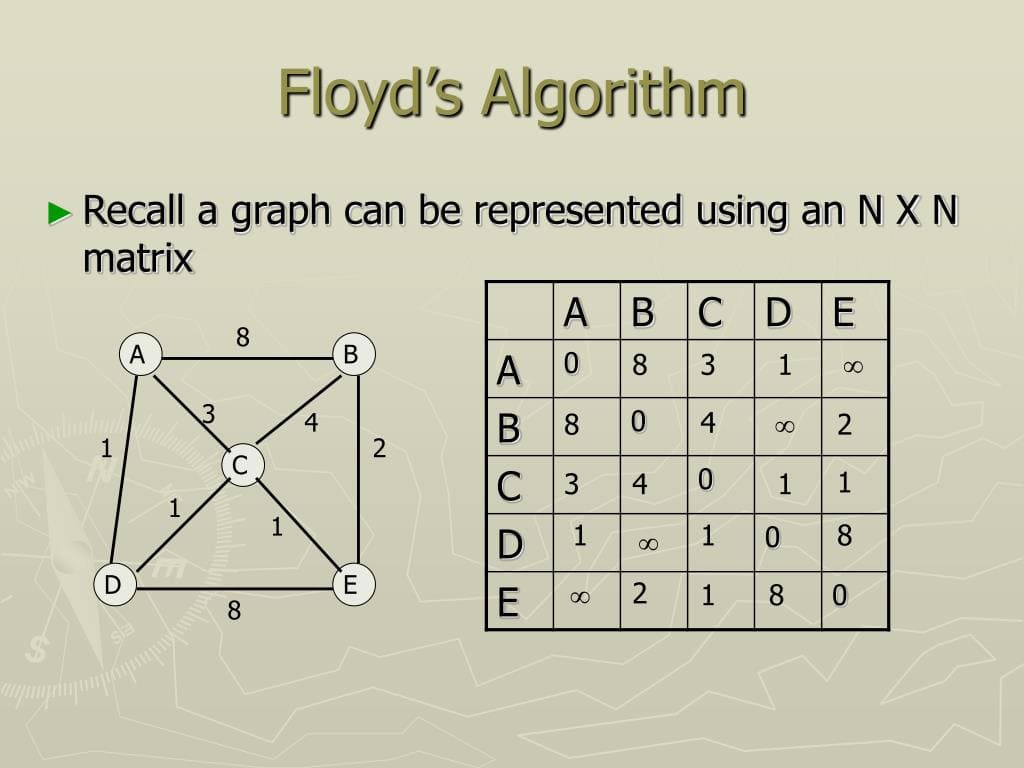
At its core, Floyd’s algorithm systematically updates a distance matrix that keeps track of the shortest known distances between each pair of vertices. Initially, the matrix is populated with the direct edge weights between nodes, and the diagonal is set to zero (since the distance from a node to itself is zero). If there is no direct connection between two nodes, the distance is marked as infinity.
The algorithm then iteratively examines whether a shorter path exists between any two nodes by passing through an intermediate node. Specifically, for each node kk, the algorithm checks if the path from node ii to node jj via kk is shorter than the currently known path from ii to jj. If it is, the matrix is updated with the shorter distance.
This process continues until all nodes have been considered as intermediates, at which point the matrix contains the shortest possible distances between all pairs of nodes. While this approach may sound computationally heavy, Floyd’s algorithm is remarkably efficient for dense graphs, operating with a time complexity of O(V3)O(V^3), where VV is the number of vertices.
For students in an Algorithms Course in Noida, learning the dynamic programming approach underlying Floyd’s algorithm offers valuable insights into how complex problems can be broken down into simpler subproblems and solved iteratively.
Example of Floyd’s Algorithm in Action
Consider a simple weighted graph with four nodes: A, B, C, and D. The edges have the following weights:
A → B: 3
A → C: ∞ (no direct path)
A → D: 7
B → C: 1
B → D: ∞
C → D: 2
The initial distance matrix would look like this:
                                   A   B   C   D
                                A    0   3   ∞   7
                                B    ∞   0   1   ∞
                                C    ∞   ∞   0   2
                                D    ∞   ∞   ∞   0
As the algorithm progresses, it identifies shorter paths, such as A → B → C → D, and updates the matrix accordingly. By the end, the matrix reflects the shortest paths between all pairs, allowing quick access to any distance query.
Understanding these step-by-step updates helps students appreciate the efficiency and logic behind Floyd’s algorithm, which is why hands-on exercises and simulations are often included in an Algorithms Course in Noida.
Real-World Applications of Floyd’s Algorithm
While the mathematical formulation of Floyd’s algorithm is fascinating, what makes it truly significant are its real-world applications. Students frequently ask how such theoretical concepts translate into practical use. Here are several important domains where Floyd’s algorithm plays a critical role.
1. Network Routing
In telecommunications and computer networking, determining the shortest path between devices is essential for optimizing data flow. Floyd’s algorithm enables routers and switches to compute the most efficient routes between nodes, minimizing latency and maximizing bandwidth utilization.
For example, in large-scale enterprise networks, understanding the shortest communication paths between servers ensures that critical applications run smoothly. Similarly, internet service providers use variations of shortest path algorithms to manage data routing across global networks.
2. Urban Traffic Management
Modern cities are increasingly adopting intelligent transportation systems to manage traffic flow efficiently. By modeling a city’s road network as a graph, traffic control systems can use Floyd’s algorithm to compute the fastest routes between intersections, adjusting traffic signals or providing real-time route recommendations to drivers.
In an Algorithms Course in Noida,students often work on case studies that simulate traffic networks, applying Floyd’s algorithm to optimize travel times across congested urban areas.
3. Social Network Analysis
Social media platforms rely heavily on graph algorithms to understand user relationships and recommend connections. Floyd’s algorithm can help analyze the shortest paths between users, which is valuable for features like friend suggestions or understanding community structures.
For example, if a platform wants to identify how closely two users are connected within a large social graph, Floyd’s algorithm provides a systematic way to calculate this information across millions of nodes.
4. Game Development
In the gaming industry, particularly in strategy games or open-world environments, determining the shortest path between points on a map is essential for realistic movement and AI behavior. Game engines frequently use graph algorithms to enable non-player characters (NPCs) to navigate complex terrains efficiently.
Students pursuing an Algorithms Course in Noidaoften explore game development projects where they apply Floyd’s algorithm to handle character pathfinding and environmental interactions.
5. Supply Chain Optimization
Businesses with complex supply chains use network models to represent manufacturing plants, warehouses, and distribution centers. Floyd’s algorithm helps companies identify the most efficient pathways for moving goods, minimizing transportation costs, and reducing delivery times.
In logistics and supply chain management, optimizing these networks directly impacts profitability and customer satisfaction. As companies expand their operations globally, the importance of efficient routing solutions only increases.
Advantages of Floyd’s Algorithm
Floyd’s algorithm offers several notable advantages that make it a popular choice for many applications. First, it is relatively simple to implement, especially when compared to more specialized algorithms. Its systematic approach and clear update rules make it accessible to students and developers alike.
Second, Floyd’s algorithm handles negative edge weights gracefully (as long as there are no negative cycles), which broadens its applicability in scenarios where certain relationships or costs are modeled with penalties.
Third, it produces a comprehensive solution by providing the shortest path between every pair of nodes, unlike algorithms that focus on single-source shortest paths. This “all-pairs” feature makes it ideal for applications requiring global network insights.
These advantages are thoroughly covered in an Algorithms Course in Noida,where instructors guide students through both theoretical concepts and practical implementations.
Limitations and Considerations
While Floyd’s algorithm is powerful, it is not without limitations. Its time complexity of O(V3)O(V^3) makes it unsuitable for extremely large graphs with tens of thousands of nodes, where more scalable algorithms such as Johnson’s algorithm or heuristics like A* might be preferred.
Moreover, the algorithm requires the entire graph to be stored in memory, which can be a constraint in memory-limited environments. Students are encouraged to consider these trade-offs when selecting an appropriate algorithm for a given problem.
In an Algorithms Course in Noida,students learn not only how to implement algorithms but also how to evaluate their suitability, efficiency, and scalability in diverse contexts.
Learning Floyd’s Algorithm in Practice
Mastering Floyd’s algorithm involves more than memorizing its steps; it requires developing an intuitive understanding of dynamic programming principles, graph representations, and matrix updates. Students benefit from hands-on practice, coding the algorithm in languages like Python, Java, or C++, and testing it against sample graphs.
Many courses, including the Algorithms Course in Noida,offer project-based learning opportunities where students tackle real-world problems such as optimizing transportation networks or analyzing social graphs. These projects reinforce theoretical knowledge and prepare students for technical interviews and industry challenges.
Future Relevance of Floyd’s Algorithm
As technology advances, the relevance of algorithms like Floyd’s only grows. From self-driving cars navigating city streets to cloud computing platforms managing data flows, the need for efficient pathfinding and network optimization is expanding.
Students who invest time in understanding Floyd’s algorithmtoday will be well-equipped to contribute to the development of tomorrow’s technologies. Furthermore, the problem-solving skills developed while learning this algorithm extend far beyond graphs, enhancing one’s ability to tackle a wide range of computational challenges.
Conclusion
Floyd’s algorithm stands as a brilliant example of how elegant mathematical techniques can solve complex real-world problems. Whether optimizing network routes, analyzing social connections, or enhancing supply chain efficiency, Floyd’s algorithm offers a robust and reliable solution for all-pairs shortest path problems.
For students enrolled in an Algorithms Course in Noida,mastering Floyd’s algorithm is not just about passing exams — it is about building a solid foundation in algorithmic thinking that will serve them throughout their careers. By understanding the principles, implementation, and applications of Floyd’s algorithm, learners position themselves to excel in both academic and professional settings, contributing meaningfully to the ever-evolving world of technology.