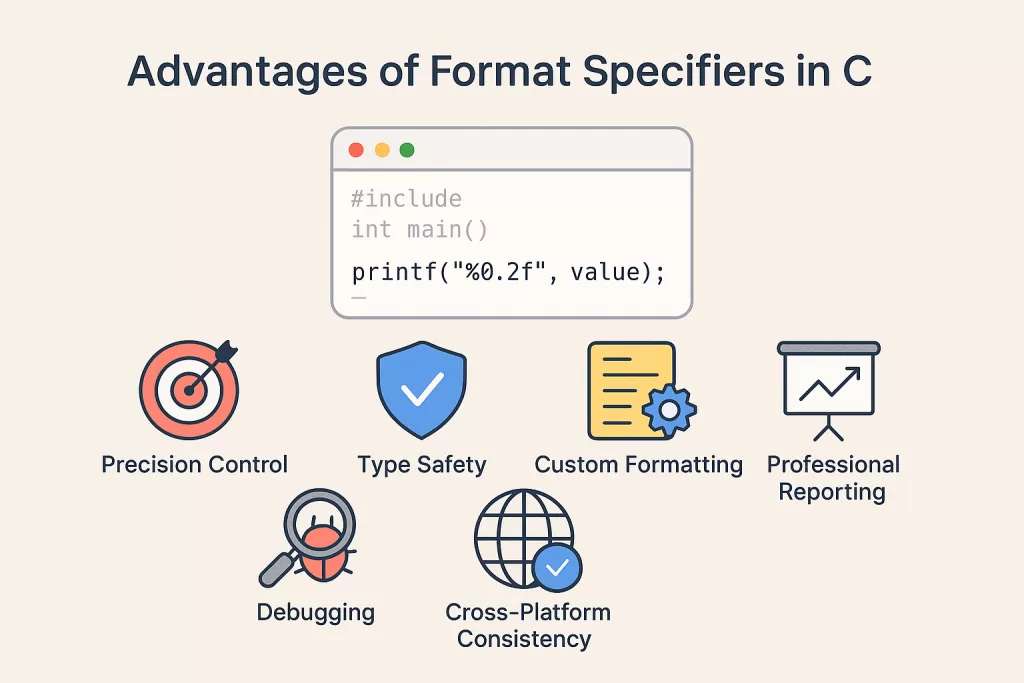
Concepts of Format specifiers
Every formatted output printing with printf() needs format specifiers and input capturing with scanf() depends on format specifiers as well. They tell the compiler the manner in which to interpret the data. As an example %d is applied to integer type, %f to floating-point numbers, %c to character types.
The Usage of Format Specifiers by printf()
The printf() is one of the main output functions in C and is used to print formatted messages on the screen. In order to show the value of a variable, you may embed a format specifier in the text string and provide more arguments to printf() function. The first parameter given to printf ought to always be a string in the form of a double quote.
As an example, printf(Number = %d, testInteger); uses %d telling it there is an integer value that will be replacing the corresponding placeholder of the output string. This value of testInteger is transferred to the printf(). The number of arguments has to be equal with the number and kind of format specifiers in the string. Assuming that the arguments are not in the proper sequence, the values may be presented improperly despite the absence of error(s) during program compilation.
The Uses of Format Specifiers by
The scanf() is a typical means of reading a formatted input from standard input usually via the keyboard. Just like in printf(), scanf() turns to format specifiers to decipher the type of the data that is being read.
Amazingly enough, scanf() has syntax scanf("format", address_of_args...);. The format string holds the format specifier(s), and the address of args is the memory address of variables where the input has to be put. Memory address of variables is get with the & (address-of) operator. When using string literals, the need of using the & operator is absent since a string variable (character array) by itself refers to the address of the first component.
One can separate format specifiers using delimiters such as spaces or commas when using scanf() to read multiple inputs. Scanf() ends reading an entry after a space, tab or Enter key is pushed by default.
returns an integer: non-negative to indicate the number of successfully converted and assigned values (from 0 to 9), or 0 cases when the variable is not assigned anything, and negative values in the event of an error during the read operation or when an end-of-file (EOF) was met.
Data Format Recognition
C has facilities of input and output formatting and these are typically inserted between the percent sign and the format specifier character. These include:
Minus (-) sign: identifies left alignment.
Number after %: The lowest field width is given. In case the characters are less than the declared width they are padded with spaces; in case the number is more, the whole number is printed without truncation.
Period (.) symbol: Separates field with and precision.
Precision: Specifies the number of digits of an integer and the number of characters of a character string and the amount of digit after a point of a floating point number.
As an example, printf("%20.5s\n", str); would print a string with a minimum of 20 characters wide, displaying only the 5 first characters.
Uncodemy C Programming courses
To pursue a better in-depth comprehension of C programming, along with the intricacy regarding format specifiers, Uncodemy is also providing extensive courses. Uncodemy strives to make people coding ninjas and offers the possibility to be guided by the best of the best.
The C Programming Course in Noida works with Uncodemy to transform greenhorns into super-competent programmers by means of practical tasks and coaching. The course introduces some basic concepts like syntax, loop, array and pointer that help to lay a strong foundation in C.
Some of the key concepts found in a standard C programming course that would improve knowledge of such concepts and terms as format specifiers can be outlined in the following way:
Variables and the Types of Data: The knowledge of variable declaration and setting correct initial values of variables of various types (e.g., int, float, char, double) is a precondition of the proper usage of format specifiers.
Operators: learning about arithmetic, relational, and logical operators assist in the calculation and comparison behavior which is often printed or read by use of the format specifiers.
Control Statements (Conditionals and Loops): The following are statements that control the flow of the program through parameter checking and repeating, i.e., choosing an option (if-else statement), switching between possibilities (switch statement), looping through a sequence (for loop, while loop, and do-while loop). Formats specifiers usually depend on the output in such structures.
Functions: Functions reduce the size of the code and allow repurposing in a simpler and organized form. Format specifiers are commonly used to perform input and output functionalities in functions.
Arrays and Strings: C considers the strings as arrays of characters. Learning how to use arrays and to manipulate strings is essential as %s and other format specifiers that deal with characters are widely utilized.
Pointers: Pointers are the basis of C and make it possible to access the pointers on the low level. It is important to understand the use of the pointers in scanf() as its use is frequently necessary to refer to the memory address of variables using the ampersand (&) symbol.
Structures and File Handling: the process of learning how to organise various data using structures and how to create and read data using files takes much use of reading writing and writing format specifiers.
Dynamic Memory Allocation: Other terms, such as malloc() and free() used in manipulation of dynamically allocated memory, would as well depend on such pointers and by extension the format specifiers that can be used to debug and print the contents of the memory.
Uncodemy in Noida provides 3 month Certification training on C with Data structure and prepares their students as full stack developers. This training may further increase knowledge about complex data structures and algorithms with the most effective input/output being possible through the format specifiers. Other courses offered by Uncodemy in areas with high human demand for technology are among the best courses available with a specific focus in skills training.
One will have a very good formal background that will ease the process of learning other computer programming languages such as C++, Java and Python when they learn C. Although learning C is not mandatory to learn blockchain development it provides a good basis of knowledge on how code operates on a lower level. C is still highly applicable today and is employed in systems programming and other systems (such as embedded systems and operating systems) and performance-sensitive systems. The fundamentals can be acquired in several weeks through regular practice, however mastering them is an endeavor.