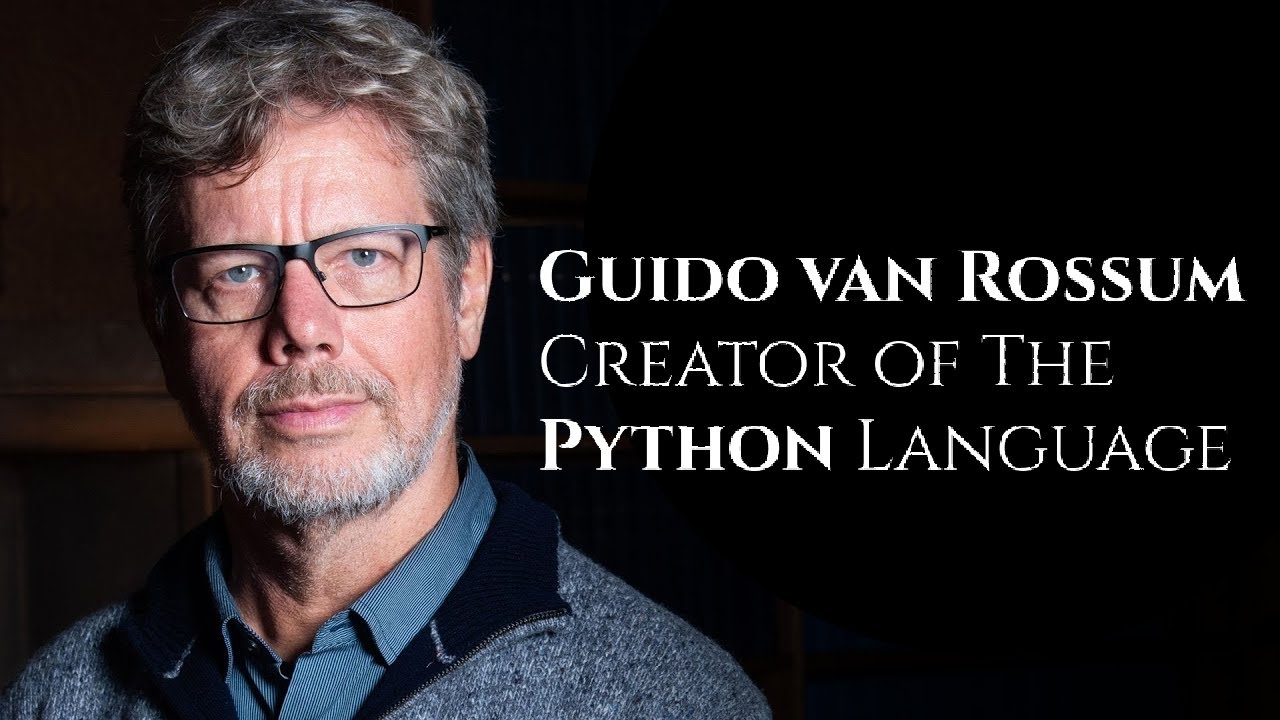
🧠 Meet the Creator: Guido van Rossum
Born in the Netherlands in 1956, Guido van Rossum was fascinated by mathematics and computing from an early age. He completed his Master’s in Mathematics and Computer Science from the University of Amsterdam in 1982.
Guido was known not just for his sharp technical mind, but also for his calm demeanor, creative thinking, and subtle humor — qualities that would later influence how Python behaves and reads.
While working at Centrum Wiskunde & Informatica (CWI), a research institute in the Netherlands, Guido was exposed to a variety of programming languages. One such language was ABC, which aimed to teach programming in a simple way but lacked extensibility. Guido loved its simplicity but was frustrated by its limitations.
So, like any passionate developer with a vision, he set out to build something better — a language that was simple, readable, and extensible. Thus began the story of Python.
🐍 Why the Name “Python”?
You might think the language was named after the snake. But surprisingly, Guido didn’t name it after the reptile at all.
He was a big fan of the British comedy group Monty Python and often watched their show “Monty Python’s Flying Circus”. He wanted a name that was short, unique, and a bit mysterious — and "Python" just clicked.
This quirky origin reflects one of the most beautiful things about Python: it doesn’t take itself too seriously. It’s fun, approachable, and yes — a little cheeky.
🏁 The Birth of Python
Python was officially born during the 1989 Christmas holidays. Guido was home, bored, and wanted a hobby project to work on. With ABC’s strengths in mind, and the shortcomings he wanted to fix, he started writing the first lines of what would eventually become Python.
After nearly two years of work, he released the first official version — Python 0.9.0 — in February 1991.
This initial version already included many features we still use today:
- Exception handling
- Functions and modules
- Lists and strings
- A basic class system
Guido wanted Python to be a language that emphasized code readability, using indentation instead of curly braces or keywords to define code blocks. This was radical for the time but has since become one of Python’s signature traits.
🔍 Design Philosophy: What Makes Python Different?
Python isn’t just another programming language. It’s a philosophy.
Here are some core ideas that Guido embedded into Python’s DNA:
1. Readability Counts
Python looks almost like English. This was intentional. Guido believed code should be easy to read, write, and understand, even for beginners.
2. There Should Be One — and Preferably Only One — Obvious Way to Do It
This contrasts with languages like Perl, which offer many ways to do the same thing. Python encourages a more structured and consistent approach.
3. Simple is Better Than Complex
Python avoids unnecessary complexity. Guido once said, “I'm not into complexity. I'm into clarity and transparency.”
These principles were formally compiled by Tim Peters (another Python contributor) into a document called “The Zen of Python”, which you can access by typing import this in a Python interpreter.
🗓️ Major Milestones in Python’s Evolution
Let’s walk through some key moments in Python’s timeline:
🐣 1991 – Python 0.9.0
- The first public release.
- Introduced core structures like lists, tuples, and dictionaries.
🚀 2000 – Python 2.0
- Included garbage collection via reference counting and cycle-detecting GC.
- Introduced list comprehensions — a powerful way to write cleaner loops.
- Opened Python up to community contributions.
🧹 2008 – Python 3.0
- A major overhaul that broke backward compatibility.
- Improved Unicode handling (great for international apps).
- Removed redundant constructs to “clean up” the language.
Though controversial at the time, Python 3 laid the groundwork for Python’s explosion in popularity over the next decade.
🌐 2020s – Python Takes Over
- By now, Python had become the top choice in data science, machine learning, web development, automation, and education.
- It topped charts like the TIOBE Index and Stack Overflow Developer Survey as the most loved or most used language.
- Its simplicity allowed hobbyists, researchers, students, and enterprise developers to use it alike.
👑 Guido as Python’s “Benevolent Dictator for Life” (BDFL)
For nearly 30 years, Guido van Rossum oversaw Python’s development as the Benevolent Dictator For Life, or BDFL — a humorous title he accepted.
As BDFL, he made final decisions about language design, updates, and controversies within the Python community. While he was always open to community discussion, he retained the final say, ensuring Python remained coherent and aligned with its original vision.
In July 2018, Guido stepped down from this role, citing the pressure of constantly being the ultimate decision-maker. But he left Python in the hands of a vibrant and global community, with a well-defined governance model.
🧑💻 Where is Guido Now?
After stepping down as BDFL, Guido surprised everyone in November 2020 by joining Microsoft. Yes, you read that right — the creator of an open-source language working at a software giant!
In his own words, he said:
“I decided that retirement was boring and I’d been missing the hustle and bustle of being part of a big team.”
At Microsoft, Guido continues to contribute to Python, focusing on improving its performance and ecosystem — proving that passion doesn’t retire.
🔎 Why Python Matters Today
So, why has Python — created over three decades ago — become even more important today?
1. Data Science and AI
Frameworks like NumPy, pandas, TensorFlow, and scikit-learn have made Python the go-to language for machine learning, data analysis, and artificial intelligence.
2. Web Development
With frameworks like Django and Flask, developers can build powerful web apps quickly.
3. Automation and Scripting
Need to automate reports, scrape data, or manage files? Python scripts can do it in just a few lines.
4. Education
Because of its simplicity, Python is now taught in schools and universities across the globe.
5. Community
The Python community is inclusive, massive, and always innovating. With open-source at its heart, it’s a language where anyone can contribute.
🎓 Want to Learn Python the Right Way?
If you're inspired by Python’s story and want to build real-world skills, we highly recommend:
✅ Uncodemy's Python Programming Course
This course covers Python from scratch, including:
- Syntax and core concepts
- Data structures and algorithms
- Real-time projects (web, automation, AI)
- Interview preparation
- Certification
It’s ideal for students, working professionals, or anyone switching careers. What’s more — the course is project-based, so you don’t just learn theory, but apply it with confidence.
🧵 The Legacy of the Founder of Python
When Guido van Rossum sat down during the Christmas of 1989, he probably had no idea that his “hobby project” would become the language powering Netflix, NASA, Instagram, Spotify, and countless other tech giants.
His vision — to create a clean, intuitive language that felt more like a conversation than code — has changed how millions of developers think about programming.
But perhaps more importantly, Python’s story reminds us that one person, with passion and purpose, can impact the world in ways unimaginable.
✍️ Final Thoughts
The founder of Python, Guido van Rossum, didn’t just create a programming language. He created a movement — one that made coding more accessible, elegant, and enjoyable.
Python’s design reflects his values: clarity, simplicity, and community.
As you write your first Python script or debug your hundredth, know that you’re part of a story that started with one man, a holiday break, and a funny TV show.
So the next time you write print("Hello, World!"), take a moment to appreciate the thoughtfulness and human touch behind it.
Happy Coding! 🐍✨