What is C Function?
Functions aid in eliminating redundancy of codes, acts as a source of abstraction and simplify control and comprehensibility of programs since one is in a position to address big problems which are easily broken into smaller easy problems.
Definition and Syntax of Function
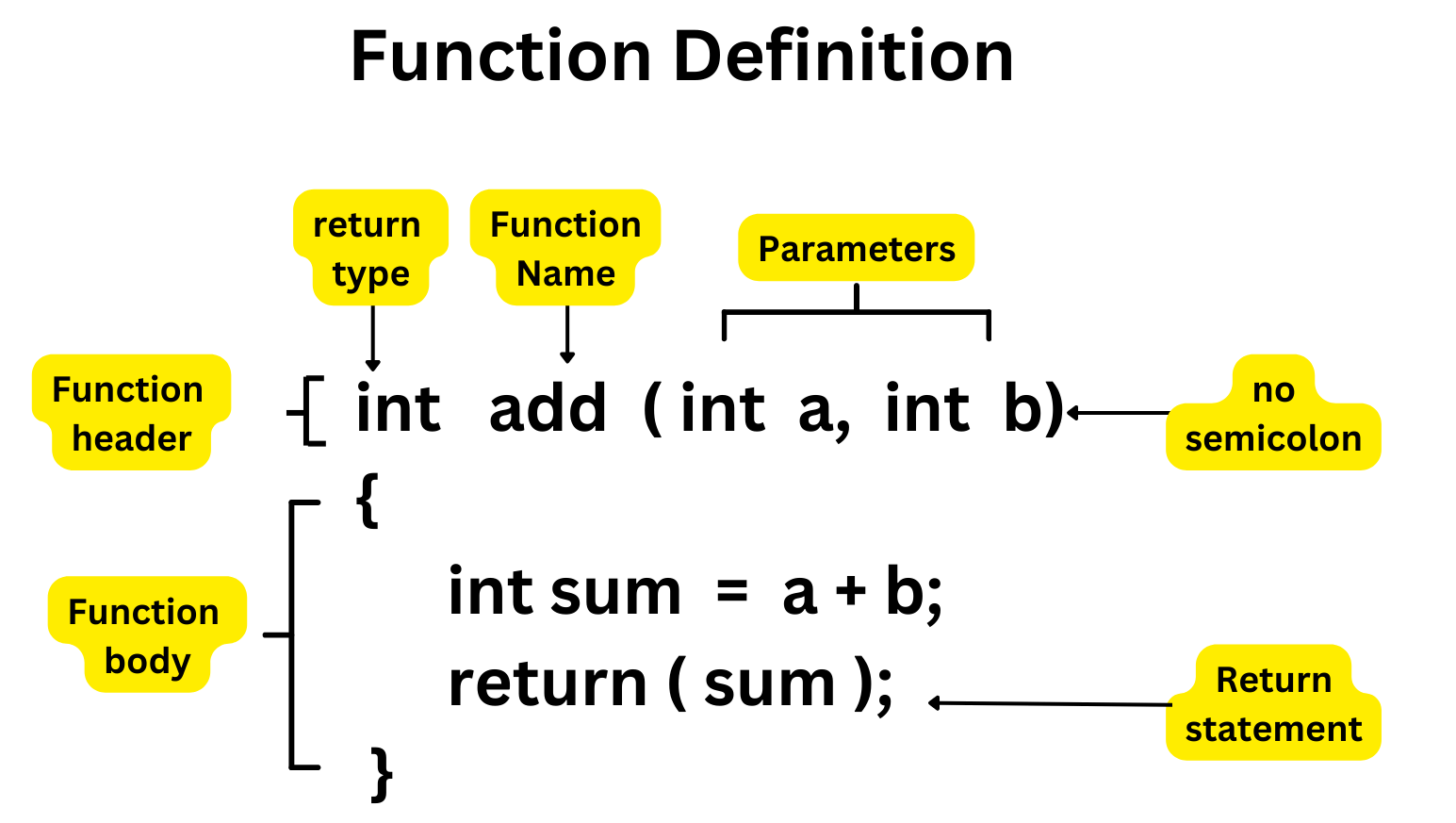
A function definition gives the compiler the information about the name of the functions, the type of value returned by the functions and the thing it does. Before the invocation of a function it is compulsory to define it.
A simple syntax to define a function in C will look something like this:
return_type function_name (arg1, arg2, … argn){
Function body
Statements which are to be processed
}
return_type: This indicates the data type of value that the function is going to return. When a function is not returning anything, then the keyword is void.
function_name: It is the name of the function that allows the compiler to identify the function when invoked.
arg1, arg2, ...argn: It is the parameters list which may include several parameters each having a certain data type, sequence and number. It is an optional list, because some functions might not use any parameters.
Body of the function: This part is put in curly brackets {} and it is where all the statements to be run as the result of calling the function are contained.
Function Declaration
A declaration of a function The declaration of a function, sometimes called the prototype of a function or the signature of a function, advises the compiler of the name of the function as well as its return type, and the names and types of its parameters. Again although putting names of the parameters in the declaration is not essential, it aids the checking of the parameters of the functions and the data type by the compiler with those given in the definition and call of the functions. It is better to declare a function first since it avoids errors in the compiler.
Function Call
The system of execution of the code of a particular function is called a function call. After a function is specified, it can be used anywhere within the program by simply calling the name of the function then parenthesis () and the semicolon (;). When one is invoking a function, it is also important to invoke the right number and type of its arguments because it is defined in its declaration. An example of a function that is executed is main() and an example of a function that prints out the output in the screen is printf().
Function Parameters
The parameters in the definition of a function are placeholder variables and they take their value (s) as supplied by the caller. The values are called arguments and are supplied as the given function is called. Parameters are the local variables in the function and they hold values which pass down to them. Parameters in the definition have names which are utilized to call them within the function. It is vital that the arguments that are passed in during a call of a function should be of the same count and the same type as the parameters declared and the sequence should also be identical.
Type of Functions-Return
When a function is executed it can provide one value to the caller. This value is referred to as the return value and it is of the same type with the return type of the function. The keyword return is also utilized to deliver back a value produced by the function. Where a function has no value to be returned, its type of return is a void. Functions directly cannot return arrays or other functions, although, in a number of cases, pointers survive this drawback.
C Functions Types
A C programming function can generally be classified into two groups; the library functions and the user-defined functions.
Library Functions
Another type of function, library functions (also called predefined functions) are predefined in C libraries so that developers have no need to write the definitions. The functions provided should be implemented by adding the required header file to the initial part of the code. The examples of the library are printf(), scanf(),ceil() and floor(). All these functions are tested and refined in advance thereby costing less development time, fewer errors. Some common header files and their description are:
stdio.h: It holds input/output functions.
conio.h: It has functions that pertain to console in and console out.
string.h: Contains procedures of manipulating strings.
stdlib.h: It has general utility functions.
math.h: It contains mathematical functions.
time.h: is made up of a series of functions that refer to time.
ctype.h: It includes functions of character handling.
User-Defined Functions
The programmer declares, defines the same, and calls the respective functions to undertake particular activities. The capacity and functionality of C programs are strengthened by the user-defined functions, which guarantee the ability of managers to create any type of a program and use it. They can be adopted in any library to be used in other programs.
Various Calling Function Methods
Functions are called differently: they either receive arguments and give out results or do nothing:
Non argument/ Value: They do not accept any arguments and do not pass a value.
Functions that have no arguments yet a return value: This is a type of function that has no arguments but it performs the computation and gives out a result/value.
Functions With No Return Value and Arguments: The function with no return value, takes input to execute.
Functions That Accept Arguments and Return a Value: These are the most common of all and allow the user to send data, do some computation and provide the output.
High-end Concepts and Best Solutions
The Function name () is main
In all C programs, there is a main() function that is used as the entry point after which the program execution commences. The return value in the main() is usually seen to be used to test the success or failure of the program. It may or may not be parameterised: int main() or int main(int , cha n Fourteen things are as functorial, and that number increases to 23 when parameterised: Even though theoretically a program can operate without main(), it is strongly suggested to make the program readable and understandable.
Recursive Functions
A recursive function can be termed as a function whose implementation makes it call itself to attain a certain exit condition. It involves addressing problems by breaking them into similar and smaller subproblems. Recursive functions work through making calls to itself, and makes a call until an exit condition is achieved, where at this point, the program flow jumps out of the function. Factorial computation of a number is an example of a use case.
Inline Functions
Inline functions are applied in order to save overhead of having to call a function, particularly when the computation is small. The compiler rather than skipping to the definition of the function replaces the call to the function with the code of the function. This makes it unnecessary to have another pointer to control the flow of execution making it more performant. An inline keyword is used in front of a definition of the inline function declaration.
The C Functions Memory Management
When a given function is called, memory is provided to store its variables and data in a special block on a stack, which is called a stack frame. This stack is called the function call stack. When the execution of a given function has ended, the stack frame is cleared off the stack consequently freeing the used memory.
The Good and the Bad of C functions
In the C programming, functions have more than a few advantages:
Less Code Repeats: Forming functions allow one to avoid repeating statements many times.
Modularity: They will divide a complex program into small chunks on which they can work on.
Code Reusability: The functions can be called many times after they have been declared once.
Better understandability: All repetitive operations become functions and are easier to read.
Abstraction: After a function is declared the caller does not have to consider the mechanics of the inside of the function.
Supports Recursion: Recursive algorithms need the use of functions.
But the functions do contain their disadvantages as well:
Can Not Return Multiple Values Directly: A function is not able to give more than one value directly.
Memory and Time cost: Memory and time cost is due to the allocation of stack frames and transfer of control in function calls.
C Best Practices and Coding Standards of C Functions
Coding standards and best practice can go a long way towards making things better when writing functions in C:
Simple: The functions should be simple to do a specific task only and well.
Descriptive Naming: Make the name of functions descriptive to indicate its usage e.g calculateArea
Brevity It should have a few lines of code in functions.
Indentation: a consistent indentation provides a better readability.
Modularization: Divide large masses of code into small logic sections or paragraphs.
Uncodemy Courses relating to C Language
Uncodemy is an IT training institute which provides a different number of job-centered professional courses and a course in training on C with Data Structure and Algorithms. The course will make a person future ready with the required IT skills and industry knowledge. Uncodemy is a systematic, yet customizable course teaching beginner, intermediate, and advanced learners. The training comprises mentorship by skilled professionals, mock interviews, career coaching as well as resume writing. Uncodemy will offer a full learning ecosystem with the help of its own Learning Management System (LMS).
Uncodemy focuses on applied, industrial and communicative pedagogical approaches. The practical style of teaching and practical case studies have led to the success of the students with non-IT background. The institute provides a lifetime placement service too. Although Uncodemy has several courses about different kinds of programming, such as Python, Java, and other skills, such as Full Stack Development, Data Science, and Software Testing, the course named "C With Data Structure And Algorithms is the most straightforward course on the fundamental points of C programming, functions, and their usage in data structure. These classes are meant to equip one with IT jobs that have good packages.