What each model was built for
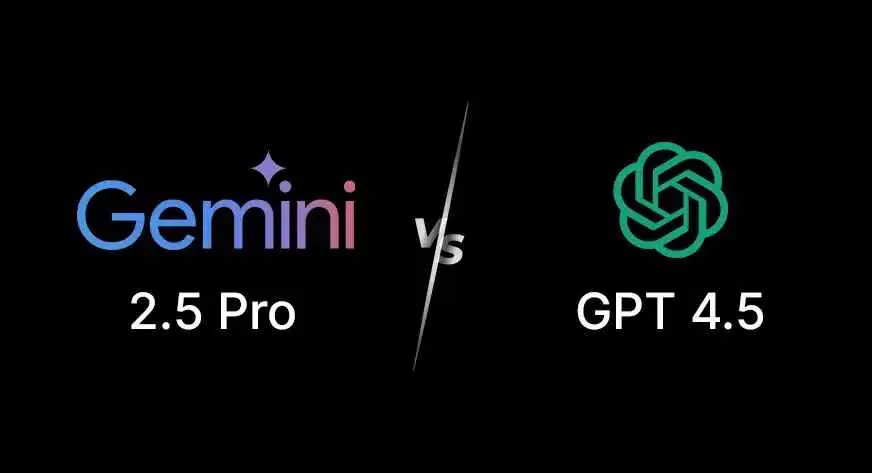
GPT-4.5 was OpenAI's largest "non-reasoning" model at launch. OpenAI positioned it as a model with broader world knowledge, more natural conversation and fewer hallucinations than GPT-4o, rather than one that works through problems step by step. It accepted text and images, and was offered in ChatGPT for paid users and as a preview in the API. It was also one of the most expensive models OpenAI had offered per token, which limited its use in high-volume enterprise workloads.
Gemini 2.5 Pro is a Google DeepMind "thinking" model: it reasons internally before answering, which helps on coding, maths and multi-step analysis. It is natively multimodal, taking text, images, audio, video and PDF files, and launched with a context window of about one million tokens. It is offered through the Gemini API (Google AI Studio) and Vertex AI on Google Cloud.
Side-by-side
| Aspect | GPT-4.5 | Gemini 2.5 Pro |
|---|
| Released | Research preview, February 2025 | Experimental March 2025; generally available June 2025 |
| Approach | Large pre-trained model without a separate reasoning phase | Built-in reasoning ("thinking") before answering |
| Inputs | Text and images | Text, images, audio, video, PDFs |
| Context window | 128K tokens | About 1 million tokens |
| Enterprise access | OpenAI API (preview) and Azure OpenAI; ChatGPT paid plans | Gemini API and Vertex AI; Google Workspace integrations |
| Status | Removed from the OpenAI API in July 2025 | Available; newer Gemini versions released since |
| Typical strengths described by the vendor | Writing quality, tone, general knowledge | Long documents, code, multimodal analysis |
How the difference showed up in enterprise tasks
Long documents and large codebases
A one-million-token context lets a team load a long contract set, a large policy manual or a sizeable part of a codebase in one request. With a 128K window, the same job needs chunking and retrieval. Retrieval is often the better design anyway (cheaper and easier to audit), but long context reduces engineering work for one-off analysis.
Customer-facing writing
GPT-4.5 was promoted for natural tone and fewer factual slips in conversation, which suited drafting support replies or marketing copy. Its cost per token made it hard to justify for every ticket in a busy support queue, so teams often used it selectively or used cheaper models with careful prompts.
Multimodal work
Insurance claims with photos, call recordings, scanned invoices and training videos are all inputs Gemini 2.5 Pro could take directly. With GPT-4.5, audio and video needed separate transcription or other models first.
Ecosystem
Enterprises often decide by platform as much as by model. A company already on Google Cloud and Workspace finds Gemini easier to govern under existing contracts; a company on Microsoft Azure often reaches OpenAI models through Azure OpenAI. Both routes offer enterprise terms under which customer prompts are not used to train the vendor's models by default; confirm the exact terms in your own agreement.
What to do if you are choosing now
Both vendors have moved on. OpenAI released the GPT-5 family in August 2025 and Google has released newer Gemini generations since 2.5. So run your decision on current models, using the same tests each time:
- Build an evaluation set from your own work. Fifty to a hundred real tasks (anonymised tickets, documents, queries) with answers your experts agree are correct.
- Score quality per task type. A model that leads on coding may trail on Hindi-English customer chats, or the other way round.
- Measure cost and latency at your volume. Estimate tokens per task and multiply by monthly volume using the vendor's current price page.
- Check data and compliance needs. Region availability, data retention, audit logs and how the service fits the Digital Personal Data Protection Act, 2023 if you process Indian users' personal data.
- Plan for retirement. GPT-4.5 lasted less than five months in the API. Put a thin abstraction layer between your application and the model API so you can swap models without rewriting the product, and keep your evaluation set so every swap is tested.
- Keep a human review step for anything legal, financial or customer-facing until your tests show the error rate is acceptable.
When each type of model fits
- Choose a reasoning, long-context, multimodal model (the Gemini 2.5 Pro style) for document-heavy analysis, code review, and workflows that mix files, images and audio.
- Choose a fast, conversational model (the GPT-4.5 style, today usually a cheaper current model) for high-volume chat and drafting where tone matters more than deep reasoning.
- Use both through a router when task types differ a lot. Many production systems send simple requests to a small model and escalate only hard ones.
For a wider view of the field, see this comparison of GPT, Claude, Gemini and Mistral, an introduction to how these LLMs differ, and a look at Claude 3.5 against Gemini 2.5. If customer support is your main use case, read about the efficiency and limits of AI in support.
Sources: OpenAI, "Introducing GPT-4.5" (February 2025) and API deprecations page; Google, Gemini 2.5 announcements (March and June 2025) and Vertex AI model documentation. Check both vendors' current model lists before any decision.