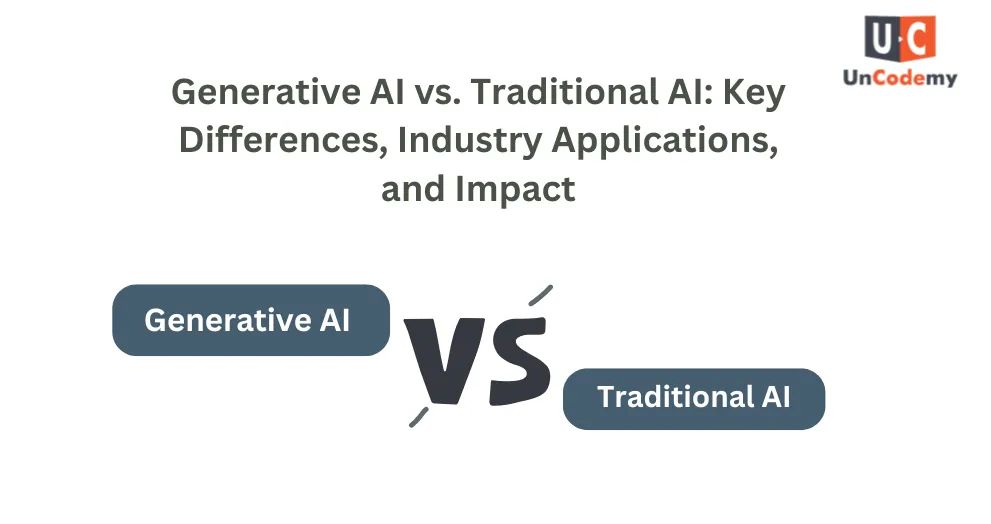
Generative AI vs. Traditional AI: Key Differences, Industry Applications, and Impact
What is Traditional AI (TA)?
Traditional AI, also known as rule-based or symbolic AI, operates using predefined rules and logic. It mimics human thinking by analyzing data and solving problems in specific ways. Traditional AI has evolved into key areas, such as:
- Machine Learning (ML): Algorithms that learn from data, used in systems like Netflix or Amazon recommendations.
- Deep Learning (DL): Advanced neural networks that power technologies like self-driving cars and voice assistants.
- Natural Language Processing (NLP): Helps computers understand human language, used in chatbots and translation apps.
- Computer Vision: Enables computers to interpret images, used in facial recognition and medical image analysis.
Strengths and Limitations of Traditional AI
Strengths:
- Accuracy and Speed: Good at handling repetitive tasks quickly.
- Data Handling: Can analyze large amounts of data efficiently.
- Scalability: Can be expanded for large operations.
Limitations:
- Limited Creativity: Cannot generate new ideas or think creatively.
- Poor Adaptability: Struggles with new, unfamiliar situations.
- No Context Understanding: Cannot grasp human emotions or complex language nuances.
What is Generative AI (Gen AI)?
Generative AI is a type of AI that creates new content like images, text, music, and videos. Unlike Traditional AI, which follows fixed rules, Generative AI uses machine learning to analyze data, recognize patterns, and generate content that feels human-made. It’s more creative and flexible than Traditional AI, allowing it to produce original outputs.
Applications of Generative AI
- Image Generation: Creating realistic photos or artistic designs.
- Text Generation: Writing content that sounds human-like.
- Music Composition: Composing original music.
- Video Synthesis: Editing or generating new videos.
- Drug Discovery: Identifying new drugs by understanding chemical patterns.
Generative AI Models
- Generative Adversarial Networks (GANs): Two networks work together to create realistic images or videos.
- Variational Autoencoders (VAEs): Compress and reconstruct data to generate new outputs, like designing new molecules.
Strengths and Limitations of Generative AI
Strengths:
- Creative Content Creation: Makes content for design, entertainment, and marketing.
- Speed: Works faster than humans in creating content.
- Personalization: Can customize content for individuals, like in ads or learning.
- Natural Communication: Can have conversations that feel human-like.
Limitations:
- Lacks True Originality: It creates unique content but doesn’t come up with groundbreaking ideas.
- Data Dependency: The quality of its work depends on the data it’s trained on.
- Bias Issues: It may create biased or unfair content if the data is biased.
- Ethical Concerns: Generative AI can be misused to create deceptive content like deepfakes.
Generative AI vs. Traditional AI: Key Differences
1) Problem-Solving Approach:
- TA: Follows fixed rules to solve problems. Works well for clear, structured tasks but struggles with new or unclear situations.
- Gen AI: Learns from data, recognizes patterns, and can create new solutions or content. More flexible and can handle complex problems.
2) Techniques and Models:
- TA: Uses rule-based systems like decision trees and expert systems.
- Gen AI: Uses advanced models like neural networks (GANs, VAEs) to create content mimicking human creativity.
3) Data Requirements:
- TA: Works with smaller, specific datasets and follows predefined rules.
- Gen AI: Needs large, diverse datasets to generate accurate outputs.
4) Strengths:
- TA: Reliable and efficient for repetitive tasks, processes data quickly.
- Gen AI: Creative and adaptable, generates original content and solves complex problems.
5) Limitations:
- TA: Inflexible and unable to handle creative tasks or new challenges.
- Gen AI: Depends on high-quality data and requires significant computing power.
6) Applications:
- TA: Data analysis, customer support chatbots, process automation.
- Gen AI: Art, music, content generation, drug discovery.
Use Cases of Generative AI vs. Traditional AI
- Image Synthesis: Gen AI creates new images; TA enhances/edit existing ones.
- Chatbots: TA provides fixed responses; Gen AI offers dynamic, learning-based interactions.
- Language Translation: TA translates using set rules; Gen AI provides context-aware translations.
- Content Generation: Gen AI generates new articles and digital content; TA follows templates.
- Recommendation Systems: TA uses past behavior; Gen AI adapts to preferences in real time.
- Speech Synthesis: Gen AI creates expressive voices; TA ensures clarity.
- Medical Diagnosis: TA uses symptoms and structured data; Gen AI finds deep patterns.
- Autonomous Vehicles: TA manages rule-based safety systems; Gen AI makes decisions based on learning.
- Financial Predictions: TA uses historical data; Gen AI recognizes complex market patterns.
Future of Generative AI
Generative AI has made huge strides with technologies like OpenAI’s GPT-3 and Nvidia’s StyleGAN. These tools are transforming creativity and innovation, and as we move forward, ethical and responsible use will be critical.
Future models like GPT-4, Llama 2, and Mistral will process multimodal data, making them smarter and more dynamic. Small Language Models (SLMs) such as PHI-2 and Mistral 7B will make Gen AI more accessible and customizable for businesses.
Platforms like LangChain and LlamaIndex are enabling autonomous AI agents that can learn and act with minimal human input, making real-time AI applications more powerful and widespread.
Impact of Generative AI on Various Industries
Healthcare
- Supports disease prediction and prevention through data analysis.
- Assists in accurate diagnosis and personalized treatments.
- Accelerates drug discovery and enhances patient care.
Finance
- Improves investment predictions and risk management.
- Enhances fraud detection through anomaly detection.
- Offers personalized financial services to customers.
Education
- Enables personalized learning for students.
- Automates grading and lesson planning for educators.
- Creates interactive and engaging learning content.
Digital Art
- Allows for unique, customized design generation.
- Speeds up prototyping in fashion, architecture, and design.
Entertainment
- Generates immersive storytelling and interactive plots.
- Assists in writing, composing music, and generating artwork.
- Personalizes content recommendations for users.
Ethical Considerations of Generative AI
Generative AI: Ethical Considerations and Emerging Trends
Generative AI brings incredible possibilities, but it also raises important ethical issues that need to be addressed to ensure it’s used responsibly. As Gen AI is expected to create 10% of the total data by 2026, it’s essential to focus on its ethical use.
Key Ethical Considerations for Gen AI
- Accuracy and Trust
Generative AI depends on the data it’s trained on, so if the data is inaccurate or biased, the AI’s decisions and outputs will be too. It’s important to make sure that the data used for training is accurate, fair, and reflects a variety of perspectives. This helps prevent harmful stereotypes and biased decisions.
- Data Governance
Since Gen AI often uses personal or sensitive data, there are concerns about privacy and security. Organizations must have strong data governance in place to protect this data and comply with regulations like GDPR and CCPA. This ensures that data is handled safely and respectfully.
- Mitigating Risks
While Gen AI can be powerful, it can also cause harm if it’s not carefully managed. For example, AI might generate incorrect financial data or create misleading images, leading to legal issues or public backlash. To prevent this, it’s important to have systems in place to review AI outputs and clearly define accountability for any risks.
- Legal and Copyright Issues
Generative AI can create original content, which raises questions about intellectual property. Who owns the content created by AI? There have been legal cases where artists sued AI platforms for using their work without permission. Organizations need to think about how they handle ownership and give proper credit to avoid plagiarism or legal issues.
- Regulatory Compliance
Governments are starting to regulate the development and use of Gen AI. Businesses must comply with these laws to avoid legal problems and ensure their AI systems are transparent and trustworthy. Following these regulations helps maintain public confidence in AI.
- Transparency
To build trust, it’s important to be transparent about how Gen AI works. Users should understand how decisions are made by AI and be aware of any biases or limitations it might have. This is becoming increasingly important as AI is used more widely.
- Deepfakes
Gen AI’s ability to create realistic videos and audio has led to the rise of deepfakes—manipulated media that can cause serious problems, from spreading misinformation to damaging reputations. As these technologies evolve, creators must be responsible and ensure that their content is truthful and not misleading.
- Bias
Gen AI can inherit biases from the data it’s trained on. This is particularly concerning in areas like hiring or lending, where biased decisions can have real-world consequences. Companies must actively work to identify and eliminate any biases in their AI systems to ensure fair outcomes for everyone.
- Job Displacement
As Gen AI automates more tasks, it may lead to job loss in certain industries. This raises ethical concerns about the impact on workers and the economy. Companies should think about ways to retrain and reskill employees whose jobs might be automated, helping them transition to new roles. At the same time, the rise of AI will create new job opportunities in fields like AI development, data science, machine learning engineering, and AI ethics. By focusing on upskilling workers for these emerging roles, companies can help balance the economic shift caused by automation.
Understanding Emerging Trends in AI
AI is evolving quickly, and new trends are emerging that are expanding the capabilities of Generative AI. These trends show how AI can change industries and impact the global economy.
- Explainable AI (XAI)
AI systems can sometimes be a “black box,” meaning we can see the results but not fully understand how the AI made its decisions. Explainable AI (XAI) aims to make these systems more transparent. With XAI, we can explain why AI makes certain choices, making the process more understandable to humans. This transparency builds trust in AI and helps address ethical concerns. For this to work well, AI systems will need to interact with human knowledge and experience, requiring new ways to combine AI and human decision-making.
- Neurosymbolic AI
Neurosymbolic AI is an approach that blends two different types of AI: neural networks and symbolic reasoning. Neural networks are great at recognizing patterns (like identifying objects in images), while symbolic reasoning is better at handling tasks like planning, problem-solving, and decision-making. By combining these strengths, neurosymbolic AI aims to create smarter systems that can reason and think more like humans. This approach makes AI more effective in tasks that require both pattern recognition and logical thinking.
✅ Conclusion
Generative AI is poised to transform creativity and innovation in the years ahead. Its ability to revolutionize industries, boost creativity, and address complex challenges is enormous. By recognizing both its potential and the challenges it presents, we can better prepare to use its capabilities for the greater good. Through responsible innovation and ethical practices, we can unlock the full power of AI for a positive impact.
📚 FREQUENTLY ASKED QUESTIONS (FAQs)
1️⃣ What is the key difference between Generative AI and Traditional AI?
Generative AI creates new content based on patterns it learns from data, while Traditional AI follows predefined rules to complete specific tasks. Gen AI is more flexible and creative, whereas Traditional AI excels at repetitive, structured jobs.
2️⃣ How does Generative AI handle creative tasks?
Generative AI can generate original content like text, images, music, and videos by learning from large datasets. It mimics human creativity and is used in fields like design, content creation, and entertainment.
3️⃣ Can Generative AI improve industries like healthcare and finance?
Yes, in healthcare, Gen AI can help with personalized treatments, diagnostics, and drug discovery. In finance, it assists in analyzing trends, detecting fraud, and managing risks more effectively.
4️⃣ What ethical challenges should be considered when using Generative AI?
Key challenges include accuracy, data privacy, transparency, and bias. Gen AI also has the potential to produce harmful content, such as deepfakes or misinformation, making ethical oversight essential.
5️⃣ How will Generative AI impact jobs?
Gen AI may automate repetitive jobs, leading to job displacement in certain sectors. However, it also creates new roles in AI development, data science, and ethics. Upskilling and reskilling the workforce is crucial to adapt to this shift.