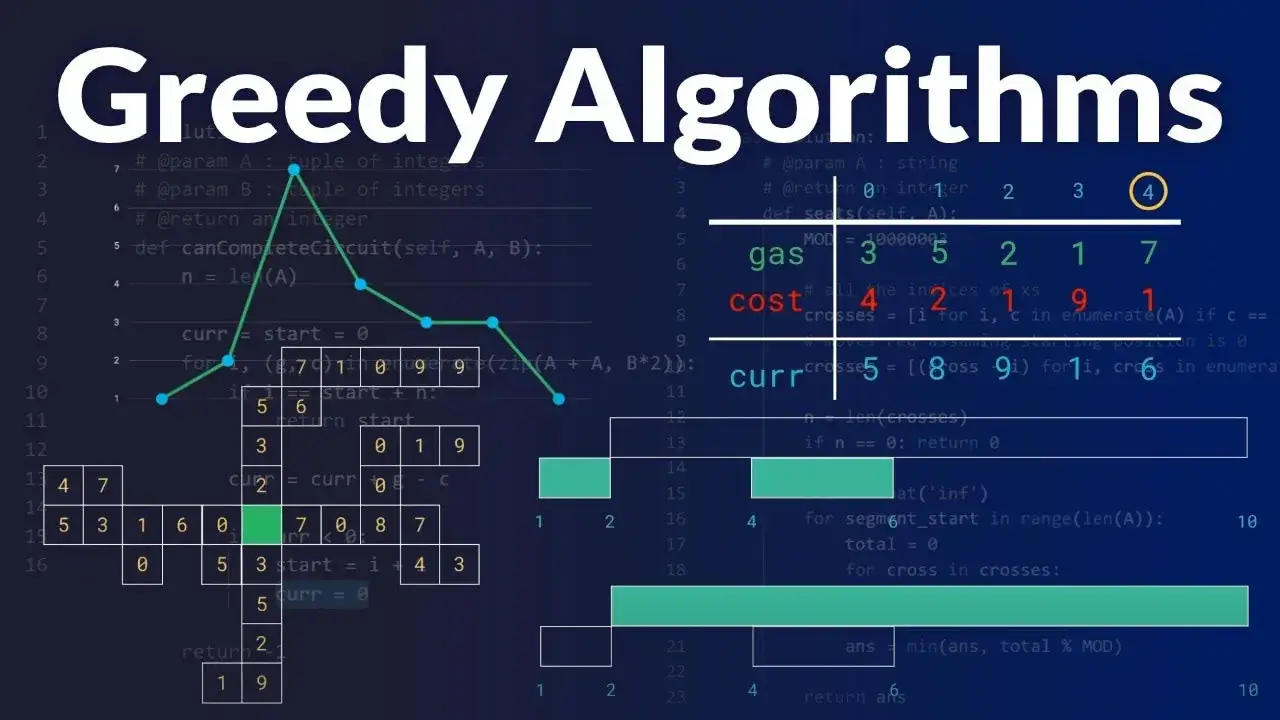
Greedy Algorithm Explained with Examples: A Beginner's Guide
If you're exploring data structures and algorithms, particularly through an Algorithms Course in Noida, one of the most intriguing techniques you'll encounter is the greedy algorithm. Simple to understand but incredibly effective in solving specific types of problems, greedy algorithms play a crucial role in efficient programming.
In this article, we’ll break down what greedy algorithms are, how they work, when to use them, and walk through some common real-world examples to help you understand the logic and application.
Greedy Algorithm Explained with Examples: A Beginner's Guide
Mr. Bambam Yadav / 1 days
0
4 min read
What is a Greedy Algorithm?
A greedy algorithm is a problem-solving approach that makes the best choice at each step with the hope that this will lead to the optimal solution. The decision-making process is based entirely on the current scenario without considering the bigger picture or future consequences.
In simpler terms, a greedy algorithm makes a locally optimal choice at every stage with the expectation that these choices will lead to a globally optimal solution.
Unlike brute-force techniques that explore all possible solutions, or dynamic programming that solves subproblems and stores results, greedy algorithms follow a straightforward and often more efficient route by picking what seems best in the moment.
Characteristics of Greedy Algorithms
Greedy Choice Property: A global optimal solution can be arrived at by choosing the local optimal choice.
Optimal Substructure:The problem can be broken down into smaller sub-problems which can be solved independently.
No Backtracking: Once a decision is made, it is never reconsidered.
Efficiency: Often faster than other algorithms like dynamic programming or brute force.
These characteristics make greedy algorithms highly efficient for a range of problems. Understanding when and why to apply them is a key takeaway from any comprehensive Algorithms Course in Noida.
When to Use Greedy Algorithms
Not all problems can be solved using greedy methods. Greedy algorithms are suitable when:
The problem exhibits greedy-choice property and optimal substructure.
You want a quick and relatively efficient solution.
Approximate solutions are acceptable in some complex problems.
Some problems might appear suitable for greedy techniques at first glance but may require dynamic programming or backtracking to guarantee an optimal solution. That's why it's essential to perform a detailed problem analysis before jumping into a greedy implementation.
How Does a Greedy Algorithm Work?
Greedy algorithms follow a straightforward pattern:
Start from an initial state.
Choose the best option based on the current state.
Update the state accordingly.
Repeat the choice until you reach the goal or all possibilities are exhausted.
This approach doesn't consider the effect of the current choice on future decisions, which is why it works well only when the problem exhibits specific properties.
Real-World Examples of Greedy Algorithms
1. Activity Selection Problem
Problem: Given a set of activities with start and end times, select the maximum number of activities that don't overlap.
Greedy Choice: Always pick the activity that ends the earliest.
                           #include

                            struct Activity {
                                int start, end;
                            };

                            void activitySelection(struct Activity arr[], int n) {
                                printf("Selected activities:\n");
                                int i = 0;
                                printf("(%d, %d)\n", arr[i].start, arr[i].end);

                                for (int j = 1; j < n; j++) {
                                    if (arr[j].start >= arr[i].end) {
                                        printf("(%d, %d)\n", arr[j].start, arr[j].end);
                                        i = j;
                                    }
                                }
                            }
2. Fractional Knapsack Problem
Problem: Given weights and values of items, determine the maximum value in a knapsack of limited capacity. You can take fractions of items.
Greedy Choice: Select items based on value-to-weight ratio.
                           struct Item {
                                int weight, value;
                            };

                            double getMaxValue(struct Item items[], int n, int capacity) {
                                // Sort items by value-to-weight ratio
                                // Pick as much of the highest ratio item as possible
                                // Repeat until capacity is filled
                            }
3. Huffman Coding
Problem: Compress data by assigning shorter codes to frequent characters.
Greedy Choice: Combine the two smallest frequency nodes until one tree remains.
4. Minimum Number of Coins
Problem: Find the minimum number of coins to make a given amount.
Greedy Choice: Always pick the largest denomination less than or equal to the remaining amount.
                           int coins[] = {10, 5, 2, 1};
                            int amount = 27;

                            for (int i = 0; i < 4; i++) {
                                while (amount >= coins[i]) {
                                    amount -= coins[i];
                                    printf("%d ", coins[i]);
                                }
                            }
5. Job Sequencing with Deadlines
Problem: Schedule jobs to maximize profit where each job has a deadline and a profit if completed by that deadline.
Greedy Choice: Prioritize jobs by descending order of profit.
6. Egyptian Fraction
Problem: Represent a fraction as a sum of unique unit fractions (fractions with numerator 1).
Greedy Choice: Always pick the largest unit fraction smaller than the remaining fraction.
Advantages of Greedy Algorithms
Easy to implement and understand
Faster and more efficient than dynamic programming for certain problems
Requires less memory
Often produces good approximations even when not optimal
Useful for real-time systems where quick decisions are necessary
Disadvantages of Greedy Algorithms
May not produce the optimal solution for all problems
Problem must exhibit specific properties (greedy-choice and optimal substructure)
Needs thorough proof or testing to confirm correctness
Lack of backtracking can lead to suboptimal solutions
Greedy Algorithm vs. Dynamic Programming
Feature
Greedy Algorithm
Dynamic Programming
Decision Strategy
Local optimum
Global optimum via subproblem solving
Use of memory
Low
High
Problem Type
Greedy-choice and optimal substructure
Overlapping subproblems
Example
Activity Selection, Fractional Knapsack
0/1 Knapsack, Longest Common Subsequence
Common Greedy Algorithm Problems for Practice
Dijkstra's Algorithm (for shortest path)
Kruskal's Algorithm (for minimum spanning tree)
Prim's Algorithm (also for MST)
Job Sequencing with Deadlines
Egyptian Fraction
Gas Station Refill Problem
Interval Partitioning
Greedy Coloring
Frequently Asked Questions (FAQs)
Q1. What is the main idea behind a greedy algorithm?
Greedy algorithms make the best decision at each step to find an overall optimal solution. They never reconsider choices once made.
Q2. Can greedy algorithms be used for all types of problems?
No, they only work efficiently for problems with greedy-choice property and optimal substructure. Otherwise, they may not yield the correct solution.
Q3. Is greedy algorithm faster than dynamic programming?
Yes, typically it is faster and requires less memory. However, it may not always produce the correct or optimal solution.
Q4. What are some real-life applications of greedy algorithms?
Examples include network routing (Dijkstra’s), file compression (Huffman coding), task scheduling, and financial optimization.
Q5. How can I practice greedy algorithm problems?
You can join an Algorithms Course in Noida or use platforms like LeetCode, GeeksforGeeks, and HackerRank to practice curated greedy problems.
Conclusion
The greedy algorithm is a powerful tool in a programmer's toolkit, especially when dealing with optimization problems. By making the best local decision at each step, greedy methods can lead to efficient and effective solutions.
Whether you are preparing for coding interviews, working on competitive programming problems, or building performance-critical software, mastering greedy algorithms is essential. They offer a balance between simplicity and speed, which is why they are frequently used in both academia and industry.
If you’re diving into problem-solving and want to solidify your understanding, enrolling in anAlgorithms Course in Noida can provide structured learning, expert guidance, and hands-on experience. Greedy algorithms, while simple in concept, require deep understanding to be applied effectively, and a dedicated course is one of the best ways to master them.
Start small, practice often, and keep refining your approach — that’s the real strategy behind becoming a problem-solving expert.