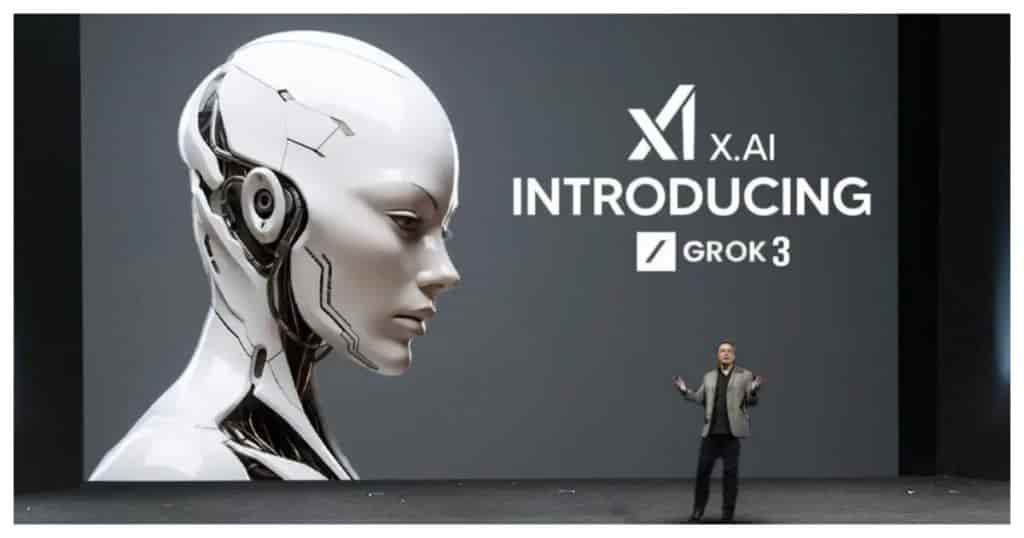
1. Origins and Philosophy Behind Grok 3
Grok 3 is not just another large language model–it’s part of Musk’s broader xAI mission, which emphasizes AI that benefits humanity while maintaining transparency and safety. Unlike some proprietary models that prioritize performance over interpretability, Grok 3 is designed with alignment and ethical use in mind. Musk’s involvement ensures that the model is backed by a vision where AI can complement human intelligence without replacing it, addressing concerns over uncontrolled AI deployment.
The philosophy here is clear: AI should empower users, developers, and businesses, rather than operate as a black-box system controlled by a few large tech companies. Grok 3, therefore, is as much about ethics and accessibility as it is about performance.
2. Core Capabilities
Grok 3 offers the full suite of capabilities expected from a modern conversational AI: natural language understanding, content generation, summarization, reasoning, coding assistance, and more. But it stands out for a few reasons:
Context Retention: Grok 3 is designed to maintain longer conversation contexts, making it ideal for use cases like virtual assistants, tutoring platforms, and customer support bots where the dialogue spans multiple turns.
Multimodal Potential: While primarily text-based, early indications suggest that Grok 3 is being developed with multimodal integration in mind, meaning it could process not just text but images and other forms of input.
Customizability: xAI promotes flexibility, allowing businesses and developers to fine-tune Grok 3 to their specific domain. This makes it practical for niche industries, such as healthcare, finance, or legal applications, where domain-specific language and knowledge are crucial.
3. Comparison With ChatGPT and Other Models
When comparing Grok 3 with established models like ChatGPT, there are a few notable points:
Speed and Efficiency: Grok 3 has been optimized for efficient inference, meaning it can handle complex tasks faster without compromising output quality. This is especially beneficial for real-time applications.
Openness vs. Control: ChatGPT and similar models are typically accessed via APIs controlled by the company, whereas Grok 3 emphasizes more flexible deployment options. This can include on-premise hosting, private cloud deployment, and controlled customization.
Ethical Safeguards: xAI prioritizes alignment and responsible AI, integrating more built-in safeguards against harmful outputs. While OpenAI also focuses on safety, Musk’s model positions itself as more transparent and adjustable in its safety measures.
4. Real-World Applications
The real strength of Grok 3 lies in its practical applications across industries:
1. Customer Support: Businesses can deploy Grok 3 as a virtual agent that handles queries efficiently while keeping context over extended interactions.
2. Education and Tutoring: Its ability to retain context makes it a strong candidate for educational platforms, offering personalized explanations and guidance to students.
3. Content Creation: From writing blogs to summarizing reports, Grok 3 can assist content teams with fast, coherent outputs.
4. Specialized Knowledge Domains: With fine-tuning, Grok 3 can adapt to domains like law, medicine, or finance, providing reliable domain-specific responses.
5. Integration With Social Media Platforms: Musk’s involvement with X (formerly Twitter) hints at potential integrations where Grok 3 could enhance social interactions, automate moderation, or assist in content generation for users.
5. Strengths and Unique Features
Several features make Grok 3 stand out from its competitors:
User-Focused Alignment: The model is designed to prioritize user intentions and provide clear, actionable responses.
Transparent Operation: Unlike some black-box systems, xAI emphasizes explainability, so developers can understand why the model produces certain outputs.
Adaptable Architecture: Grok 3 can be integrated into various environments, whether web apps, mobile apps, enterprise software, or research tools.
Scalable Performance: Its architecture supports scaling from small startups to large enterprises without significant performance loss.
6. Challenges and Considerations
Despite its promise, Grok 3 faces challenges like any AI model:
Data Limitations: Open-source datasets or proprietary datasets may impact its performance in niche areas, so careful fine-tuning is essential.
Computational Requirements: Running a model like Grok 3 at scale may require substantial hardware resources, which could be a barrier for smaller organizations.
Competition: Established models like ChatGPT, Claude, and Gemini have significant user bases, polished interfaces, and extensive documentation, which means Grok 3 must work hard to capture market attention.
7. The Future Outlook
Grok 3 reflects Elon Musk’s vision of AI that is powerful, adaptable, and ethical. Its emphasis on flexibility, transparency, and alignment positions it as a viable alternative to mainstream AI chatbots. As xAI continues to refine the model, add multimodal capabilities, and expand its real-world integrations, Grok 3 has the potential to become a go-to AI assistant for developers, businesses, and global users alike.
Expanding Grok 3’s Role in Everyday Applications
While the core features of Grok 3–like natural language understanding, context retention, and potential multimodal support–are impressive on their own, its practical adoption is where the model truly shines. Businesses are increasingly exploring AI not just as a novelty but as a productivity multiplier, and Grok 3 fits seamlessly into this vision. For instance, customer service platforms can leverage its ability to maintain long conversation threads, providing users with consistent and coherent support, reducing frustration that often arises with chatbots that “forget” context after a few exchanges.
In the education sector, Grok 3’s contextual awareness allows it to tailor explanations for individual learners, offering personalized tutoring experiences. This can be especially impactful in multilingual classrooms or regions where access to expert teachers is limited. By integrating Grok 3 into virtual learning platforms, institutions can bridge knowledge gaps efficiently while keeping students engaged.
Content creation is another domain where Grok 3 demonstrates real-world utility. From drafting blog posts to summarizing technical reports, the model can significantly reduce the time professionals spend on repetitive writing tasks. Its adaptability also allows for fine-tuning in specialized fields like legal research or medical documentation, making it a versatile assistant for niche industries.
Moreover, Grok 3’s design encourages developer experimentation. With the ability to fine-tune and deploy the model in controlled environments, startups and independent developers can create bespoke AI solutions that cater to their target audience, all while maintaining data privacy. As AI becomes more embedded in daily workflows, models like Grok 3 highlight the importance of balancing accessibility, reliability, and ethical design, showing that next-generation AI can be both powerful and responsible.
Final Thoughts
Grok 3 by xAI represents a significant step forward in the rapidly evolving AI landscape. Unlike models that focus solely on raw performance or flashy demonstrations, Grok 3 emphasizes a balance between power, usability, and ethical responsibility. Elon Musk’s vision for xAI seems clear: AI should be accessible, adaptable, and aligned with human values. This model is not just about creating another chatbot–it’s about offering a versatile platform that developers, businesses, and educators can truly rely on.
One of the standout qualities of Grok 3 is its contextual intelligence. The ability to maintain conversations over multiple exchanges and remember past interactions provides a more human-like experience, making it suitable for applications like customer support, virtual tutoring, and personalized content generation. This capability allows organizations to build AI-driven systems that feel responsive, consistent, and intelligent, which is often what users expect but rarely get from standard models.
The flexibility and customization offered by Grok 3 are key topics covered in this Artificial Intelligence course. Learners explore how developers can fine-tune the model for specialized domains, deploy it in private or cloud environments, and seamlessly integrate it with existing tools. This AI course highlights why such control is especially valuable for industries like finance, healthcare, and legal services, where accuracy and data privacy are critical. By examining these capabilities, the Artificial Intelligence course demonstrates how xAI positions Grok 3 not as a one-size-fits-all model, but as a solution designed to adapt to specific organizational needs.
At the same time, it’s important to acknowledge that Grok 3 is still emerging in a field crowded with strong competitors like ChatGPT, Claude, and Gemini. While it excels in transparency, alignment, and customizability, there is still work to be done in scaling its multimodal capabilities and ensuring global adoption. However, the foundation is solid, and with continuous updates, Grok 3 could become a trusted AI partner across multiple sectors.
For learners and aspiring AI developers, platforms like Uncodemy play a crucial role in understanding and leveraging models like Grok 3. By providing structured courses, tutorials, and practical guidance, Uncodemy helps individuals explore the capabilities of cutting-edge AI while also understanding the ethical and technical considerations that come with it. For anyone looking to experiment with AI, create applications, or stay ahead in the AI-driven job market, combining Grok 3’s potential with Uncodemy’s learning resources can be a game-changer.
In conclusion, Grok 3 exemplifies how AI can be powerful, responsible, and versatile at the same time. It offers exciting possibilities for both professionals and developers, providing tools to innovate, automate, and enhance real-world applications. As AI adoption grows, Grok 3 and platforms like Uncodemy will likely play a pivotal role in shaping the next wave of intelligent solutions, empowering users to harness AI in ways that are safe, ethical, and impactful.